























French Defenseman Suspended for Remainder of Olympic Hockey Tournament After Fight with Tom Wilson

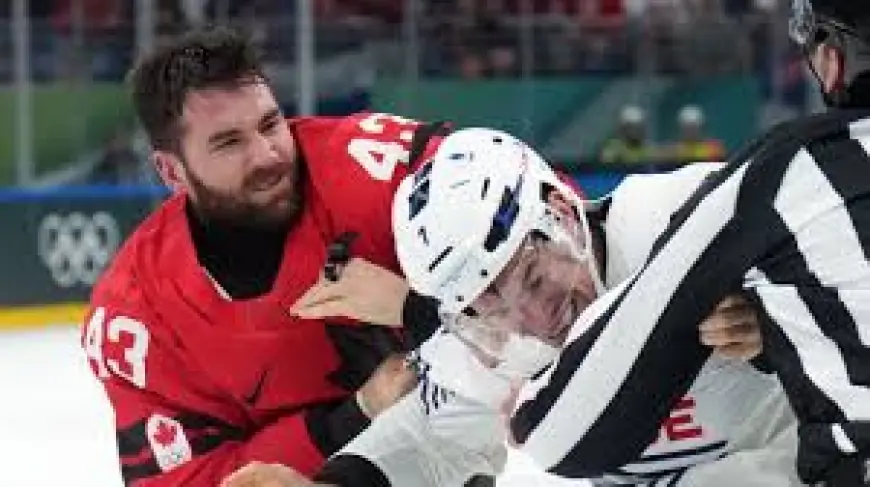
France has removed defenseman Pierre Crinon from the roster for the remainder of the Olympic hockey tournament following a confrontation with Canada’s Tom Wilson late in a lopsided preliminary-round game. The federation said the player's conduct violated the Olympic spirit and the values expected of France’s national team.
Federation cites violation of Olympic values
The French Ice Hockey Federation announced that Crinon will not be allowed to play in Tuesday’s qualification-round game against Germany and will be barred from any further participation should France advance. The federation said Crinon’s behavior when leaving the ice after his ejection “constitutes a clear violation of the Olympic spirit and also undermines the values of our sport. ” The decision was made in alignment with the French National Olympic and Sports Committee.
Sequence on the ice and tournament context
The incident occurred with about 6: 59 remaining in a match Canada led 10-2. Crinon delivered a high hit that left a Canadian star shaken, prompting Wilson to engage. The two players tangled near the French net and ultimately were assessed fighting penalties and game misconducts, resulting in ejections. Under the tournament’s disciplinary framework, fighting penalties do not automatically carry tournament suspensions, but the national federation exercised its authority to impose an internal sanction.
France enters the next phase of the tournament 0-3 in group play and faces a must-win scenario against Germany. A victory would move France into the qualification round, although Crinon will not be available if France advances. Canada, unbeaten in group play, is set to play Wednesday at 10: 40 a. m. ET in the quarterfinals against either Czechia or Denmark.
Ramifications for teams and tournament tone
The suspension removes a veteran defenseman from France’s depth chart at a pivotal moment, further complicating an already difficult path in the tournament. Beyond roster implications, the move signals the federation’s intent to prioritize sportsmanship and image at the Games. Tournament organizers and national bodies often balance competitive instincts with broader expectations that players represent their countries in a manner consistent with Olympic ideals.
For Canada, the altercation will be treated as a closed matter on the ice; the team advances and now shifts focus to the knockout stage. For France, the federation’s action puts a spotlight on discipline and leadership within the program as it seeks a result in its next match and contemplates life beyond these Games.
The episode underscores how quickly a single sequence can reshape narratives at the Olympics, where national pride and high stakes magnify every confrontation. With both teams moving into the tournament’s next rounds, officials and delegations will be watching how conduct and consequence play out on and off the ice in the days ahead.