














Small Prophets review: Mackenzie Crook’s magical social-realist comedy is pure pleasure

Small Prophets arrives as a quietly beguiling follow-up to Mackenzie Crook’s earlier work, trading rural treasure hunts for a suburban mystery infused with folk magic. It’s a show that mines the ordinary for wonder, balancing melancholy and mirth with a delicate touch and performances that make its small miracles feel large.
A gentle, uncanny premise
At the centre is Michael Sleep (Pearce Quigley), a shaggy, soft-spoken man whose life has stalled since his partner, Clea, vanished seven years earlier. Michael’s existence—shift work on a DIY shop floor, ritual visits to his father in care, and evenings alone in an overgrown semi—could easily have become a dour exercise in grief. Instead, Crook flips the tone: grief and longing remain central, but they’re threaded through with oddball humour and an escalating strand of the supernatural.
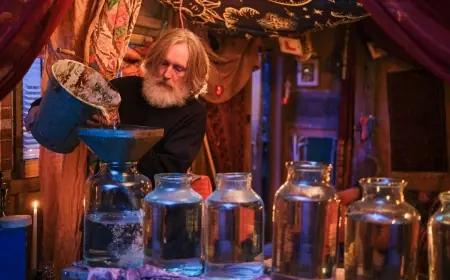
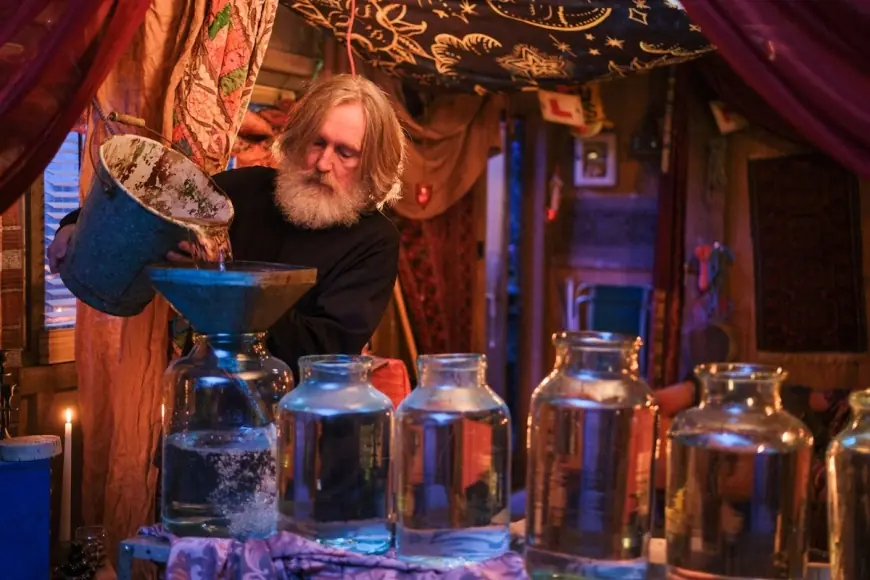
The conceit is simple and wondrous. Prompted by his father Brian’s ramblings, Michael attempts an ancient alchemical recipe and conjures tiny jar-bound creatures—homunculi—that can answer questions and predict future scraps. What might read as whimsical fantasy in lesser hands is handled with restraint here. The magic never obliterates the everyday; it amplifies it, creating a new, humane logic that allows intimate truths to surface. The series prefers small revelations to spectacle, and the result is a show that feels both uncanny and deeply lived-in.
Standout performances and Crook’s comic architecture
Casting is a decisive strength. Quigley, elevated from a notable supporting turn in Crook’s earlier work, carries the series with a quietly powerful mix of melancholia and mischief. He’s abetted by Lauren Patel, who plays Kacey, a younger colleague whose friendship with Michael becomes one of the series’ emotional anchors—part platonic confidante, part conspirator. Their scenes have a rare tenderness, threaded with gently subversive humour.
Playing Brian, an engagingly eccentric elder whose memory frays at the edges, is a performer whose presence lends the series gravitas and warmth. The scenes between father and son are simultaneously poignant and comic, a testament to the careful hand of both actor and writer. Supporting turns add colour—an officious manager, a prickly neighbour worried about hedges, shop-floor customers who fall prey to Michael’s dry wind-ups—each character given precise, thoughtful beats.
Crook’s writing and direction deserve note. He resists easy sentimentality, letting jokes bloom out of character detail rather than broad set pieces. The show’s rhythm is patient; moments of quiet observation sit beside slyly surreal sequences, producing an effect that feels like magical realism rendered for suburban landscapes and retail parks. Music and production design further the mood: small, eerie cues and cluttered domestic spaces that feel honest rather than stylised.
Why Small Prophets matters
What distinguishes Small Prophets is its refusal to choose between heart and oddness. It honours everyday grief while granting the possibility of repair—sometimes literalised through jars of little creatures—without ever promising tidy closure. The series also deepens a thematic through-line from Crook’s earlier work: the idea that the world’s small rituals and eccentricities are repositories of meaning.
For viewers weary of broad comedy or high-concept fantasy, this show is a welcome hybrid: modest in scale but ambitious in emotional reach. It rewards close watching and a willingness to accept small wonders. In a television landscape dominated by noise, Small Prophets is a gentle, strange, and thoroughly pleasurable reminder that the most extraordinary stories can begin in the most ordinary places.