
















USA vs Denmark Olympic hockey turns into a 6–3 Team USA rally after Jeremy Swayman’s long-range mistake, with Brady Tkachuk and Jack Eichel driving the response

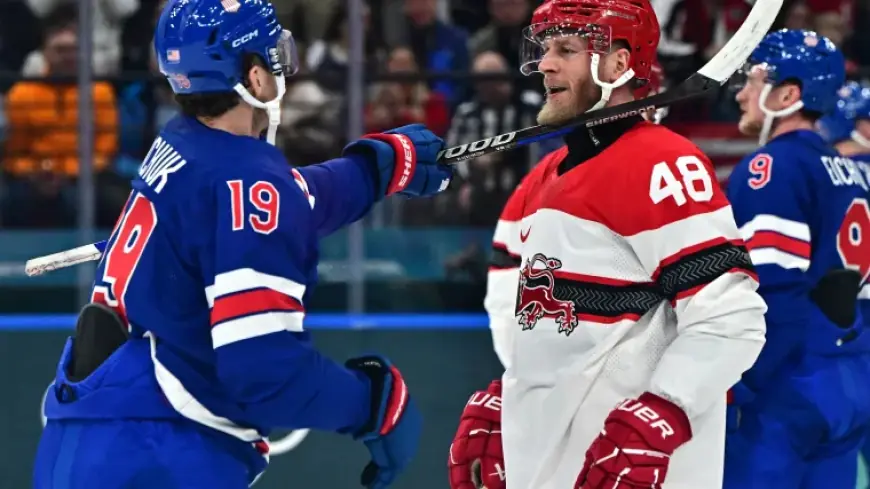
Team USA men’s hockey survived an early scare against Denmark on Saturday, February 14, 2026 ET, rallying for a 6–3 win that moved the Americans to 2–0 in group play at the 2026 Winter Olympics. The game was messy at the start, sharp in the middle, and ultimately revealing: the United States has the skill to bury teams when it finds rhythm, but it can still hand an underdog momentum with a single lapse.
The flashpoint came in the first period when U.S. goaltender Jeremy Swayman allowed a goal from near center ice, the kind of soft concession that instantly changes a tournament game’s temperature. Denmark, already playing with nothing to lose, used the moment to push the pace and briefly look like it could turn the night into a true upset bid.
It didn’t last. The Americans answered with a surge that looked a lot more like a medal contender: heavy shot volume, cleaner breakouts, and a faceoff-and-forecheck game that repeatedly reset possession in Denmark’s end.
What happened in USA vs Denmark: from 2–1 down to a five-goal swing
The United States trailed 2–1 after the first period, then flipped the game in the second by scoring three times. The turning point was not one highlight play, but a sequence of repeatable advantages: winning draws, arriving first on loose pucks, and shooting quickly before Denmark could get set.
Jack Eichel’s goal that put the U.S. in front captured the theme: quick execution immediately after gaining possession. Brady Tkachuk’s strike kept the pressure on and reflected what he brings to a short event like the Olympics: straight-line force, net-front chaos, and emotional volume that lifts a bench.
By the end, the United States had put up 47 shots and scored six times. Denmark started with Mads Sogaard in goal and went to Frederik Dichow later as the game slipped away.
The Swayman storyline: one mistake, then the response that matters more
Swayman’s early miscue will live in highlight loops because it was so unexpected. But the more important takeaway for Team USA is what happened afterward. The team didn’t unravel. It didn’t start trading chances recklessly. Instead, it tightened its structure, controlled the puck, and turned the game into a volume contest that favored the deeper roster.
That matters in tournament hockey. Goalies can have a bad moment. The teams that medal are the ones that can absorb it without letting a five-minute wobble become a 60-minute spiral.
The next question is how the coaching staff manages the crease going forward. Team USA has multiple high-end options, and one shaky goal can accelerate a rotation decision in a hurry, especially with the knockout round looming.
Denmark’s Olympic hockey roster: why the underdogs looked dangerous early
Denmark is not short on real talent, and the roster has NHL experience and legitimate top-end skill. Lars Eller provides veteran stability down the middle. Nikolaj Ehlers and Oliver Bjorkstrand bring speed and finishing that can punish any defensive misread. Frederik Andersen is the marquee name in goal, even if he didn’t start this one.
Denmark’s path to a shock result was clear: keep the game tight, let the goaltending hold, and capitalize on any U.S. mistakes with quick strikes. For one period, it worked. Once the U.S. started owning the puck, Denmark’s margin for error collapsed.
Behind the headline: why this game was really about maturity, not just the score
The United States is built to win on talent, but Olympic hockey punishes arrogance. The incentive for Team USA in group play is to bank points without revealing panic when something goes wrong. A center-ice goal against is the perfect test of temperament. The Americans passed it by turning the rest of the night into disciplined pressure rather than frustrated offense.
For Denmark, the incentive is proof. Even if the underdog doesn’t win, forcing a heavyweight to sweat builds belief for the next game and sends a message to the group: Denmark can bite if you get casual.
Stakeholders extend beyond the standings. Players like Brady Tkachuk and Jack Eichel are fighting for identity inside a star-stacked lineup, not just ice time. Coaches are managing reputations as much as tactics, because every decision becomes part of the medal narrative.
What we still don’t know
A few key pieces remain unresolved after two U.S. wins:
-
Can Team USA stay clean defensively against opponents that can match its speed for full shifts, not just spurts?
-
Will special teams remain a weapon once rivals stop taking avoidable penalties?
-
How will the U.S. handle back-to-back style scheduling stress and travel routines as the stakes rise?
-
For Denmark, can the scoring show up consistently enough to turn strong periods into complete games?
What happens next: realistic scenarios and triggers
-
Team USA locks up the best path to the quarterfinals with one more composed win. Trigger: the Americans control starts and avoid chasing games early.
-
The U.S. goalie plan changes quickly if another soft goal appears. Trigger: a second high-visibility mistake that forces a confidence decision.
-
Denmark stays in the mix by turning its next game into a one-goal grind. Trigger: disciplined defensive layers and a goaltending performance that steals a period.
-
The U.S. becomes a true gold favorite if it wins a tight, low-scoring matchup. Trigger: a 2–1 type win that shows patience and late-game execution.
Saturday’s result counts as a win in the standings, but it also served as a warning label: in Olympic hockey, even the most talented team has to earn stability shift by shift. Team USA did that after the wobble, and the 6–3 final is what it looks like when a favorite stops flirting with danger and starts playing like it knows what it is.