

























Astronomers Stunned by Unconventional ‘Inside-Out’ Planetary System

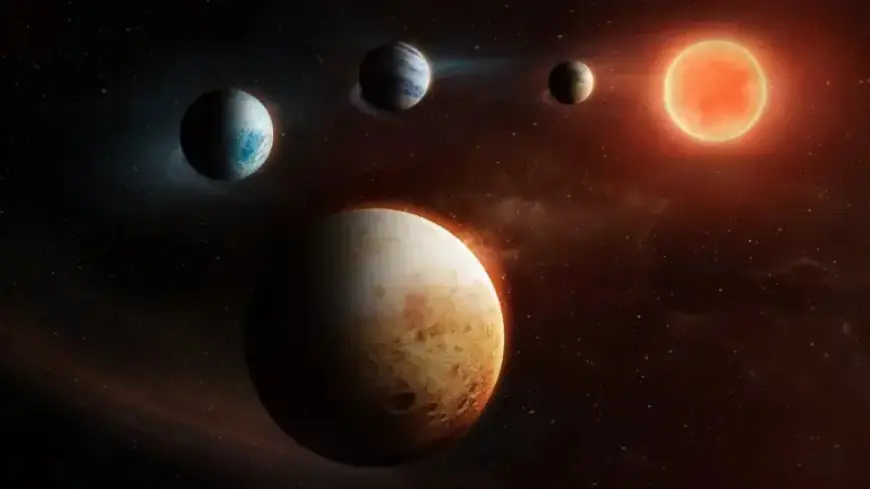
Recent discoveries in astrophysics have revealed an unusual planetary system that challenges traditional models of planet formation. This system, located around the dim star LHS 1903, is noteworthy for its ‘inside-out’ arrangement of planets.
Unconventional Planetary Configuration
Researchers led by astrophysicist Thomas Wilson from the University of Warwick have found that LHS 1903 hosts four planets with a counterintuitive arrangement. This star is around seven billion years old and has approximately half the mass of the Sun.
- Star Name: LHS 1903
- Number of Planets: Four
- Age of Star: 7 billion years
- Mass of Star: 0.5 times the Sun’s mass
Characteristics of the Planets
The planetary system consists of three main planets — LHS 1903 b, c, and d — along with a recently identified fourth planet, LHS 1903 e. Here’s a brief overview of these planets:
- LHS 1903 b: A dense, rocky super-Earth.
- LHS 1903 c and d: Both classified as sub-Neptunes, these planets feature substantial gaseous atmospheres.
- LHS 1903 e: A rocky world, considerably smaller and located at the system’s outer edge, which lacks a gaseous atmosphere.
Implications for Planet Formation Theories
Conventional wisdom suggests larger gas giants typically form in the cooler, outer regions of a star’s protoplanetary disk. However, findings from LHS 1903 indicate a different scenario. The researchers propose a ‘gas-depleted formation’ hypothesis, suggesting that the planets formed sequentially, with the innermost worlds appearing first.
According to Wilson, this means that the inner planets experienced formation in a resource-rich environment, while LHS 1903 e formed later in a region that lacked sufficient gas.
Future Research Directions
This discovery adds an important piece to the puzzle concerning the ‘radius valley,’ a gap in the distribution of exoplanet sizes. The existence of both small and gaseous planets in the same system allows scientists to study planetary formation under controlled conditions.
Experts believe further observations using the James Webb Space Telescope will enhance understanding of how planetary atmospheres develop. Wilson emphasizes that investigating LHS 1903 could yield significant insights into the formation and evolution of planetary systems orbiting M-dwarf stars.
Conclusion
The findings surrounding LHS 1903 mark a substantial advancement in astrophysics and planetary science. As astronomers continue to explore these unusual systems, they may refine existing models of planet formation and gain a deeper understanding of planetary evolution across the universe.