

























Astronomers Stunned by Discovery of ‘Inside Out’ Solar System

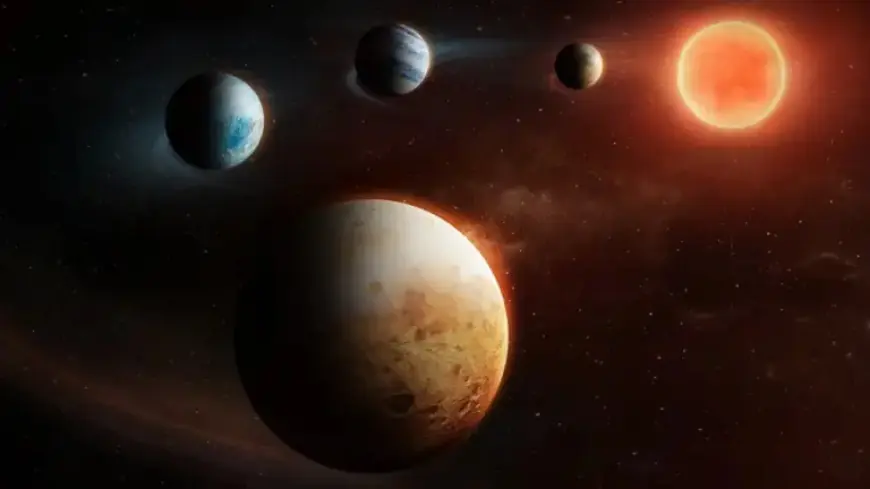
A striking discovery in astronomy has emerged, as scientists unveil a peculiar solar system with a planet configuration unlike anything previously observed. This revelation challenges long-held beliefs about planetary formation. Specifically, it pertains to a star designated LHS 1903, located within the Milky Way’s dense disc.
Unconventional Planetary Arrangement
The LHS 1903 system consists of four planets. The first is rocky, followed by two gas giants, and intriguingly, another rocky planet orbits in the outer region. This arrangement directly contrasts with our Solar System, where rocky planets are closer to the Sun and gas giants are positioned farther out.
Details of the Discovery
- Star Type: LHS 1903 is a red dwarf star, characterized by lower brightness and cooler temperatures than our Sun.
- Planet Composition: The inner planet is rocky, flanked by two gas giants, and followed by another rocky planet.
- Research Team: An international group of astronomers conducted this research, led by Thomas Wilson from the University of Warwick.
- Publication: Findings were published in the journal Science.
Implications of the Findings
The discovery of this ‘inside-out’ solar system raises important questions about how planets form. Traditionally, it was believed that planets develop concurrently within a gas and dust-filled protoplanetary disc. Wilson and his team propose a new scenario: planets might form sequentially in a gas-depleted environment.
As Wilson explained, “Rocky planets typically do not emerge far from their star due to intense radiation that strips gas away.” The formation of the fourth planet in a gas-poor region challenges conventional wisdom.
Broader Context in Exoplanet Research
This discovery adds to a growing catalog of over 6,000 identified exoplanets since the 1990s. These planets are often detected through the observation of brightness variations as they transit their respective stars.
As astronomers learn about diverse exoplanet systems, established theories of planet formation are coming under scrutiny. Isabel Rebollido from the European Space Agency notes, “We are beginning to reassess our planet formation theories in light of new exoplanet discoveries.”
The LHS 1903 solar system serves as a compelling case study for rethinking our understanding of planetary formation and the dynamic complexities of the universe.