























Macklin Celebrini Sparks Team Canada Hockey Buzz as the 2026 Roster Hits the Ice

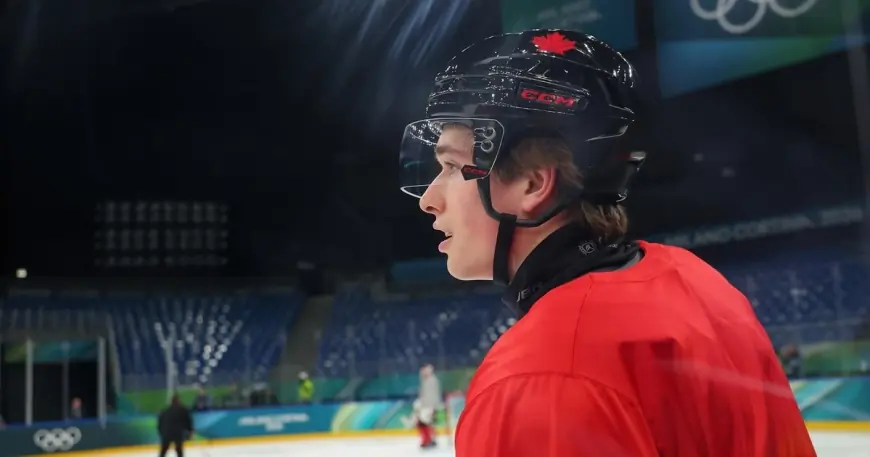
Macklin Celebrini has become one of the defining storylines of Team Canada men’s hockey at the 2026 Winter Games, not just because he made the roster, but because of what he represents: a generational handoff happening in real time. On Thursday, February 12, 2026 ET, Canada opened group play against Czechia with a 25-man roster built entirely from NHL players, blending household-name veterans with a younger core that includes the 19-year-old Celebrini.
The roster, originally unveiled on December 31, 2025, reflects a clear strategic choice: lean into elite speed and puck skill across all four lines, then rely on battle-tested leadership in the room to keep the tournament tight when games inevitably turn into single-bounce outcomes.
Team Canada hockey roster: the headline names and the roster’s basic shape
Canada’s men’s roster is constructed as a pure best-on-best group, with NHL talent at every position. The build is straightforward and deliberate:
-
Veteran anchors up front and on the blue line, including Sidney Crosby, Connor McDavid, and Nathan MacKinnon
-
A wave of prime-age scoring and two-way forwards to keep shifts fast and matchup-proof
-
Mobile defensemen who can exit cleanly, support the rush, and sustain offensive-zone pressure
-
Goaltending designed to hold the floor in one-goal games, where tournaments are often decided
On paper, it is the kind of roster that can win in multiple styles: track meet hockey when needed, or slower, heavy playoff-style hockey when the bracket tightens.
Macklin Celebrini: why his role matters more than his age
Celebrini’s inclusion is not ceremonial. He is being treated as a legitimate piece of the forward mix, with early deployment suggesting Canada wants his pace, confidence, and puck touch in meaningful minutes. The reason he is drawing so much attention is simple: international tournaments rarely hand big responsibilities to teenagers unless the upside is obvious.
Behind the headline, Celebrini’s presence signals two things at once:
-
Canada believes its next wave can contribute immediately alongside established stars
-
The coaching staff is comfortable pushing tempo and creativity, even with the risk that comes with youth
That is the quiet bet underneath the roster construction. A team loaded with elite veterans can win safely, but it can also become predictable. A player like Celebrini injects unpredictability in the best way: quick reads, fast hands, and the willingness to attack seams.
Celebrini plus: what the chemistry question is really about
Searches for Celebrini plus are essentially asking one thing: who is he playing with, and what does it tell us about Canada’s plan?
In tournaments like this, line combinations are less about labels and more about problem-solving. Coaches are trying to build trios that can:
-
Enter the zone with control rather than dumping pucks
-
Recover pucks quickly after shots
-
Defend the middle so that offensive risk does not turn into odd-man rushes against
If Celebrini is used with high-velocity linemates, it is a signal that Canada wants him attacking off the rush. If he is paired with heavier forecheckers, it suggests a plan to let him create after retrievals. Either way, the subtext is the same: Canada is not hiding him.
Team Canada hockey: what’s developing today and what to watch next
Canada’s opener against Czechia is more than a first test; it is the first data point for how the roster actually works under Olympic pressure. Early in the game day cycle, one notable development emerged: defenseman Josh Morrissey left the opener and was reported not to return, with the cause not immediately clear. If that absence lingers, it could force Canada to reshuffle pairings and adjust special teams.
This is where tournament margins appear. One injury can change:
-
Power-play quarterbacking and zone-entry structures
-
Defensive matchups against top opposing lines
-
Minutes distribution that can compound fatigue later in the bracket
Canada has depth, but the margin shrinks when the opposition is also stacked with NHL talent.
Behind the headline: incentives, stakeholders, and why this roster was built this way
The incentive structure is different at the Olympics than in an 82-game season. Coaches and management care less about long-term development and more about winning seven games with as little volatility as possible.
Stakeholders and pressure points are obvious:
-
Veterans are chasing legacy, and leadership expectations are heavy
-
Younger stars like Celebrini are chasing credibility on the biggest stage
-
Management is chasing a gold-medal result that validates roster philosophy and selection choices
What’s missing publicly, and will only become clear through games, is the internal pecking order: who gets the late defensive-zone draws, who runs the top power play, and who sits when a matchup demands a different tool set.
What happens next: realistic scenarios with clear triggers
-
Celebrini earns a larger role if his line drives possession and creates high-danger looks
Trigger: consistent zone entries and noticeable puck recoveries -
Canada leans more conservative if early games get sloppy
Trigger: turnovers leading directly to goals against -
Blue-line roles change if the Morrissey situation persists
Trigger: any confirmation of a multi-game absence -
Special teams becomes the tournament swing factor
Trigger: one game decided by power-play execution or penalty-kill structure
For now, the clearest takeaway is that Celebrini is not merely along for the experience. Team Canada built this roster to win immediately, and it is treating its youngest forward as part of that plan, not a footnote to it.