






















Trump shares racist Obama “monkey” video, then deletes it after rare GOP backlash

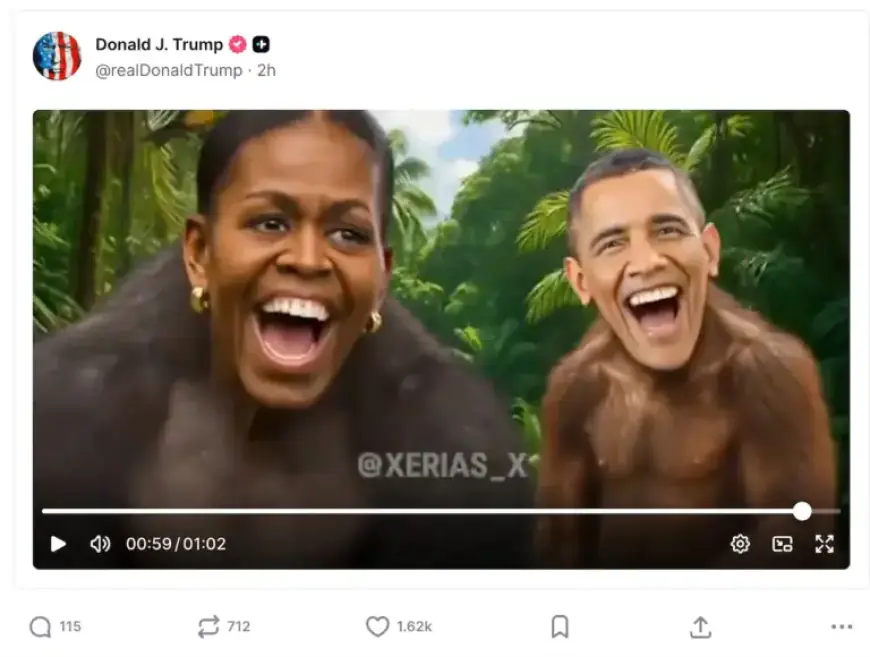
President Donald Trump ignited a political firestorm after sharing an AI-styled animated clip that depicted former President Barack Obama and former first lady Michelle Obama as primates, a racist trope that drew condemnation across party lines. The post appeared late Thursday night, Feb. 5, and was removed Friday, Feb. 6, after roughly 12 hours of growing blowback and demands that the White House take it down.
The episode set off a rare public split inside the Republican Party in Trump’s second term, with several GOP lawmakers urging deletion and an apology, while close allies defended the post and attacked critics.
What the video showed and why it mattered
The clip used a cartoon “jungle” theme and included a segment portraying the Obamas as primates. It also included content echoing long-debunked claims about the 2020 election. The combination — racial insult wrapped inside a political conspiracy montage — amplified outrage beyond the usual partisan lines, particularly because the imagery targeted a former president and first lady.
The Obamas have not issued a public statement on the incident as of Sunday, Feb. 8. Democrats and civil-rights advocates framed the imagery as part of a long history of racist depictions aimed at Black public figures, while some conservative voices argued it was a broader parody that caricatured multiple politicians.
How Trump and the White House explained it
Trump declined to apologize, saying he did not see the offensive portion before it was shared and that he only watched the beginning of the clip. He also said he condemns the racist imagery, while maintaining that sharing the post itself was not a “mistake.”
The White House offered shifting explanations over the first day of backlash. Early on, officials described it as an “internet meme” with an animated theme, then later said a staff member posted it in error. The changes in messaging became a second storyline, raising questions about internal review of presidential social media and how quickly the West Wing reacts when a post becomes politically toxic.
Republicans respond — and Tim Scott becomes a focal point
The pushback was notable because it came from within Trump’s own party, where public criticism has been uncommon. Several Republican senators described the imagery as unacceptable and urged removal and an apology. Sen. Tim Scott of South Carolina, the Senate GOP campaign chair and the only Black Republican senator, called the imagery the most overtly racist content he had seen associated with the White House and urged immediate deletion.
Other Republicans echoed that even if the video was intended as parody, the racist context was obvious and the post should have been taken down faster. A handful of House Republicans also urged deletion and an apology, while some defended Trump personally even as they condemned the content itself.
Democrats, Jeffries, and the broader political fallout
Democrats seized on the incident as evidence that Trump continues to use racially inflammatory material as a political weapon — intentionally or through recklessness — and they pressed GOP leaders to break more clearly with him. House Democratic leader Hakeem Jeffries demanded an apology and praised the small number of Republicans who spoke out publicly, arguing that silence would normalize racist attacks.
Outside elected office, the controversy spread quickly into the entertainment and commentary world, with public figures weighing in and late-night political talk framing the episode as a test of whether Republicans will draw lines when the conduct is plainly offensive.
What to watch next: posts, process, and political risk
The near-term question is procedural: whether the White House tightens how presidential posts are reviewed and who has publishing access, especially after an explanation that pointed to staff error. The political question is bigger. Republicans heading into the 2026 midterm cycle now face a familiar dilemma — defend Trump at all costs, or risk his retaliation by criticizing conduct that turns off persuadable voters.
Key moments so far:
-
Late Thu., Feb. 5: The animated clip is shared on Trump’s social media account.
-
Fri., Feb. 6: Republican and Democratic criticism builds; the post is removed after roughly 12 hours.
-
Fri., Feb. 6–Sat., Feb. 7: Trump says he won’t apologize and claims he did not view the offensive segment before sharing.
-
Sun., Feb. 8: Democrats renew calls for an apology; GOP divisions remain visible as allies and critics trade attacks.
How long the controversy lasts may depend on whether Trump keeps revisiting it — or whether new posts quickly replace it in the news cycle. Either way, the episode has already sharpened a central theme of this term: the president’s online behavior can force even reluctant allies to choose between loyalty and condemnation, sometimes in public.
Sources consulted: Associated Press; ABC News; PBS NewsHour; Al Jazeera