

























NASA’s SPHEREx Mission Monitors Interstellar Comet’s Increasing Brightness

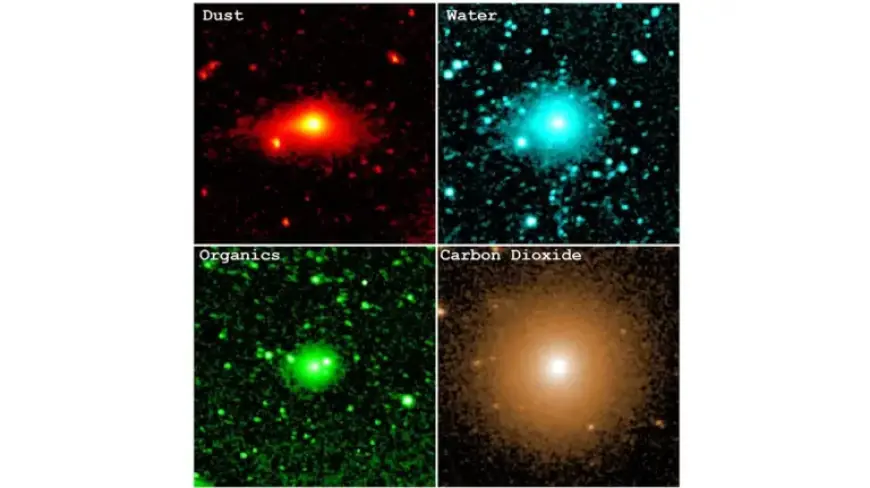
The NASA SPHEREx mission has provided crucial insights into interstellar comet 3I/ATLAS. This comet passed through our solar system and garnered attention due to its increasing brightness and unique composition. Observations conducted in December 2025 revealed significant findings about this celestial object.
Key Discoveries from SPHEREx Observations
The SPHEREx mission, which stands for Spectro-Photometer for the History of the Universe, Epoch of Reionization and Ices Explorer, monitored comet 3I/ATLAS after its close approach to the Sun. Scientists detected various organic molecules, including:
- Methanol
- Cyanide
- Methane
These compounds, significant for biological and geological processes, indicate a complex history for the comet.
Increase in Brightness
Two months following its closest approach to the Sun, 3I/ATLAS displayed a dramatic increase in brightness. This phenomenon is typical for comets as they release gases, such as water vapor, carbon dioxide, and carbon monoxide. This activity occurs when the Sun’s heat causes ice on the comet’s surface to sublimate.
Sublimation and Comet Composition
Carey Lisse of the Johns Hopkins Applied Physics Laboratory noted that comet 3I/ATLAS was “full-on erupting into space” in December 2025. This eruption released an array of materials that had been locked in ice for billions of years. Observations also indicated that the comet’s nucleus produced a coma, an atmosphere surrounding it formed from sublimated gases.
Delayed Activity
Interestingly, peak sublimation does not coincide with the time the comet is nearest to the Sun. The Sun’s heat gradually penetrates the outer layers, causing deeper ice to start sublimating later. This delayed venting, observed with 3I/ATLAS, highlights the complex interactions between a comet and solar radiation.
Additional Observations
In August, SPHEREx noted a coma rich in carbon dioxide and limited carbon monoxide. The December observations revealed a more active and diverse coma, accumulating various materials from erupting ice and rocky content. Phil Korngut from Caltech emphasized that the Sun’s energy had penetrated the comet, unlocking pristine materials beneath the surface.
Comet Ejection Dynamics
3I/ATLAS is also ejecting rocky material, leading to a small pear-shaped dust tail. The ejected materials are larger than typical dust grains, illustrating the comet’s active processes as it traverses the solar system.
The Significance of the SPHEREx Mission
SPHEREx was launched on March 11, 2025, and aims to create extensive infrared maps of the cosmos. Its unique position allows it to observe phenomena like comet 3I/ATLAS shortly after launch. Scientists at institutions across the U.S., South Korea, and Taiwan are analyzing the data collected by SPHEREx.
Future Implications
The findings from comet 3I/ATLAS contribute to NASA’s broader efforts to understand the evolution of solar system bodies. This mission exemplifies the agency’s commitment to exploring comets and asteroids to uncover their compositions and properties. The SPHEREx dataset remains accessible for further scientific inquiries.