






















Trump Deletes Post Depicting the Obamas as Apes After Backlash, Renewing Debate Over Racism, 2020 Election Lies, and White House Accountability

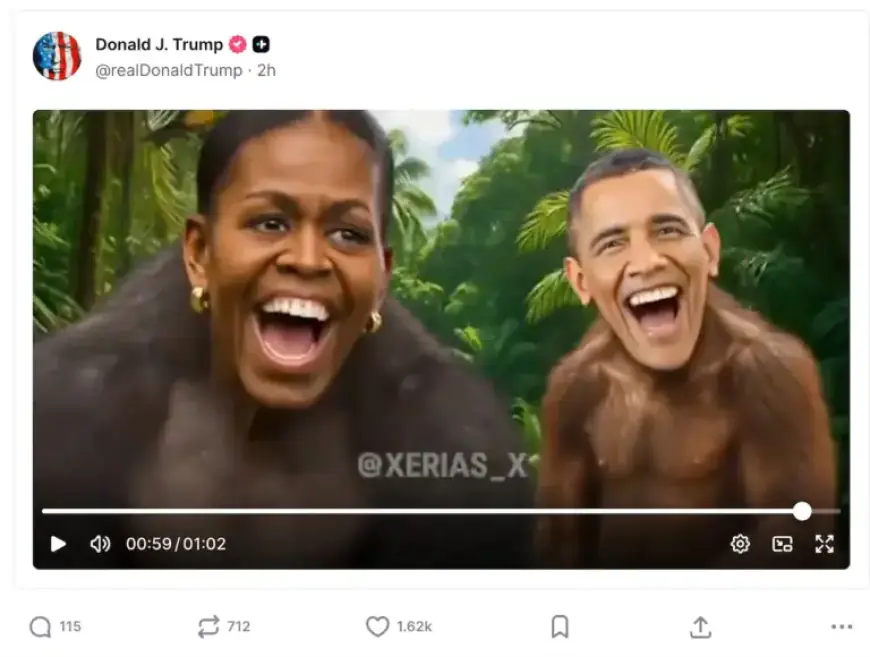
President Donald Trump faced bipartisan condemnation after a video shared from his account late Thursday night, February 5, 2026, showed former President Barack Obama and former First Lady Michelle Obama portrayed with the bodies of apes. The post was removed around midday Friday, February 6, 2026, as the White House shifted from dismissing criticism to describing the upload as an error tied to a staff action.
The episode quickly became one of the most talked-about political flashpoints of the week, not only for the racist imagery itself, but for how it intersected with a broader wave of posts pushing debunked claims about the 2020 election.
What happened and when
The video was posted at 11:44 p.m. ET on Thursday and remained visible for hours. It was roughly a minute long and blended election-related conspiracy themes with the offensive animation. By Friday morning, lawmakers and advocates were demanding its removal, and the post was taken down around noon ET.
A White House spokesperson, Karoline Leavitt, initially characterized the blowback as “fake outrage” before the administration later emphasized that the content was removed and suggested it should not have been posted.
Why this is more than a “bad post” story
The racist trope of comparing Black people to primates is among the oldest and most inflammatory forms of dehumanization in American political culture. When it appears in a presidential post, the impact is amplified: it becomes a signal about what is acceptable within the leader’s orbit, what will be excused as humor, and what kind of behavior supporters may feel licensed to repeat.
At the same time, the clip’s election-conspiracy framing matters. The offensive imagery did not appear in isolation; it was embedded in a message stream aimed at re-litigating the legitimacy of the 2020 result. That pairing is politically potent because it fuses grievance politics with racial provocation, encouraging followers to process the controversy not as a moral breach but as another front in partisan warfare.
Who pushed back, and why their reactions matter
Some Republicans publicly urged deletion, including Senator Tim Scott of South Carolina, who called the post exceptionally racist. That kind of intraparty criticism is notable in a political environment where many elected allies tend to avoid confronting the president’s rhetoric directly.
Democrats condemned the post as well, arguing that it reflected something deeper than a one-off mistake. For the Obama camp, the response was muted publicly, a common strategy when engaging can prolong the news cycle and feed the online outrage machine.
Behind the headline: incentives and stakeholder pressures inside the White House
The White House has competing incentives when a controversy erupts from the president’s own feed.
One incentive is defensiveness: frame the backlash as overblown to protect the president’s image and keep supporters energized. Another incentive is containment: delete quickly to reduce the life span of screenshots and clip-sharing, then shift blame to process failures or unnamed staff actions.
The stakeholders are broad:
-
The Obamas, who face renewed harassment and dehumanizing attacks whenever such imagery trends
-
Black public officials and communities, who read the incident as a test of whether racism will be confronted or normalized
-
Republican leaders, who must decide whether silence equals complicity or whether criticism risks political retaliation
-
White House staff, whose credibility is strained if “a staff mistake” becomes the default explanation for inflammatory content
-
The broader public, which is increasingly forced to navigate politics as a stream of provocative content rather than policy signals
What we still don’t know
Several key details remain unclear in public view:
-
Who sourced the video and who approved its posting, if any approval took place
-
Whether the internal explanation is an accurate account of how the post went live
-
Whether any disciplinary steps were taken inside the communications operation
-
Whether similar content will reappear through allied accounts or reposts in the coming days
These gaps matter because accountability in modern political communication often hinges on process transparency. Without it, each controversy becomes a cycle of denial, deletion, and repeat.
What happens next: likely scenarios and triggers
-
Further fallout in Congress
Trigger: more lawmakers decide the episode demands formal condemnation or hearings focused on hate-driven content. -
A renewed focus on platform governance
Trigger: civil rights groups and legal observers press for tougher enforcement against racist depictions, even when shared by public officials. -
Campaign-style escalation
Trigger: the controversy becomes a fundraising and mobilization tool, with allies framing it as censorship and opponents framing it as disqualifying conduct. -
Internal tightening of posting controls
Trigger: the White House quietly changes who has access to publish and what review steps exist, without publicly acknowledging the shift. -
Another flashpoint tied to 2020 claims
Trigger: future posts revive election-fraud narratives, pulling the same coalition lines back into place.
Why it matters
This incident sits at the intersection of race, power, and information control. A deleted post does not delete the signal it sent, and the controversy is less about one offensive clip than about the governing style it represents: politics as provocation, accountability as a moving target, and national discourse shaped by content designed to inflame.
As of Friday night ET, the practical question is whether the White House treats this as a genuine breach with real consequences, or as another outrage cycle to be absorbed, reframed, and forgotten until the next post lands.