

























Giant Phantom Jelly Sighting Off Argentina Captured on Deep-Sea Video, Renewing Questions About One of the Ocean’s Rarest Giants

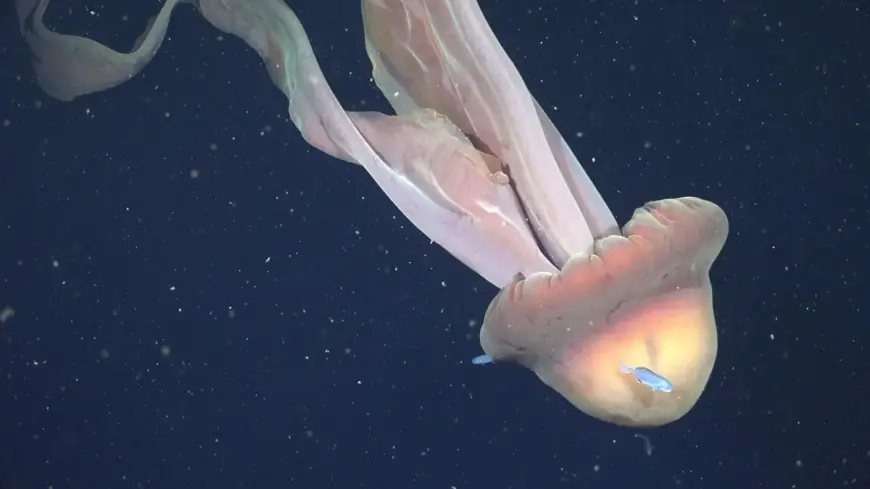
A giant phantom jelly—an elusive deep-sea jellyfish so rarely seen alive that each encounter becomes a global event—has been filmed drifting through the dark waters off Argentina, after a remotely operated vehicle recorded the animal in a submarine canyon at roughly 820 feet below the surface. The footage, circulated widely on Wednesday, February 4, 2026, ET, has reignited public fascination with a creature that can appear almost otherworldly: a broad bell and four flowing, ribbon-like arms that can trail for dozens of feet.
The sighting matters for more than spectacle. Encounters with the giant phantom jelly are scientifically valuable because the deep ocean remains one of Earth’s least observed habitats. Each clear video can help researchers refine what they know about where these animals live, how they move, and what role they play in deep-sea food webs.
What happened in the giant phantom jelly sighting
During a deep-sea expedition off the Argentine coast, a research team operating a remotely operated vehicle recorded a giant phantom jelly moving calmly through the water column along the wall of the Colorado–Rawson submarine canyon. The animal was observed around 250 meters down, a zone where sunlight fades and the ocean begins to shift toward true deep-sea conditions.
Researchers identify the animal as Stygiomedusa gigantea, commonly called the giant phantom jelly. It is known for an unusually large bell—often described as about a meter across in the biggest individuals—and for four long oral arms that can extend up to about 10 meters. Unlike many jellyfish people encounter near beaches, this species lacks the familiar stinging tentacles and appears to rely on its long arms to capture prey such as plankton and small fish.
What are giant phantom jellies, and why they’re so rarely seen
The giant phantom jelly is a deep-sea species that likely ranges widely across global oceans, but it spends much of its life far from human observation. That makes it hard to study. Most “sightings” come from submersibles, remotely operated vehicles, or chance encounters that happen to be recorded. Even among deep-sea researchers, it’s considered a special find because it appears infrequently and often at depths and locations where surveys are sporadic.
The rarity is not necessarily because the species is near extinction; it’s because we don’t spend much time looking in the places it lives, and because the deep ocean is vast. When a survey vehicle happens to pass one at the right angle, in the right light, with the right cameras rolling, the result can be an unusually detailed look at a creature that typically remains a silhouette in scientific records.
Behind the headline: why this moment is happening now
The timing of the viral surge is no accident. Deep-sea exploration has entered a period where high-definition cameras, improved lighting, and more frequent expeditions are producing footage that is both scientifically useful and instantly shareable. The incentives align:
-
Research teams want to communicate discoveries and justify continued exploration funding.
-
The public responds strongly to “rare creature” visuals that cut through everyday news noise.
-
Ocean policy debates—about protected areas, fisheries impacts, and seabed extraction—are increasingly shaped by public awareness of deep-sea biodiversity.
Stakeholders include scientists collecting environmental samples, national institutions supporting oceanographic work, industries with interests in deep-water resources, and conservation advocates arguing that “unknown” ecosystems deserve protection before disruption becomes irreversible.
What we still don’t know about the sighting
Even with striking video, the most important scientific questions remain open:
-
How common giant phantom jellies actually are in the region, and whether this area is a recurring habitat or a one-off encounter.
-
What the animal was doing at that depth—feeding, migrating vertically, or simply drifting with currents.
-
How environmental conditions (temperature, oxygen, prey availability) influence where and when it appears.
-
Whether these jellies have distinct population patterns across oceans or represent a more connected global distribution.
In deep-sea biology, a single sighting is a clue, not a conclusion.
Second-order effects: why a jellyfish clip can influence real policy
This kind of discovery often has ripple effects beyond science. Viral deep-sea footage can increase pressure for marine protection measures, shift philanthropic funding toward exploration, and elevate scrutiny of activities that disturb deep habitats. It can also intensify debates about “use versus preservation” in waters that are out of sight for most voters but increasingly within reach of industrial technology.
At the same time, public attention can distort expectations—people may assume that rare footage means the deep sea is now “well understood,” when the opposite is closer to the truth.
What happens next: realistic scenarios to watch
-
More targeted surveys in the same canyon system
Trigger: researchers see signs that the region repeatedly produces rare encounters and warrants return missions. -
Follow-on scientific reporting from collected samples
Trigger: laboratories analyze water chemistry, DNA traces, and biological specimens from the expedition to map ecosystem links. -
New guidance on protecting deep-sea hotspots
Trigger: discoveries of sensitive reef systems or unusual biodiversity prompt policy discussions about safeguarding specific areas. -
A broader wave of “rare species” sightings as exploration expands
Trigger: more expeditions, better cameras, and improved mapping make once-mythic animals appear more frequently—without necessarily meaning they’ve become more common.
The giant phantom jelly sighting is captivating because it feels like a glimpse into another world. But the deeper significance is practical: every confirmed observation is a small expansion of what humanity knows about the largest living space on the planet—and a reminder of how much remains unseen.