

























Enhanced Low-Power Optical Amplification via Second-Harmonic Resonance

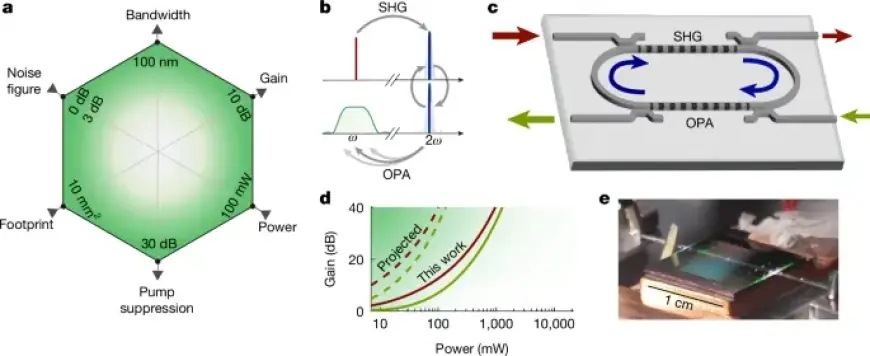
Recent research in photonics has made significant strides in the development of enhanced low-power optical amplification through second-harmonic resonance. This technology aims for improved efficiency and performance in optical systems, making it a topic of interest for researchers and industry professionals alike.
Overview of Optical Amplification Techniques
Optical amplification plays a critical role in modern communication systems and imaging technologies. By increasing the strength of optical signals, amplifiers enable long-distance transmission and high-resolution imaging capabilities. Recent advancements in nonlinear optics have led to various innovative approaches, enhancing this fundamental technology.
Key Developments in Enhanced Optical Amplification
- Second-Harmonic Resonance: This technique has garnered attention for its ability to improve the efficiency of optical amplifiers.
- Integrated Waveguides: Research indicates that nano-engineered waveguides can facilitate ultra-low-power amplification while maintaining high gain.
- Parametric Amplification: New methods of parametric amplification using lithium niobate materials are pushing the boundaries of traditional amplification techniques.
Recent Research Findings
Several studies have reported significant breakthroughs in optical amplification using advanced materials and techniques. For instance, recent papers highlighted the following:
- The generation of squeezed states by parametric down conversion has been documented, demonstrating the effectiveness of utilizing second-harmonic processes.
- Highly efficient phase-sensitive parametric gain in LiNbO3 ridge waveguides has shown promise for reducing noise and enhancing overall system performance.
- Incorporating engineered waveguides has enabled the development of amplifiers with notable gains beyond 30 dB, confirming their capability for demanding applications.
Applications of Enhanced Optical Amplification
Enhanced optical amplification techniques are poised to impact various fields, such as:
- Telecommunications: With the increase in data transfer demands, precise optical amplifiers can significantly improve transmission rates over long distances.
- Quantum Computing: These advancements support quantum communication systems, enhancing the performance of error correction and signal integrity.
- Medical Imaging: Nonlinear optical microscopy enhanced by these techniques can lead to better image resolution for biomedical applications.
Future Directions
The future of optical amplification lies in continued exploration of low-power technologies, second-harmonic resonance, and the integration of advanced materials. As researchers push the boundaries of these systems, they aim to develop even more efficient and compact solutions capable of addressing the growing demands of various sectors.
In conclusion, the progress in enhanced low-power optical amplification through second-harmonic resonance marks a pivotal development in the field of photonics. Ongoing research and innovation will play essential roles in shaping the future of optical technologies.