Melania Trump’s New Documentary Film Fuels a Culture War, a Comeback Bid, and a Big Bet on Theatrical Hype

A new feature-length documentary centered on First Lady Melania Trump is turning into one of the most unusual political-media events of early 2026: a prestige-style rollout, a nationwide theatrical push, and a marketing campaign that looks closer to a blockbuster than a typical nonfiction release. The film, titled Melania and directed by Brett Ratner, is scheduled to reach theaters on Friday, January 30, 2026 ET, following a high-profile premiere event on Thursday, January 29, 2026 ET.
The project is being framed publicly as an intimate look at Melania Trump during the transition back into the White House ahead of the January 2025 inauguration. But the way it is being launched, and who is behind it, is what’s driving the story far beyond entertainment pages.
What the Melania movie is and why it’s suddenly everywhere
The documentary’s core promise is access. It follows Melania Trump over a compressed window in the run-up to the inauguration and early days of the second term, positioning her as narrator and central character rather than a supporting figure in a broader political narrative.
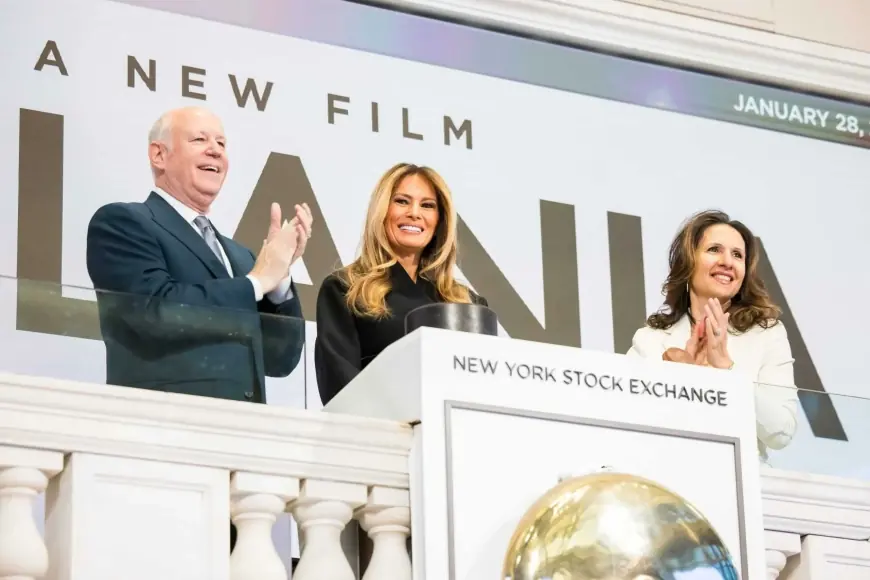
The rollout has been unusually ceremonial. On Wednesday, January 28, 2026 ET, Melania Trump appeared at the New York Stock Exchange to ring the opening bell while promoting the film, signaling that this is not a quiet release aimed at niche documentary audiences. It’s meant to feel like an event.
That choice matters because it blends three worlds that usually keep some distance: government visibility, celebrity-style branding, and a commercial film launch.
Brett Ratner’s return is part of the headline, not a footnote
Ratner’s involvement is inseparable from the public reaction. This is his first major film project in years after stepping away from mainstream filmmaking amid prior misconduct allegations that he has denied. For supporters of the documentary, his role is treated as a technical choice: a director hired to execute a glossy, access-driven portrait. For critics, his return becomes a symbol of how power and proximity can reopen doors that public opinion once seemed to close.
That tension shapes how audiences interpret everything else. Even basic questions like “Is this a documentary or a brand vehicle” become loaded because the filmmaker’s reputation changes what people assume about intent and editing choices.
The money question: why the budget talk won’t go away
The film is also controversial because of the scale of the financial bet. Widely discussed figures around the deal put distribution rights at about 40 million dollars, with marketing spend discussed at around 35 million dollars, implying a total outlay near 75 million dollars. Even allowing for industry variance, that is extraordinary for a documentary.
A spend that large creates a different set of incentives. The film doesn’t just need viewers, it needs validation: packed premieres, strong opening weekend optics, and headlines that suggest momentum. That can encourage aggressive promotional tactics and tight control over early access, including who gets to see the film before release.
Behind the headline: what each side wants out of this release
Context helps explain why this is happening now.
Melania Trump’s incentive is narrative control. A documentary offers a way to define her role on her terms: selective access, curated behind-the-scenes moments, and a storyline that emphasizes composure, taste, and deliberateness rather than political combat.
Ratner’s incentive is rehabilitation through scale. A high-profile project tied to the most powerful address in the country is not merely another directing credit. It’s a statement that he is back in the arena.
The distributor’s incentive is leverage. A splashy political documentary can generate attention that spills into subscriptions, advertising, partnerships, and broader access across Washington and culture. Even if box office is modest, the value can be reputational and strategic.
Stakeholders include the administration, which will be judged for how closely it embraces the film; critics, who will evaluate whether the project functions as art, marketing, or political messaging; and the public, which is increasingly sensitive to the blurred boundary between governance and content creation.
Second-order effects are real. If this release succeeds as a template, it encourages more official-adjacent documentaries that function like soft power campaigns, with public institutions and public figures learning to communicate through entertainment mechanics rather than traditional interviews and press briefings.
What we still don’t know
Several missing pieces will decide whether the film becomes a short-lived curiosity or a long-running flashpoint.
How much editorial control Melania Trump had over the final cut, and how that shaped what was included or excluded.
Whether early audience reactions reflect genuine enthusiasm or a mobilized opening-weekend push.
How broadly the film will travel internationally, and whether political sensitivity limits distribution in certain markets.
Whether the film answers substantive questions about influence and priorities, or stays primarily in mood, imagery, and personal branding.
What happens next: realistic scenarios and triggers
A strong opening weekend that reframes the story as a commercial win
Trigger: sold-out screenings in key markets and sustained demand into the second weekend.
A backlash cycle that turns the film into a referendum on propaganda and privilege
Trigger: viral clips, critiques about access, and renewed focus on Ratner’s involvement.
A modest box office that still succeeds as a political messaging tool
Trigger: heavy conversation online plus long-tail viewing after the theatrical window.
Distribution turbulence abroad
Trigger: additional markets pulling back due to local political pressure or reputational risk.
A wave of copycat political documentaries with bigger budgets and tighter message discipline
Trigger: proof that high-spend nonfiction can dominate attention even without critical consensus.
The central reality is this: Melania is not being sold as a quiet documentary. It’s being launched as a cultural product with political gravity, built to shape perception as much as to inform. Whether audiences treat it as revealing, revisionist, or simply a glossy brand portrait will determine what this experiment means for the next election cycle, the next administration, and the next era of documentary filmmaking.