

























“‘5pc’: One Nation’s Astonishing Development Unveiled”

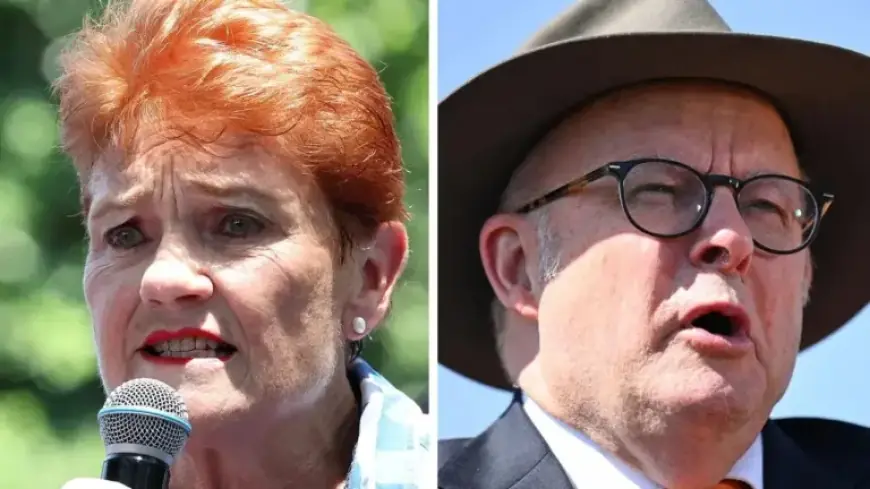
Recent polling indicates that One Nation could secure up to 36 seats in the event of an immediate election, positioning itself as the official opposition party. This significant growth is attributed to a DemosAU survey conducted from January 13 to 21, which involved 1,933 voters. The poll revealed One Nation’s primary vote at 24%, just 5% behind Labor, who garnered 30%.
Polling Insights
The DemosAU survey also indicated a decline for the Coalition, which fell to 21%. The Greens and other parties received 13% and 12%, respectively. Both One Nation and Labor saw a 1% rise from previous polling, while the Coalition experienced a 2% decrease.
Voter Preferences
- Pauline Hanson: 26% prefer her as Prime Minister.
- Sussan Ley: 16% support the Liberal leader.
- Anthony Albanese: 36% favor the current Prime Minister.
Despite Hanson’s modest net positivity rating of -5%, she is viewed more favorably than Albanese and Ley, whose ratings were -14% and -18%, respectively. DemosAU research head George Hasanakos noted that if these results translate to an election outcome, Labor would maintain a strong lead, while One Nation could emerge as the second-largest party.
Seat Projections
The seat distribution forecast, based on a Monte Carlo probability analysis, estimates:
| Party | Projected Seats |
|---|---|
| Labor | 87 – 95 |
| One Nation | 29 – 36 |
| Liberals | 9 – 18 |
| Nationals | 1 – 5 |
| Greens | 0 – 2 |
| Others | 6 – 11 |
Hasanakos emphasized the fragmentation on the right side of Australian politics, which has contributed to One Nation’s rise. The party primarily appeals to individuals with a high school education, those in regional settings, and voters aged over 55— demographics where the Coalition has traditionally found strength.
Support Dynamics
Interestingly, there is minimal gender disparity in One Nation’s support, with nearly equal backing from men and women. According to the survey, 24% of women and 25% of men indicated they would vote for One Nation.
Political Engagement
On January 26, Hanson energized her supporters during an Australia Day rally in Brisbane. She expressed pride in Australia while challenging climate change concerns and advocating for the mining and manufacturing sectors. Hanson’s discourse also addressed incoming speech laws that she believes could curtail minor party representation.
She criticized Prime Minister Albanese for immigration policies, urging her audience to rally behind One Nation for stronger parliamentary representation. Hanson concluded by reinforcing her commitment to equality for all Australians, calling for national unity regardless of birthplace.
Trends in Support
DemosAU’s previous model indicated that one in five Coalition voters had shifted to One Nation, a figure that has now increased to nearly one in three. Among Labor voters, approximately 11% have also shifted support. The upcoming election landscape appears increasingly competitive, with One Nation poised to capitalize on the prevailing political dynamics.
Overall, as the political climate shifts, the emergence of One Nation is a significant development in Australian politics, positioning the party as a formidable contender for the next election cycle.