Solar Flares Spike Again: X-Class Blast Triggers Severe Space Weather and Widens Aurora Range

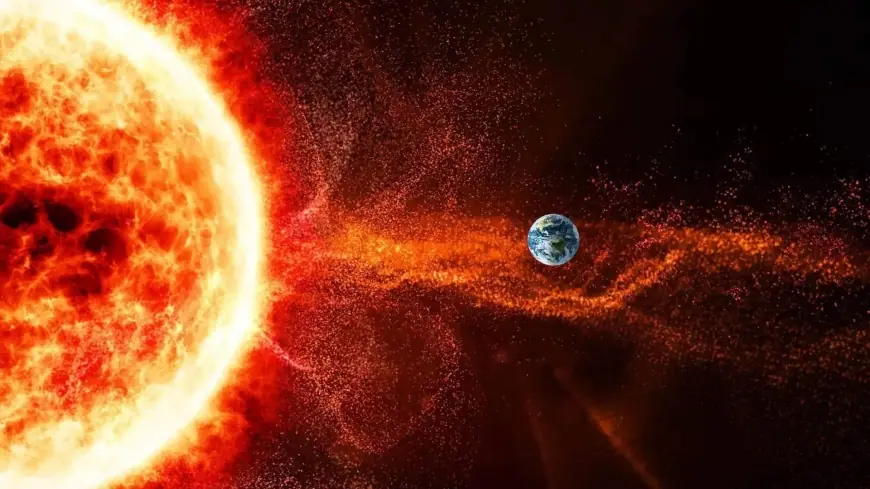
A powerful solar flare over the weekend has kicked off a fast-moving chain of space-weather impacts, including strong radio disruption, a severe geomagnetic-storm watch, and heightened radiation levels measured in Earth orbit. The flare’s associated coronal mass ejection (CME) arrived sooner than many early model runs suggested, increasing the odds of vivid auroras well outside their usual latitude band and raising operational concerns for aviation, satellites, and high-frequency radio users.
This isn’t just a pretty-sky story. When an X-class solar flare is tied to an Earth-directed CME, the biggest effects often arrive in waves: an immediate radio hit on the sunlit side of Earth, then a geomagnetic punch hours to a couple days later, plus elevated particle radiation that can complicate satellite operations and polar routes.
-
An X1.9-class solar flare erupted on January 18, 2026, from active region AR4341.
-
The flare produced an R3 (Strong) radio blackout, affecting HF communications on the daylit side during peak impact.
-
A CME linked to the flare reached Earth on January 19, 2026, with storm conditions escalating to G4 (Severe) after arrival.
-
Space-weather scales also flagged a severe solar radiation storm (S4) in progress on January 19, indicating elevated energetic particles.
-
Aurora visibility expanded substantially, with potential viewing much farther south than typical, depending on cloud cover and local darkness.
Solar flares: what happened, and why this one mattered
Solar flares are bursts of radiation from the Sun’s atmosphere, ranked from A to X (with X being the strongest). An X1.9 flare sits in the “strong enough to matter” tier, especially when it originates from an Earth-facing sunspot group and is paired with a CME that heads our way.
This event had that combination. The flare itself delivered the quick, predictable effect: a sudden surge of X-ray and extreme ultraviolet energy that can disrupt high-frequency (HF) radio. The slower, more dramatic effect arrived later: the CME, a huge cloud of magnetized plasma, slammed into Earth’s magnetic field and drove geomagnetic-storm conditions.
What pushed this into a “watch closely” category was the intensity on multiple scales at once: strong flare, strong geomagnetic response, and a severe radiation environment detected by satellites.
Timeline of impacts from this solar flare and CME
Below is the sequence in plain timekeeping. (Exact regional impacts vary with local daylight and magnetic conditions.)
| Milestone | When (UTC) | When (ET) | When (UK time) |
|---|---|---|---|
| X1.9 flare peak (AR4341) | Jan 18, 18:09 | Jan 18, 1:09 pm | Jan 18, 6:09 pm (GMT) |
| CME shock arrival noted | Jan 19, 19:38 | Jan 19, 2:38 pm | Jan 19, 7:38 pm (GMT) |
| Severe radiation storm flagged (S4) | Jan 19, 18:54 | Jan 19, 1:54 pm | Jan 19, 6:54 pm (GMT) |
The key nuance: the flare is the “flashbulb” moment; the CME is the “freight train” that arrives later. Once the CME’s magnetic field couples efficiently with Earth’s (especially if it carries a sustained southward component), geomagnetic activity can intensify quickly, and auroras can spread farther from the poles.
What “G4” and “S4” mean in real-world terms
A G4 (Severe) geomagnetic storm can do more than boost auroras. It can also stress power systems at high latitudes, degrade some navigation signals, and increase satellite drag by puffing up the upper atmosphere. Satellite operators may need to adjust attitude-control plans, manage charging risk, or delay sensitive maneuvers.
An S4 (Severe) solar radiation storm points to elevated energetic particles that can raise radiation exposure for high-altitude flights, especially on polar routes, and can increase single-event upsets in spacecraft electronics. It doesn’t mean “danger on the ground” for most people, but it does shift the risk calculus for aviation dispatchers and satellite teams.
HF radio users often feel the most immediate pain: a strong flare can cause a wide-area HF blackout on the sunlit side of Earth, and geomagnetic storms can further degrade HF propagation afterward.
In the months leading into January 2026, solar activity has frequently shown a pattern of “quiet-to-loud” spikes: a cluster of stronger events, then a lull, then another cluster. This flare-CME combo fits that pattern and underscores how quickly conditions can escalate when an Earth-facing active region becomes productive.
What to watch next after these solar flares
Space weather rarely ends with the first hit. The next 12–36 hours typically determine how “clean” or “messy” the CME passage is. A few practical signals to track:
-
Whether geomagnetic indices stay elevated through multiple local nights (aurora chances increase with persistence).
-
Whether additional eruptions occur from the same active region while it remains Earth-facing.
-
Whether radiation levels keep rising or begin a steady decline (important for polar aviation and satellite operations).
-
Whether the storm’s magnetic orientation remains favorable for continued geomagnetic coupling.
FAQ
Are solar flares the same as CMEs?
No. A flare is a burst of radiation; a CME is a cloud of plasma and magnetic field. They can happen together, but either can occur without the other.
Do solar flares affect internet and cell service?
Most everyday internet and mobile networks are resilient. The more common disruptions involve HF radio, some navigation accuracy, and satellite operations, with knock-on effects mainly in specialized sectors.
Why do auroras appear farther south during strong events?
A stronger geomagnetic storm expands the auroral oval, letting the same physics that normally lights polar skies reach lower latitudes.
If this active region stays productive over the next day or two, additional flares are possible while it remains in a favorable position on the Sun’s disk. The main uncertainty is not whether auroras occur, but how intense and long-lived the geomagnetic response remains as the CME’s magnetic field evolves during passage.