AI Revolutionizes Discovery of Mammalian Metabolites

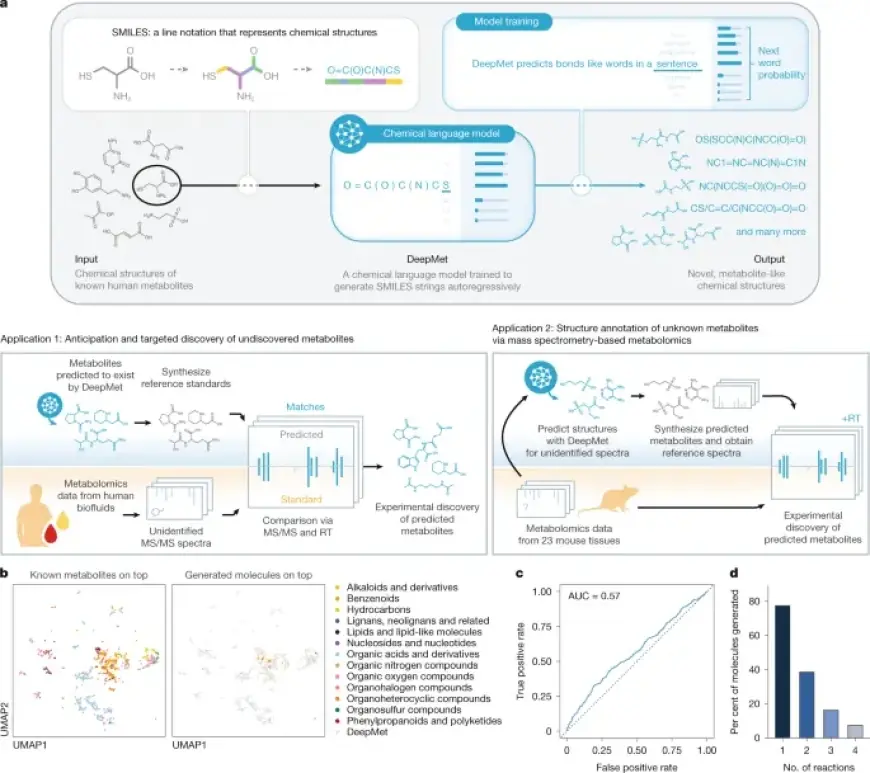
A recent study has highlighted a groundbreaking advancement in metabolomics, focusing on how artificial intelligence (AI) is transforming the discovery of mammalian metabolites. By utilizing machine learning techniques, researchers have developed a model named DeepMet, which enhances the identification and characterization of metabolites in mammalian systems.
AI-Driven Training Dataset Development
The foundation of this research relies on a training dataset sourced from the Human Metabolome Database (HMDB). This extensive database features 114,222 metabolites, with a majority classified as expected or predicted rather than experimentally verified. Out of these, only 8,970 metabolites were found to be detected or quantified, primarily consisting of lipids, which accounted for a significant number (6,791) of the identified compounds.
Data Filtering and Model Training
- Training set validation: To refine the dataset, lipids were excluded, resulting in a final training set of 2,046 small molecule metabolites.
- SMILES representation: The structures were converted into canonical SMILES format, ensuring data integrity for the language model.
- Model architecture: A recurrent neural network (RNN) based on long short-term memory (LSTM) was employed, demonstrating superior performance in generating metabolite-like structures.
Evaluating Metabolite Similarities
The researchers conducted various analyses to ensure that the AI-generated compounds exhibited characteristics akin to known metabolites. Techniques included dimensionality reduction to visualize chemical similarities and the use of a supervised machine learning classifier to differentiate between generated and actual metabolites.
Additionally, the authors utilized BioTransformer, a knowledgebase for enzymatic reactions, to further validate the generated metabolites against existing biotransformation products.
Integration with Experimental Data
To substantiate predictions made by DeepMet, a large-scale resource of anonymized human metabolomics data was leveraged. This resource facilitated validation through mass spectrometry, enhancing the reliability of the generated metabolites identified by the AI model.
Key Experimental Findings
- The study included 29.1 million MS/MS spectra from 4,510 runs, evaluating the model’s predictions against a vast array of metabolomics datasets.
- A total of 106 synthetic standards were acquired to confirm the presence of predicted metabolites, leading to a significant success rate in metabolite identification.
Future Directions in Metabolite Discovery
This research promises to greatly enhance the metabolomics field, allowing for more precise identification of both known and novel metabolites. As DeepMet continues to evolve, it could facilitate new discoveries in pharmacology and biomedical research, vastly improving our understanding of human metabolism.
In conclusion, the AI-driven approach showcased in this study represents a significant milestone in the automation and accuracy of metabolite discovery, offering invaluable insights for future research within the metabolomics landscape.