String Theory Explains a Universe Encompassing Dark Energy

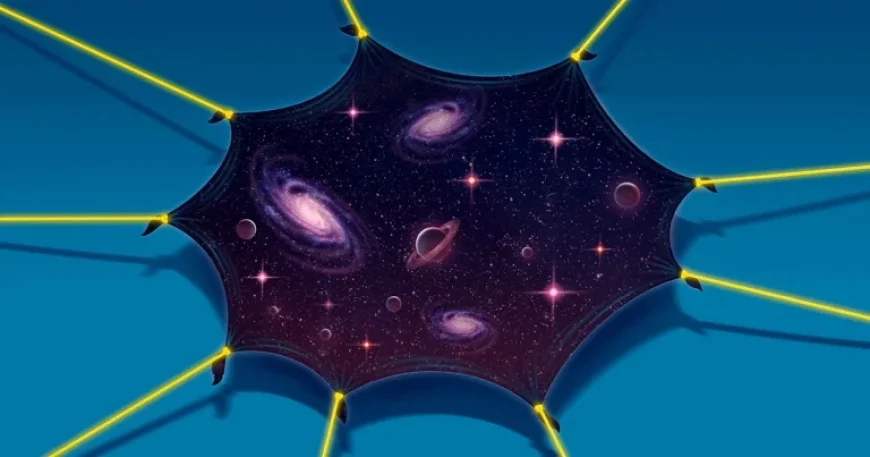
Recent research in string theory has opened up new avenues in understanding the universe’s structure. Scientists are striving to explain phenomena related to dark energy, a mysterious force that accelerates the universe’s expansion.
String Theory and Dark Energy
Researchers Bento and Montero have proposed a model utilizing a compact geometry that resembles a 2D torus, akin to a doughnut. This 6D Riemann-flat manifold is chosen for its simplicity and potential to yield desirable physical properties. Their approach aims to create a foundation for exploring dark energy through string theory.
Alternative Approaches
In contrast, the Silverstein team opted for a more complex geometry involving negatively curved hyperbolic manifolds. This choice not only complicates calculations but also illustrates the diversity of methods within the field.
- Bento and Montero’s framework is built on M-theory.
- This theory necessitates the existence of seven dimensions.
- However, their calculations operate in a 5D model.
Following Bento and Montero’s initial findings, researchers Gianguido Dall’Agata and Fabio Zwirner from the University of Padua published their own work. They also utilized Riemann-flat manifolds in their analyses, focusing on the Casimir effect as a means of producing dark energy. Zwirner emphasized the complementarity of their techniques, fostering a collaborative spirit in the field.
Caveats in Research
Despite the promising results, Bento and Montero acknowledged significant limitations in their findings. Their de Sitter solution is unstable, suggesting that the positive dark energy noted will diminish over time. This leads to a dynamic scenario rather than a constant state, challenging the long-standing notion introduced by Einstein in 1917.
New Evidence on Dark Energy
Recent results from the Dark Energy Spectroscopic Instrument in April 2024 indicated a potential weakening of dark energy, a finding reinforced the following year. This raises critical questions about the stability of the cosmological constant.
- Most observations prior to this suggested a fixed amount of dark energy.
- Current data hint at fluctuating energy levels.
Bento and Montero’s research, based on M-theory, offers advantages by reducing complexity. Nevertheless, they face the pressing challenge of reconciling their 5D findings with the 4D universe we observe. The resolution of this issue remains a high priority. Bento expressed the urgency of developing a four-dimensional solution, noting that without it, their work cannot represent the final answer.
Conclusion
As studies continue, the scientific community remains hopeful for breakthroughs in understanding dark energy through the lens of string theory. Bento and Montero’s approach represents a significant step forward, despite the hurdles ahead.