



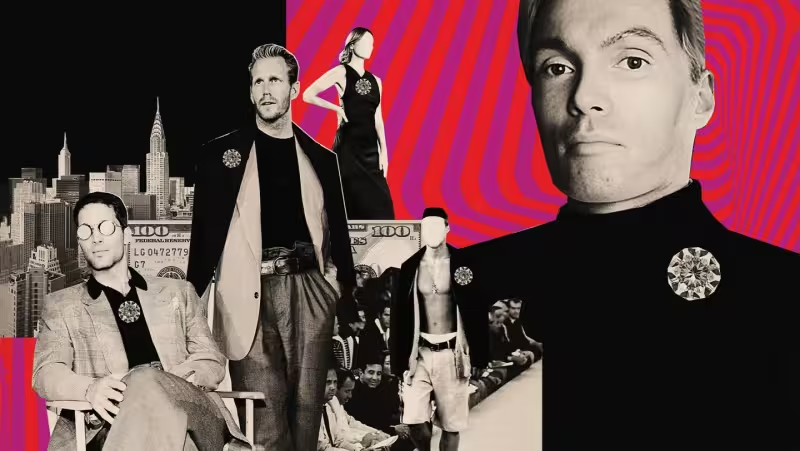
“I was becoming a more evolved, better me,” Hoyt Richards says on camera in Bring Me The Beauties, the three-part HBO documentary that premiered June 1 and reopens one of New York’s stranger, quieter scandals: how a Princeton football recruit who became the world’s first male supermodel handed nearly every dollar he earned to a charismatic cult leader.
The film, directed by Chris Smith, centers on Richards’s testimony and interviews with several other former members of a group that called itself Eternal Values. Smith says the project took about five years to make and that he had to reconstruct a story with little online trace because the cult’s activities were largely pre-internet. The series mixes Richards’s recollections with archival footage of Frederick Von Mierers — born Frederick Myers — who styled himself as a social arbiter and spiritual conduit, telling followers, “Only invite the beauties” and promising something he called “God’s higher cocktail party on Earth.”

Richards’s career was unmistakable: a Princeton scholarship, a turn on the football field, then a leap into fashion that put him before the lenses of Helmut Newton and Steven Meisel and into campaigns for Versace, Valentino, Ralph Lauren and Burberry. The documentary makes clear that as Richards rose in the late 1980s — at one point described as the highest-paid male model — nearly every dollar he made flowed into Von Mierers’s orbit. The film includes the grim ledger: expensive gemstones sold at enormous markups, mandatory tanning sessions, restrictive fruit-and-vegetable diets, 90-minute astrological “life readings” and the day-to-day chores of cleaning the leader’s East 54th Street apartment where followers slept on futons.
Context: Von Mierers built his influence in the late 1970s by moving through New York society and recruiting attractive young people from nightclubs and high-society circles. In 1978 he approached a 16-year-old Richards on a Nantucket beach; later he took followers to places like Studio 54 and hosted afterparties at his apartment. He cast himself as an elite — he listed himself in the Social Register and claimed family ties to the Vanderbilts and a Kress fortune — and then layered onto that persona the extraordinary claim that he was a “walk-in,” an extraterrestrial consciousness from the star Arcturus inhabiting a human body.
The friction in the story is baked into the footage: Von Mierers preached detachment from worldly concerns even as he sold gemstones that he said had healing powers and encouraged followers to buy them at steep prices. He held seminars at a Park Avenue church and even broadcast on Manhattan public-access television in the small hours. By March 1990, Manhattan prosecutors were investigating his operation; a high-profile profile of him appeared the same month. Von Mierers died in March 1990 after concealing an AIDS diagnosis, and the group he founded did not vanish — Eternal Values survived his death and, former members say in the film, became harsher and more paranoid.
The documentary does not shy from the strange mixture of glamour, sex and commerce that sustained Von Mierers: drug-fueled encounters, an illicit gem business, private parties that doubled as recruitment events and strict rules that required followers to renounce sexual relationships and submit to regimented routines. Richards’s on-camera explanation is simple and saddening: the practices and the praise convinced him he was improving. “I was becoming a more evolved, better me,” he tells viewers.
Smith’s film piles the evidence — archival clips, photographs, contemporaneous accounts and firsthand testimony — but it also leaves a gap the director acknowledges: there was little public documentation to go on and much of the story depends on the memories of former members. Smith told viewers it took about five years to assemble what appears on screen.
What happens next is concrete and narrow: HBO has released a three-part series that premiered June 1, and the film is now the most complete public account of Hoyt Richards’s time in Eternal Values. The documentary brings Richards and other former followers into the light and lays out how glamorous access and spiritual promises translated into almost total financial surrender. Whether the series settles every question about Richards’s life inside the group or fully explains how he and others disentangled themselves is left to the film and to viewers; for now, the three episodes are the only new, widely available record of a story that began on a Nantucket beach and ended — at least publicly — with a leader’s death in 1990.



