
























India’s Maritime Chokepoint Dependence: Exploring Stunted Alternative Routes

India has stepped up efforts to diversify trade pathways. The goal is to reduce exposure to key maritime chokepoints. Several transnational corridors are now under varying stages of planning or use.
Major maritime chokepoints and India’s exposure
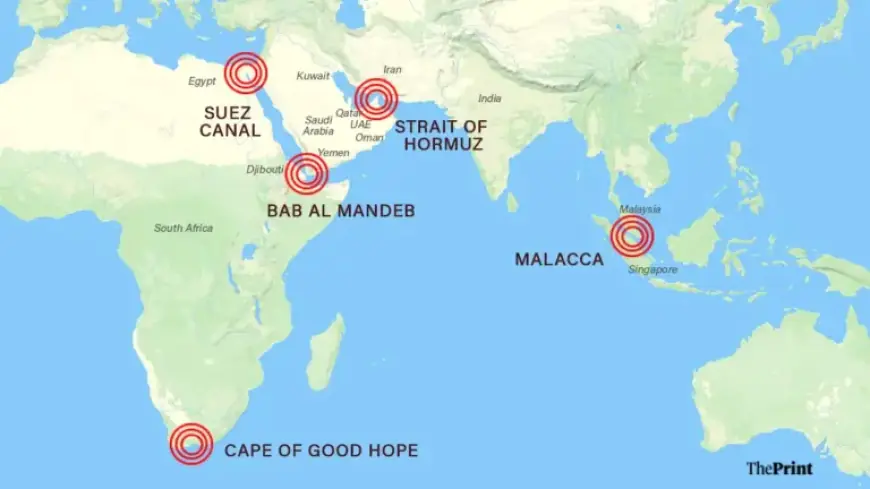
Four key chokepoints shape India’s trade and energy flows. These are the Suez Canal and Bab al-Mandab, the Strait of Hormuz, and the Malacca Strait.
- Suez Canal and Bab al-Mandab: A 2024 ICRA report found the Suez Canal handled 35 percent of India’s foreign trade. EIA data for the first half of 2025 show the Suez‑Bab al‑Mandab corridor carried about 11.4 percent of global maritime oil flows, roughly 9.1 mbpd. India represented nearly 59 percent of oil flows through the Suez in 2025, up from about 11.5 percent in 2020.
- Strait of Hormuz: EIA data put Hormuz at 26.2 percent of global maritime oil flows in H1 2025, about 20.9 mbpd. India accounted for about 13.6 percent of those oil flows. For LNG, India took roughly 19.3 percent of Hormuz-linked volumes.
- Strait of Malacca: The Malacca Strait accounted for 29.1 percent of maritime oil flows in H1 2025, around 23.3 mbpd. China dominates transit through Malacca, but India relies on it for imports of industrial goods, electronics, APIs, and coal from Southeast Asia and Australia.
Recent disruptions and their impact
Hostilities in the region raised costs and forced reroutes in 2024. Houthi attacks in Bab al‑Mandab led many ships to sail around the Cape of Good Hope. That detour added about 6,500 km and caused shipping and insurance costs to increase roughly fivefold.
Flows shifted markedly between 2023 and 2024. Global crude through Bab al‑Mandab fell from 9.3 mbpd in 2023 to 4.1 mbpd in 2024. Exports routed via the Cape rose from 6.2 mbpd to 9.3 mbpd in the same period.
Planned and emerging alternative corridors
India is pursuing multiple land and sea corridors. These aim to cut transit times and dependency on chokepoints.
- International North‑South Transport Corridor (INSTC): Launched in 2000, the INSTC is a 7,200–7,500 km multimodal link connecting India with Russia and Europe via Iran and Central Asia. A 2022 trial ran cargo from Astrakhan to Mumbai via Bandar Abbas. In 2024, an estimated 26.9 million tons moved on the INSTC, mostly Russian exports. The corridor promises to reduce transit from 45–60 days to about 23 days under ideal conditions. Geopolitical tensions still constrain expansion.
- India‑Myanmar‑Thailand Trilateral Highway (IMT‑TH): Conceived in 2002, major construction began in 2012. The full 1,360 km corridor links Moreh in Manipur to Yangon and Bangkok. A precursor, the 160 km Indo–Myanmar Friendship Highway, was built between 2001 and 2002. The IMT‑TH remains incomplete, especially inside Myanmar, because of the 2021 coup and ongoing conflict.
- Chennai‑Vladivostok Maritime Corridor: Operational since 2024, this eastern maritime route cuts transit time from about 35–40 days via the Suez to roughly 24 days. The corridor spans around 5,600 nautical miles and passes the Malacca Strait en route to Vladivostok. Commercial use remains limited due to logistical hurdles and sanctions affecting Russia.
- India‑Middle East‑Europe Corridor (IMEC): Announced in 2023, IMEC envisions linking India’s west coast to high‑speed rail and road links across the Gulf to Israel’s Haifa, then by sea to Greece’s Piraeus. The project aims to offer an alternative to traditional sea lanes and to China’s BRI. Progress depends on resolving regional geopolitical tensions and competing infrastructure interests.
Obstacles to alternatives
Each corridor faces political and operational limits. Sanctions, conflicts, and regional rivalries slow development. Existing infrastructure and vested interests also complicate implementation.
China’s Belt and Road investments add another layer of competition. Beijing’s pipelines, port stakes, and overland corridors reduce incentives for some partners to shift routes.
What the shifts mean for India
India’s energy and trade patterns are changing fast. Russian oil has become a larger supplier as Europe reduces purchases. India’s share of Suez oil flows rose sharply by 2025.
But alternatives remain stunted. Land and maritime corridors show promise. They are not yet viable substitutes for chokepoints at scale.
This assessment of India’s maritime chokepoint dependence and attempts at alternatives appears in reporting by Filmogaz.com. It highlights the continuing urgency to diversify trade links and to address geopolitical barriers.