

























3D Universe Map Reveals 47 Million Galaxies from Milky Way to Cosmic Noon

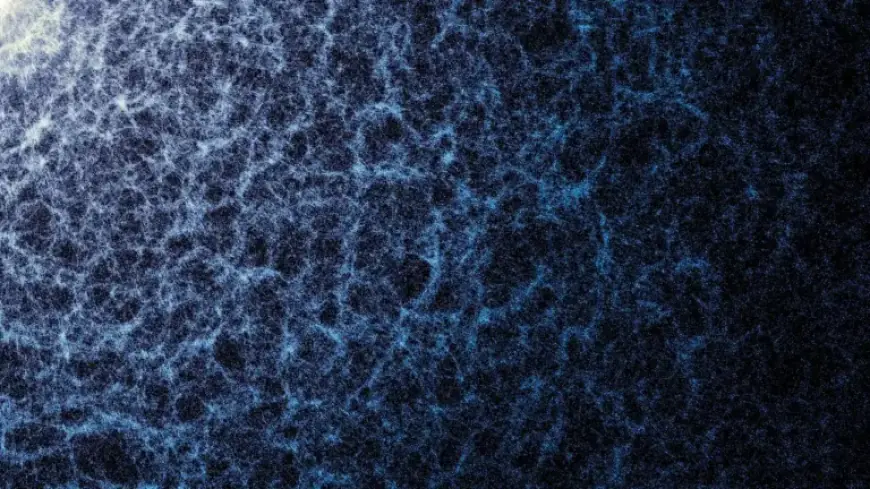
On April 17, 2026, researchers unveiled the largest high-resolution 3D Universe Map to date. The map charts roughly 47 million galaxies, spanning nearby regions such as the Milky Way out to epochs near cosmic noon.
Instruments and survey design
The Dark Energy Spectroscopic Instrument, or DESI, produced the dataset. DESI sits on the Nicholas U. Mayall 4-meter Telescope at Kitt Peak National Observatory in Arizona.
It uses 5,000 robotic fiber-optic sensors to capture light from distant objects. The five-year campaign collected spectra across large swaths of the sky.
What the map shows
The visualization reveals a filamentary cosmic web of galaxies, clustered along strands and separated by vast voids. Each plotted point corresponds to a galaxy whose light took billions of years to reach Earth.
Because the survey records distance as well as position, it produces a true three-dimensional view. That lets scientists trace how galaxies moved and gathered over time.
Survey yields and coverage
The project initially aimed to catalogue about 34 million galaxies and quasars. In practice, DESI recorded more than 47 million galaxies and over 20 million Milky Way stars during the run.
A time-lapse visualization shows the map’s steady growth across the five-year operation. The dataset extends from local structures to eras approaching cosmic noon.
Scientific goals and early hints
One primary aim is to probe dark energy, the agent linked to the universe’s accelerated expansion. Dark energy is estimated to comprise around 70 percent of the cosmos.
By comparing galaxy distributions across epochs spanning roughly the past 11 billion years, researchers can test whether dark energy has changed. Early DESI results suggest a possible evolution over cosmic history, a finding that could reshape cosmology if confirmed.
Collaboration and timeline
The effort represents a large international collaboration. More than 900 researchers from over 70 institutions contributed, under leadership from Lawrence Berkeley National Laboratory.
The U.S. Department of Energy Office of Science funded the project, with institutional partners across observatories and laboratories. DESI will continue observations through 2028 to increase sky coverage by about 20 percent.
Next steps
Future observing plans will target fainter and more distant galaxies. Teams will also focus on regions obscured by the Milky Way and on southern-sky areas that are harder to observe from Arizona.
Analysts expect the first results from the full DESI dataset in 2027. Ongoing work promises deeper insight into galaxy evolution and the nature of dark energy.
- Release date: April 17, 2026
- Instrument: DESI on Nicholas U. Mayall 4-m Telescope
- Location: Kitt Peak National Observatory, Arizona
- Robotic fibers: 5,000
- Galaxies mapped: ~47 million
- Stars recorded: >20 million (Milky Way)
- Collaboration: >900 researchers, >70 institutions
- Lead institution: Lawrence Berkeley National Laboratory
- Funding: U.S. Department of Energy Office of Science
- Survey continuation: through 2028
- Full dataset results expected: 2027
Filmogaz.com will follow further developments as the project expands its 3D Universe Map and refines measurements across time. The new map already offers an unprecedented view from the Milky Way to cosmic noon.