

























Experience the Universe: Dennis Mammana Reveals Three Cosmic Perspectives in One Night

I spent a long career working inside planetariums. I could move the sun, moon and planets around the dome. The job gave me a rare sense of control over the sky.
Ancient thinkers imagined the heavens on crystalline spheres circling above us. Modern astronomy shows that perception is an illusion caused by enormous distances. Scientific methods now measure those distances with precision.
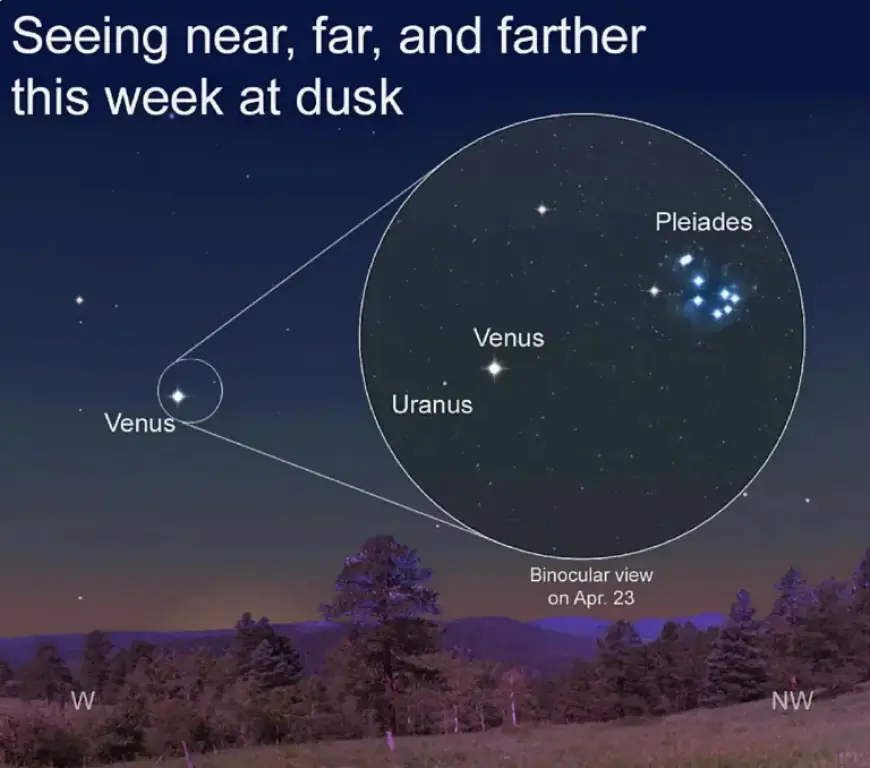
On Thursday, April 23, you can use simple binoculars to view three very different sky objects. This is a chance to Experience the Universe and see three cosmic perspectives in one night. The tip comes from Dennis Mammana and other sky observers.
Three targets to watch
- Venus. It shines as a brilliant evening “star” low in the western sky at dusk. On the 23rd it will lie about 136.8 million miles away.
- Uranus. Look lower left of Venus to find this faint planet. Discovered in 1781 by William Herschel, it sits roughly 1.9 billion miles from Earth.
- The Pleiades, or Seven Sisters. This compact star cluster drifts lower each spring toward the west. Its stars are about 2,600 trillion miles distant.
When and how to observe
Begin at dusk while the western sky still holds twilight colors. Use binoculars aimed low toward the horizon for the best chance of seeing all three targets.
Because they lie low and the sky remains bright at dusk, fitting them into one binocular field will be challenging. Still, the view rewards patience and steady hands.
| Object | Distance | Light-travel time | Note |
|---|---|---|---|
| Venus | 136.8 million miles | 12.3 minutes | Earth-sized, cloud-covered, very bright |
| Uranus | ~1.9 billion miles | ~2.8 hours | Telescopic discovery by William Herschel, 1781 |
| Pleiades (Seven Sisters) | 2,600 trillion miles | ~444 years | Light began its journey around 1582 |
Perspective and perception
Seeing these three objects highlights how scale changes everything in astronomy. The planets feel nearby, while the star cluster reveals vast cosmic time.
A planetarium recreates motion on a dome and helps teach these contrasts. Observing the real sky adds the element of distance and light-travel time.
For more observing notes and skywatching tips, see Filmogaz.com. Enjoy the chance to view Venus, Uranus and the Pleiades in one night.