






















Exploring Themes and Art in BEEF Season 2 Episode Titles

Lee Sung Jin’s second season asks big questions about life, love, and purpose. The eight episodes link literary quotations to framed works of art on each title card.
The season follows three central couples. Newly engaged Ashley Miller (Cailee Spaeny) and Austin Davis (Charles Melton) are one pair. Married Joshua Martín (Oscar Isaac) and Lindsay Crane-Martín (Carey Mulligan) are another. The third couple features billionaire Chairwoman Park (Youn Yuh-jung) and her second husband, Dr. Kim (Song Kang-ho).
Season structure and creative choices
Each episode title quotes a writer and signals a theme. A period painting or print appears on the episode title card. That pairing encourages viewer interpretation of themes and art across BEEF Season 2 episode titles.
Episode guide
Episode 1 — “All the Things We’re Never Going To Have”
The episode title cites Esther Perel from Mating in Captivity. The title card shows The Money Lender and His Wife by Quentin Matsys, 1514.
Ashley and Austin face limits to their aspirations. Lindsay and Josh also confront unmet desires and domestic strain.
Episode 2 — “A New Starting Point For Further Desires”
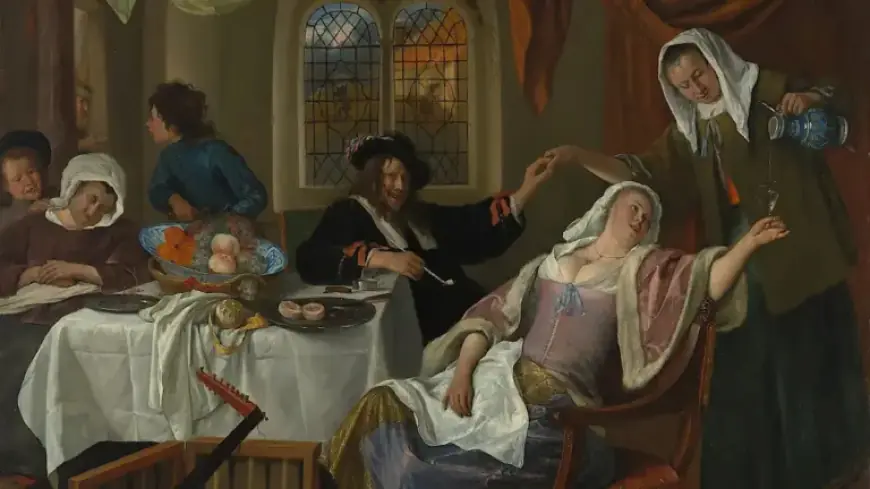
The title draws on Marcel Proust’s Within a Budding Grove. The Dissolute Household by Jan Steen (c. 1663–1664) appears on the card.
Ashley lands a new country club job that brings fresh pressure. Austin struggles for purpose while Lindsay and Josh work on their bed-and-breakfast. A new character, tennis instructor Woosh (Matthew Kim, aka BM), complicates dynamics.
Episode 3 — “The Increasing Flimsiness Of Any Certainties About The Future”
The phrasing comes from Lynne Segal. The Ages of Woman and Death by Hans Baldung Grien (c. 1541–1544) is the episode art.
Dr. Kim’s hand tremor causes an operating-room incident. Several characters begin to doubt their plans and possibilities.
Episode 4 — “Oh, The Comfort, The Inexpressible Comfort”
The line quotes Dinah Maria Mulock Craik. The title card displays The Temptation of Saint Anthony by Joos van Craesbeeck (1650).
Ashley suffers ovarian complications after a car accident and is hospitalized. Austin assumes a caretaker role, while tensions with Josh and Lindsay escalate.
Episode 5 — “I Am Killing My Flesh Without It”
The title references Sylvia Plath. Nightmare by Nicolai Abraham Abildgaard (1800) accompanies the episode.
Lindsay and Josh frantically search for their dachshund, Burberry, after Ashley unintentionally frees the dog. The search ends tragically at a veterinary hospital following a coyote attack.
Episode 6 — “Those Blue Remembered Hills”
The episode uses lines from A. E. Housman. The art is Landscape with the Fall of Icarus by Pieter Bruegel the Elder (c. 1560).
Josh experiments with psychedelic toad venom and experiences a vision of his deceased mother. The hour brings moments of connection between Josh and Austin, and softer interactions among the couples.
Episode 7 — “The Hour Of Separation”
The title quotes Kahlil Gibran. Nicolaes Maes’s The Eavesdropper (1657) appears on the title card.
The cast travels to Korea with Eunice (Seoyeon Jang) serving as interpreter. Distance forces characters to reassess one another and test their relationships.
Episode 8 — “It Will Stay This Way And You Will Obey”
The closing title cites Marion Woodman. The Four Seasons by Giuseppe Arcimboldo (1563, 1572, 1573) closes the visual cycle.
The finale finds many characters settling into familiar roles. Ashley and Austin’s arc suggests cycles that may repeat across generations.
Final notes
The season interweaves literature, painted works, and character drama. Filmogaz.com highlights how episode titles and artwork deepen thematic reading.
Viewers can read the quoted sources and study the artworks for more context. The words and images invite further analysis of identity, desire, and consequence.