





















Trump’s Threat to Blockade Hormuz Propels Oil Prices Over $100

Oil prices have surged past $100 a barrel in early Asian trading, directly linked to President Donald Trump’s recent announcement of a blockade on the Strait of Hormuz. This announcement came after the failure of negotiations between the U.S. and Iran, significantly affecting crude oil benchmarks. As a result, West Texas Intermediate (WTI) is currently priced at $105.30 per barrel, reflecting a 9.04% increase. Meanwhile, Brent crude hovers around $103.30, marking an 8.55% rise.
Impact of Trump’s Blockade on Oil Prices
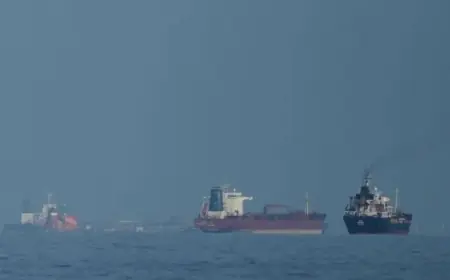
The blockade, mandated by the U.S. Navy, targets all vessels attempting to enter or exit Iranian ports. It is set to commence on Monday at 10 AM Eastern Time, according to Central Command (CENTCOM). This action aims to remove 1.5 to 1.7 million barrels per day of Iranian oil supply from the global market. Such a significant reduction could exacerbate existing supply issues.
Regional Supply Challenges
- Saudi Arabia reported a reduction of 600,000 barrels per day in its production capacity due to Iranian attacks.
- The Kingdom has since restored its East-West pipeline flows, which saw a decrease of about 700,000 barrels per day.
These developments come at a time when the oil market is already tight, making the situation more precarious. Iranian officials have warned that any military presence in the Strait would breach the ongoing ceasefire, potentially leading to renewed attacks on energy infrastructure.
Political Context and Future Outlook
President Trump’s comments on social media reveal that nuclear enrichment remains a key sticking point in U.S.-Iran negotiations. He indicated that Iran is “unwilling to give up its nuclear ambitions,” which complicates the potential for peace in the region. The current geopolitical climate suggests that oil prices may continue to rise as uncertainty persists.
In summary, as Trump’s blockade of the Strait of Hormuz unfolds, the oil market is poised for further volatility. An already constrained supply coupled with geopolitical tensions could lead to a consistent upward trend in oil prices.