

















Taiwan Opposition Leader Advocates Reconciliation Following Xi Jinping Meeting

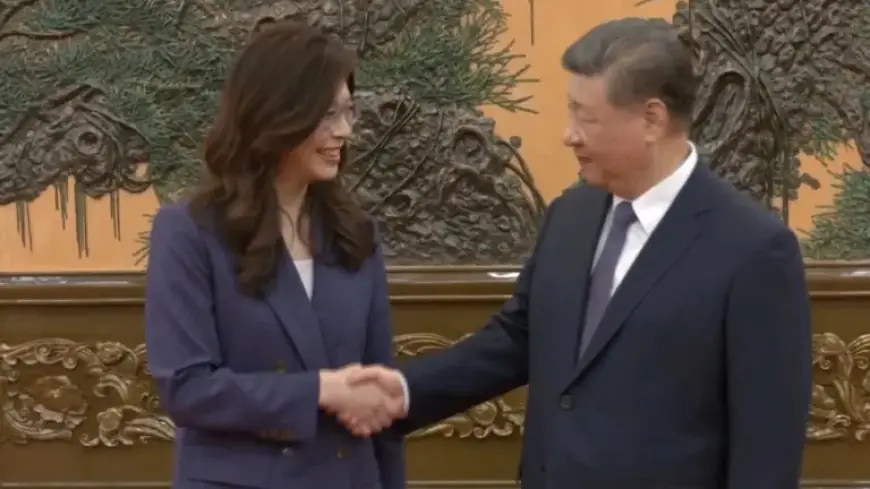
The recent meeting between Taiwanese opposition leader Cheng Li-wun and Chinese President Xi Jinping in Beijing has sparked significant discussions. Both leaders emphasized their opposition to Taiwan’s independence and expressed a mutual desire for peaceful resolutions concerning Taiwan’s future.
Overview of the Meeting
This meeting marks a pivotal moment in Taiwanese politics as Cheng is the highest-ranking Taiwanese leader to meet Xi since President Ma Ying-jeou’s encounter in 2015. The gathering took place at the Great Hall of the People, featuring both closed-door discussions and public remarks.
Key Insights from Cheng’s Remarks
- Cheng advocated for transcending political confrontations between Taiwan and China.
- She expressed hopes that the Taiwan Strait would transform from a conflict zone into a symbol of connection and peace.
- Her comments resonated with familiar Chinese Communist Party themes, praising past achievements like poverty eradication.
Xi’s Perspective
President Xi reiterated the historical and cultural ties between Taiwan and China. He stated that both regions share common roots and emphasized unity among all ethnic groups, including Taiwanese. He expressed readiness to work alongside the Kuomintang (KMT) for peace across the Taiwan Strait.
Opposition to Foreign Interference
Both Cheng and Xi condemned external interference in Taiwan-China relations, particularly referencing U.S. involvement. Cheng hinted at a potential slowdown in Taiwan’s military development, which aligns with KMT’s stance against a defense-oriented approach.
Wen-ti Sung, a fellow with the Atlantic Council, noted that Cheng’s proposition of “institutional arrangements for war prevention” indicates her reluctance to support aggressive military spending or arms acquisitions, which has been a contentious issue in Taiwan’s legislature.
Defensive Spending Controversy
- The KMT has blocked a $40 billion budget aimed at acquiring U.S. military weapons, proposing a smaller $12 billion alternative instead.
- Current Taiwanese President Lai Ching-te criticized the KMT for avoiding cross-party negotiations and delaying defense budget approvals.
Tensions in Cross-Strait Relations
Despite Cheng’s calls for reconciliation, the ruling Democratic Progressive Party (DPP) warns against complacency with China’s increasing military maneuvers around Taiwan. Lai stated that history shows compromising with authoritarian regimes leads to weakened sovereignty and democracy.
The Cultural and Historical Context
The KMT and the Chinese Communist Party have a tumultuous history, including a civil war during the 20th century. The KMT retreated to Taiwan after losing to the CCP, and the unresolved conflict continues to shape current tensions.
Cultural Identity and National Sentiment
Taiwan’s national identity has evolved dramatically since the 1990s. A 2025 survey indicated that 62% of respondents identified solely as “Taiwanese.” This marks a significant rise from 17.6% in 1992, while the identification with both “Taiwanese and Chinese” declined significantly.
Conclusion
Cheng’s meeting with Xi Jinping illustrates an attempt at reconciliation amidst a complex historical backdrop. However, significant differences in national identity and political aspirations remain evident, marking ongoing challenges in Taiwan-China relations.