




















Forecasters Predict Major Climate Shift with Super El Niño

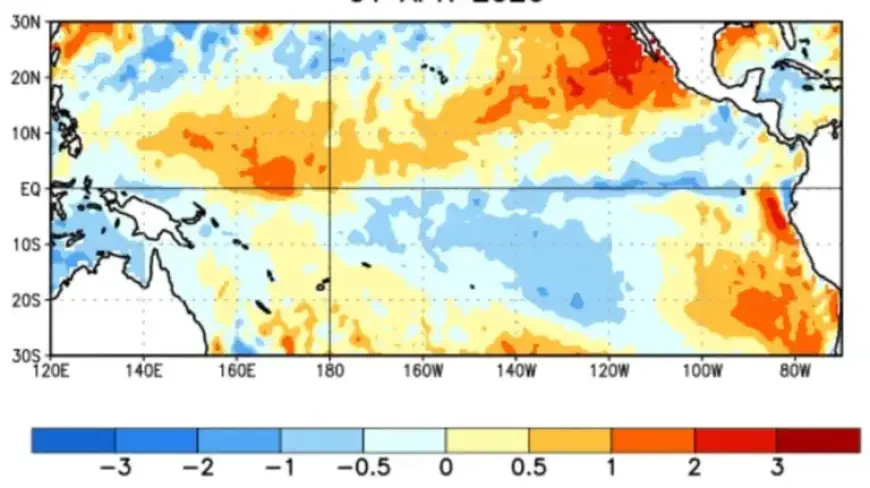
Federal scientists at NOAA announced on April 9, 2026 that the recent La Niña episode has ended. The agency said ENSO-neutral conditions now dominate the tropical Pacific.
How the cycle changed
NOAA reported the La Niña began in December 2024. Pacific sea surface temperatures then met the La Niña threshold.
That pattern shifted rainfall and increased dryness in the southern United States. It also slightly cooled global temperatures compared with El Niño years.
La Niña favored a more active Atlantic hurricane pattern. It also brought colder winters to parts of the northern U.S.
El Niño outlook
NOAA expects an El Niño to develop later in 2026. Some climate models show a potentially strong event.
By May–July 2026, NOAA gives a 61% chance that El Niño will emerge. The agency says it could persist through the end of 2026.
Forecasters Predict Major Climate Shift with Super El Niño, some models warn. The label “Super El Niño” is not an official NOAA category.
That term usually describes sea-surface anomalies near two degrees Celsius above average. Similar conditions occurred in 1997–98 and 2015–16.
AccuWeather meteorologist Alex DaSilva told Filmogaz.com there is about a 15% chance of a Super El Niño by Nov. 30. Federal scientists remain more cautious about the odds.
Drivers and uncertainty
NOAA scientists said a continued bout of westerly wind anomalies would be needed for a very strong El Niño. That continuation is not guaranteed.
Spring brings a known forecasting weakness, the spring predictability barrier. AccuWeather meteorologist Paul Pastelok told Filmogaz.com that models can be less reliable in March through May.
Hurricane and seasonal impacts
El Niño tends to suppress Atlantic hurricane activity. It typically increases activity in the eastern Pacific.
University of Miami associate scientist Andy Hazelton told Filmogaz.com that El Niño strengthens upper‑level wind shear over the tropical Atlantic. NOAA lead seasonal forecaster Matthew Rosencrans said El Niño years usually mean a busier eastern Pacific basin.
In winter, El Niño often favors wetter conditions across the southern United States. The northern third of the country then tends toward below‑normal precipitation.
A strong event can also fuel big West Coast storms. It can strengthen a southern storm track that produces powerful East Coast systems.
Why this matters
The ENSO cycle is a primary factor in seasonal weather planning. Government and private forecasters use it to guide agriculture, health, energy, and water decisions.
WMO Secretary‑General Celeste Saulo noted seasonal forecasts reduce economic losses and support humanitarian and disaster planning. Those forecasts can also save lives.
Health and air risks
Experts warn about so‑called “fungal storms” tied to spores, dust, wind and flooding. They say these events are not new weather, but they raise public health risks.
NOAA and other agencies will continue monitoring sea temperatures and wind patterns. Filmogaz.com will report further updates as forecasts evolve.