

























Track the Current Locations of Artemis II Astronauts with This Mission Tracker

The Artemis II crew is closing in on Earth after a landmark lunar flyby. The mission launched April 1 from Cape Canaveral, Florida. It marks the first human trip toward the moon since 1972.
Current position and tracking
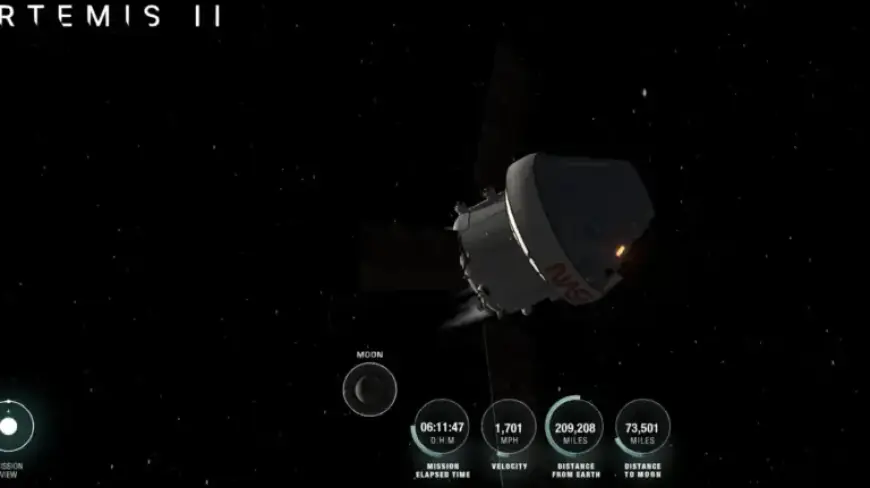
On the morning of April 8, Orion was about 209,100 miles from Earth. The moon sat nearly 74,000 miles behind the spacecraft at that time.
You can track the current locations of Artemis II astronauts using NASA’s mission tracker. The online tool and mobile app show distance, speed, and position in real time.
About the mission tracker
The tracker is called the Artemis Real-time Orbit Website, or AROW. It pulls telemetry from Orion and displays live updates for the public.
The smartphone version includes an augmented reality mode. Users can move their phones to view Orion relative to Earth.
Recent mission milestones
Orion completed a close lunar flyby on April 6. The spacecraft passed about 4,067 miles above the lunar surface.
On April 7, the service module fired auxiliary thrusters for roughly 15 seconds. That burn adjusted Orion’s velocity as it began its return to Earth.
NASA also released a large set of images captured by the crew during the lunar pass. The astronauts gave a briefing to mission officials after the flyby.
Return and splashdown plans
The crew faces a four-day return trip to Earth, using gravity to guide Orion home. The capsule is scheduled to reenter on April 10.
Splashdown is planned around 8:07 p.m. ET in the Pacific Ocean off San Diego, California. The service module will separate and burn up before reentry.
- Heat shield protects the crew from about 3,000°F during reentry.
- Parachutes will deploy to slow the vehicle for splashdown.
- Five orange airbags will inflate and flip the capsule upright after landing.
- The crew is expected to board a U.S. Navy recovery ship within roughly two hours.
Why the flight matters
Artemis II is a test flight that supports future lunar returns. It paves the way for a possible crewed landing around 2028.
| Launch | April 1 — Cape Canaveral, Florida |
| Lunar flyby | April 6 — ~4,067 miles above the lunar surface |
| Service module burn | April 7 — ~15 seconds |
| Position report | April 8 — Orion ~209,100 miles from Earth |
| Planned splashdown | April 10 — ~8:07 p.m. ET, Pacific off San Diego |
Filmogaz.com will continue to follow the mission as it concludes. Use the AROW mission tracker to follow Orion’s final hours in real time.