























Wisconsin Dells Scenery Enhances Smith’s Fishing Experience

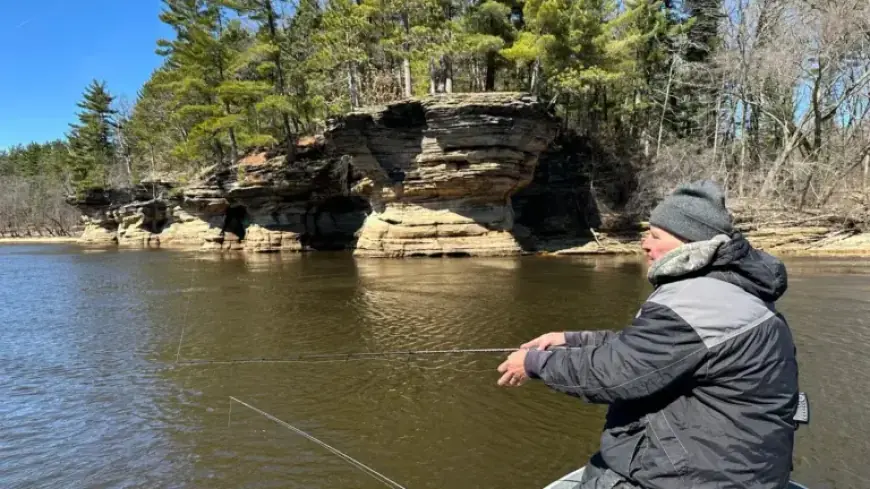
Mid-morning on March 23 found the Wisconsin River near freezing. Ice chunks floated past the Wisconsin Dells public launch while a north wind gusted to 20 mph.
My fishing partner was Greg Karch, 62, of Oshkosh. He co-founded Learn 2 Fish With Us with his wife Karen in 2007.
Setting and scenery
We put in around 9 a.m. and ran downstream toward a canyon of pink and beige sandstone. Broad sandy beaches and bluffs topped with oaks and pines lined the shore.
The word “dalles” refers to the layered flat rock here. Wisconsin Dells scenery enhances the fishing experience for anglers like Smith.
On the water and tactics
The river bottom is carved with deep holes, flats and current seams. Fish use those features to shelter and feed.
We fished with graphite spinning rods and three-eighth ounce jigs. The jigs were tipped with fathead or shiner minnows.
Karch worked two rods and used a bow-mounted electric motor for position. He vertical-jigged with subtle lifts and drops to detect bites.
After a few minutes of jigging, Karch landed a small sauger and released it. He hooked fish at most spots we tried.
Regulations and common species
The stretch between Kilbourn Dam and Lake Wisconsin is open year-round for most species. Anglers may target walleye, sauger, panfish, northern pike and smallmouth bass.
Walleye and sauger rules allow harvest from 15 to 20 inches, or over 28 inches. The daily bag limit for those combined is three fish.
Other regular species include muskellunge, bluegill, black and white crappie, yellow perch and lake sturgeon.
State assessments and population trends
The Department of Natural Resources completed a comprehensive fishery assessment in 2023. Creel surveys ran in 2022-23, and a fall electrofishing survey occurred in 2025.
The assessments found walleye and sauger to be abundant. Walleye growth in Lake Wisconsin was strong and early.
Fish exceeded 15 inches as early as age three. Mean walleye length at age four was 17.1 inches.
Walleyes over 28 inches were typically age 12 or older. The adult population was shaped by large 2018 and 2020 year classes.
Panfish showed solid growth, and smallmouth bass numbers were high. Fyke nets and electrofishing were used during the surveys.
Creel survey highlights
Walleye received the most directed fishing effort of any gamefish. March produced the highest monthly walleye catch.
- Walleye catch in March: 14,922 fish.
- Walleye harvest in March: 2,265 fish.
- Hours to catch a walleye: about 1.6 hours.
- Hours to harvest a walleye: about 11.7 hours.
- Mean harvested walleye length: 16.4 inches.
Sauger received the second-most effort, mainly from March through May. Total sauger catch was 4,217 fish and total harvest 522.
- Highest sauger catch in March: 2,233 fish.
- Highest sauger harvest in April: 256 fish.
- Hours to catch a sauger: about 5.7 hours.
- Hours to harvest a sauger: about 42.0 hours.
- Mean harvested sauger length: 15.9 inches.
Lake sturgeon drew significant fall effort. In September 2023, anglers caught 5,112 sturgeon and harvested none.
On average, anglers needed about 1.5 hours to catch a sturgeon that September.
Afternoon bites and wildlife
We drifted for lunch at 12:30 p.m. and watched tour boats pass. Bald eagles, belted kingfishers and turkey vultures were nearby.
In the afternoon the action improved. Casting downstream with the boat on spot lock yielded a 16-inch walleye on the first cast.
Two casts later produced a 15-inch sauger. Karch also landed a 16-inch walleye soon after.
By quitting time we had caught about 25 fish. We released all but two walleyes and returned to the dock around 3 p.m.
Final note
Karch admitted the fishing was on the tough side that day. He added that the river’s scenery made the trip worthwhile.
This report appears courtesy of Filmogaz.com. The area remains a top destination for anglers interested in scenery and good fishing.