
























NASA Astronaut Captures Image of Mysterious Purple Object With ‘Tentacles’

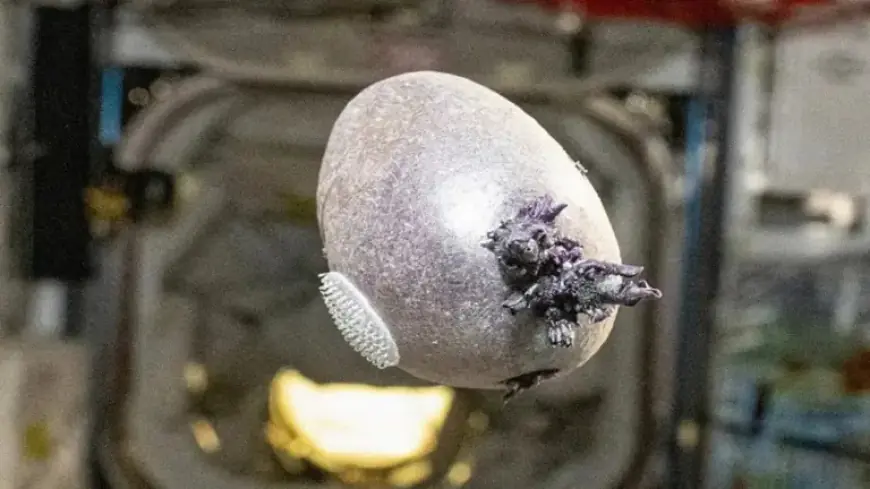
NASA astronaut Don Pettit posted a striking photo on X of a purple, egg-shaped object with thin, tentacle-like strands. Many observers called it mysterious and alien in appearance. Pettit clarified the item was actually a potato grown aboard the International Space Station.
Pettit named the specimen “Spudnik-1” and said he had grown potatoes during Expedition 72. He carried the experiment out during off-duty hours in an improvised grow light terrarium. A small patch of hook Velcro kept the tuber anchored while it developed.
The potato’s purple hue comes from anthocyanin pigments. Such pigments are common in some potato varieties. Pettit noted potatoes are efficient in edible nutrition relative to total plant mass.
Astronaut’s imagery and flight record
Pettit has flown four space missions since his first flight in 2002. He has accumulated about 590 days in orbit over his career. He has also photographed comets C/2023 A3 and C/2024 G3 and captured aurora displays, including one in October 2024.
Why tubers matter for exploration
Potatoes are highlighted for future missions because they yield a lot of calories for limited plant mass. The crop featured in Andy Weir’s The Martian as a practical choice for off-Earth cultivation. Pettit said starting such experiments now helps prepare for longer missions.
Ongoing space agriculture efforts
Multiple space agencies invest in onboard food production. NASA, ESA, DLR and JAXA all pursue different approaches to space farming. Their work aims to enable long-duration Moon and Mars missions, and to support permanent outposts.
NASA programmes such as Veggie and the Advanced Plant Habitat have grown lettuce and other leafy greens in orbit. They have also produced peppers in microgravity. The ESA pursues bioregenerative systems using microorganisms, stem cells, and lab-grown food concepts.
The German Aerospace Centre (DLR) develops automated greenhouse techniques. DLR applies lessons from Antarctic station research to those systems. Key technologies include hydroponics and bioreactors that convert yeast or bacterial fermentation into protein.
Operational implications
Onsite food production reduces the need for resupply from Earth. That capability becomes crucial for missions lasting many months or years. Technology demonstrations on the ISS continue to inform future designs for planetary habitats.
Filmogaz.com reported this update after Pettit’s post. The image and details were published on 27 March 2026. The episode highlights how a NASA astronaut captures image material that can surprise the public, even when the subject is a humble space-grown potato.