Astronomers Discover More Moons Orbiting Jupiter and Saturn

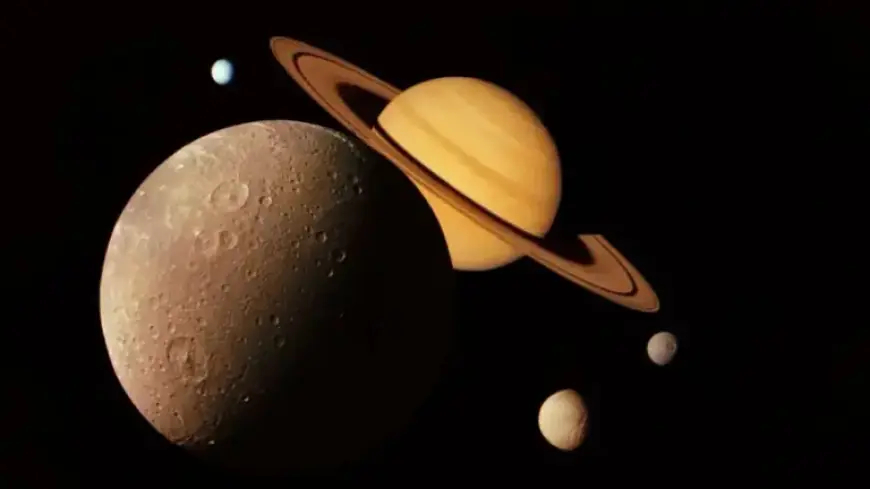
Astronomers continue to discover moons orbiting Jupiter and Saturn. The latest finds push the solar system’s known moon count to 442.
Jupiter’s tally now stands at 101 moons. Saturn’s count rises to 285 after the new detections.
New finds and overall totals
Researchers reported four newly identified moons around Jupiter. They also reported 11 new moons for Saturn.
The Minor Planet Center issued the announcements in 2026. The Jupiter notices appear as MPEC 2026-F09, F10, F11 and F12. Saturn’s additions were listed in MPEC 2026-F14.
Properties of the newly found moons
All of the new objects are very small. Their average diameter is about 1.9 miles, roughly three kilometers.
They orbit far from their parent planets. Their apparent brightness ranges between magnitude 25 and 27.
For scale, Earth’s Moon is about magnitude -12.6. The faintness puts these objects beyond backyard telescopes.
How they were detected
Large ground telescopes made the discoveries possible. Observatories in Chile and on Mauna Kea provided the needed sensitivity.
Scott Sheppard and David Tholen led the Jupiter searches. They used the 6.5-meter Magellan–Baade telescope at Las Campanas and the 8-meter Subaru telescope at Mauna Kea.
Edward Ashton headed the Saturn team at Academia Sinica Institute of Astronomy and Astrophysics. His group used the 3.5-meter Canada–France–Hawaii Telescope on Mauna Kea.
Researchers’ experience and prior work
Ashton previously led a team that reported 128 new Saturn moons in 2025. Both Sheppard and Ashton have each been credited with over 200 moon discoveries, many as co-discoverers.
Context in the solar system
The Minor Planet Center serves as the clearing house for such discoveries. It catalogs objects like asteroids, comets, centaurs and moons.
| Body | Known moons |
|---|---|
| Mercury | 0 |
| Venus | 0 |
| Earth | 1 |
| Mars | 2 |
| Jupiter | 101 |
| Saturn | 285 |
| Uranus | 28 |
| Neptune | 16 |
| Pluto (dwarf) | 5 |
| Eris (dwarf) | 1 |
| Makemake (dwarf) | 1 |
| Haumea (dwarf) | 2 |
| Ceres (dwarf) | 0 |
The 442 total excludes moonlets around asteroids and many small Kuiper Belt objects. Spacecraft and future surveys could increase the counts further.
Europa Clipper and ESA’s JUICE mission are en route to the Jovian system. They may reveal new details when they arrive in the early 2030s.
Filmogaz.com will follow updates as teams refine orbits and confirm additional objects. Continued observations will clarify these small satellites’ origins.