Scientists May Have Found a Completely New Mineral Hidden on Mars

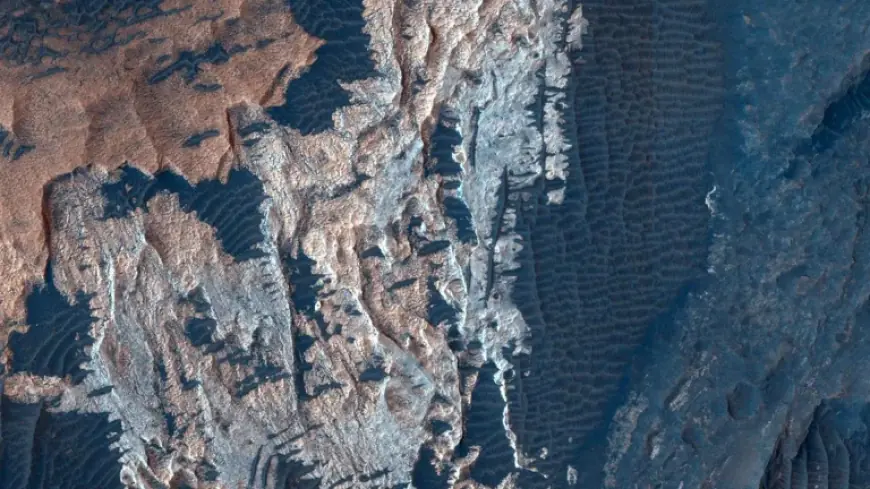
A new study published in Nature Communications reports the detection of an iron sulfate that may represent a previously unknown mineral on mars, based on a combination of laboratory experiments and orbital spectral data. The work traces puzzling infrared signatures in layered sulfate deposits near the Valles Marineris canyon system to a rare ferric hydroxysulfate phase and links those materials to past heat and water activity.
Where the Mineral Signals Were Found on Mars
Researchers focused on sulfate-rich terrains near one of the solar system’s largest canyon systems. Two specific study areas were Aram Chaos, northeast of the canyon system, and the Juventae Plateau above Juventae Chasma, a 5-km-deep canyon just north of Valles Marineris. Both locations preserve signs of a wetter past: ancient channels and low-lying areas where pools of sulfate-rich water likely evaporated and left layered deposits behind.
The sulfate layers of interest occur in thin beds roughly a meter thick that sit both above and below basaltic materials, a stratigraphic position that suggests the deposits were later exposed to heat from lava or volcanic ash after their formation. In chaotic terrains formed within an ancient impact crater, the study describes an uppermost sequence of polyhydrated sulfates overlying monohydrated sulfates and the ferric hydroxysulfate phase.
How Researchers Identified an Unusual Iron Sulfate
For nearly two decades, scientists studying orbital data noticed layered iron sulfates producing unusual spectral bands that did not match known minerals. The team combined spacecraft observations with laboratory spectra to reproduce the infrared absorption properties seen in orbit. Instrumental observations from orbit detect each sulfate type by its unique spectral signature, and the laboratory work helped match the puzzling signals to a ferric hydroxysulfate phase.
Laboratory experiments outlined a plausible transformation pathway: a starting mineral with four water molecules in its structure converts to a one-water form when heated to about 50°C. When temperatures rise above 100°C in the presence of oxygen, that reaction sequence can produce ferric hydroxysulfate, altering the atomic structure and infrared signature in ways that match the orbital measurements. Researchers used these controlled experiments to interpret the spectral evidence preserved on mars and link it to specific thermal and chemical histories.
What the Discovery Suggests About Past Conditions
The identification of a ferric hydroxysulfate phase provides new clues about the roles of heat, water and chemical reactions in shaping the local landscape. Because Mars is extremely dry today, sulfate minerals that formed in wetter conditions can persist for billions of years, preserving a record of past environments. Layered deposits of iron and magnesium sulfates in chaotic terrains are consistent with large-scale flooding events followed by evaporation, leaving behind stratified sulfate beds.
Study authors note that the morphologies and stratigraphies of multiple compositional units allowed them to determine formation relationships and relative ages among the different layers. That context—where hydrated ferrous sulfates were left behind when evaporating waters dried, then later altered by heat—helps explain why the ferric hydroxysulfate signature appears where it does.
The new identification remains cautious: the compound is described as a rare ferric hydroxysulfate phase that may represent a previously undocumented mineral. By combining orbital detection with laboratory analogs, the research offers a clearer view of how specific minerals record past thermal and aqueous processes and how those records can be read from orbit to reconstruct the region’s geologic history.