White Bald Eagle photos in Missouri spotlight a rare genetic condition

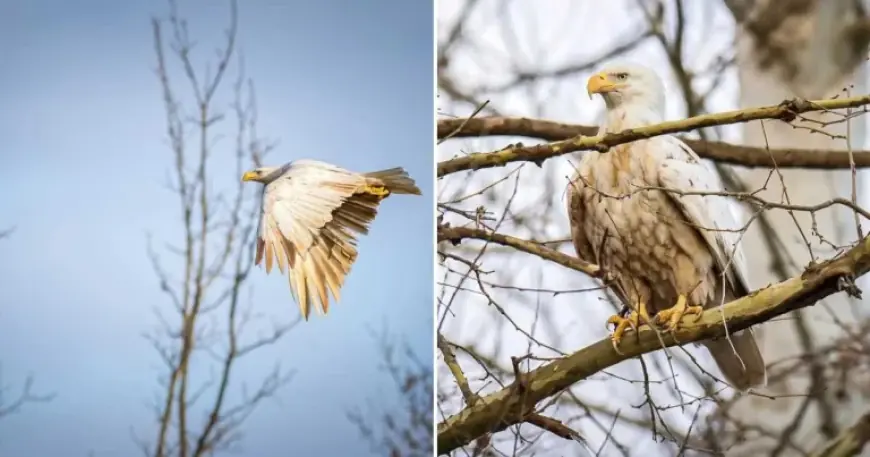
Wildlife photographer Terry Nunn spent eight hours waiting in Southwest Missouri for a closer look at a white bald eagle he had been trying to photograph for weeks. The patience paid off late in the day, when a young female flew in, perched on a treetop, and gave him a narrow window to shoot a series of images. The result was not just a personal milestone for Nunn, but a viral-style moment that pushed a little-known condition—leucism—into broader public view.
Terry Nunn’s eight-hour wait
Nunn, who posts under @terrynunnphotography, described the experience in visceral terms: a pounding heart, trembling fingers, and hands shaking as the bird moved through the trees and finally passed within range. He wrote that he spent “8 hours watching her fly to a few different trees” and that she eventually came “within a couple hundred yards, ” the best opportunity he had managed across multiple trips to the area. His Canon gear was already set up when the moment arrived, allowing him to capture photographs spanning flight, perching, and close detail of the bird’s pale plumage.
The sequence matters because it frames the images as the product of repeated field attempts rather than a lucky snapshot. The pattern suggests the photographs resonated partly because the effort is easy to understand: one subject, one narrow chance, and an entire day committed to getting it right. Nunn called the set some of the photos he is most proud of in his career, not because they are “perfect, ” but because of what it took to make them and the subject itself.
“Ghost of the Ozarks” leucism
The eagle Nunn photographed has been dubbed one of the “Ghosts of the Ozarks, ” a label tied in the context to leucistic white bald eagles seen in the region. The condition described is leucism, identified as a rare genetic condition associated here with a complete lack of melanin and unusual red eyes, with the National Eagle Center and Sequoyah National Wildlife Refuge cited in the context as explainers of the phenomenon. The bird’s appearance—clusters of blonde feathers and white tail—makes it visually distinct enough that viewers shared the images widely online, with the pictures “making the rounds on the internet. ”
That attention can easily blur the line between aesthetic fascination and biological explanation. Yet the context repeatedly anchors the bird’s look in genetics, describing pigmentation changes that produce the pale feathers and other features. The figures point to why the moment is treated as exceptional: a separate account in the provided context places the odds of seeing a leucistic bald eagle at about 1 in 30, 000, illustrating how unlikely it is for most people to encounter such a bird in the wild.
Even within the same topic, the context shows how quickly discussion turns to definitions. One description contrasts albinism and leucism, and also mentions piebaldism, emphasizing that multiple pigmentation-related conditions exist, but differ in how they affect appearance. In this case, the images circulating are attributed to leucism, reinforcing that the “all-white” look commonly used as shorthand is being connected to a specific condition rather than a generic label.
Missouri images and online attention
The photographs themselves vary in positioning, background, and movement. Some depict the young female in flight against “azure skies, ” while others show her on a treetop, partially obscured by “tangles of spindly branches” that mask her pale profile. Those variations work like a built-in narrative: the bird is not posed or staged, and the environment remains part of the story, including the distance Nunn noted as his best chance.
Public response is described in the context as awe, wonder, and curiosity—an emotional reaction that can act as a gateway to deeper interest in wildlife and the conditions that shape what people see. The pattern suggests the same element that made the event meaningful for Nunn—rarity—also fuels its shareability. A white bald eagle is an instantly legible visual anomaly, and the phrase “Ghost of the Ozarks” gives that anomaly a memorable identity that travels with the images.
What remains open is the most basic follow-up: whether Nunn will photograph the same leucistic eagle again on a later trip to Southwest Missouri, and whether additional sightings will add clarity to how many of these “Ghosts of the Ozarks” are in the area. If the odds cited—about 1 in 30, 000—hold in the way the context frames them, then each confirmed encounter will likely keep generating the same mix of fascination and debate over how to describe what people are seeing.