Aep Power Outage leaves thousands in the dark as winds push east

The aep power outage is part of a wider disruption spreading with an intensifying weather system, as more than 90, 000 customers across the region were without electricity early Friday. The same powerful winds that helped trigger outages also slowed travel, with delays building at major Midwestern airports. The storm’s path stretches across the Upper Midwest, the Great Lakes, and into the Ohio Valley.
Aep Power Outage and the customers caught in a fast-moving wind field
Early Friday, more than 90, 000 customers were without power across Minnesota, Wisconsin, Illinois, and Michigan as strong winds swept through. Those outages formed one of the first clear signs of how broad the wind field had become, with gusts tied to an intensifying clipper moving steadily east. While the context does not specify which utility territories were affected, the scale of the number underscored how quickly electricity service can be interrupted when winds climb and infrastructure is stressed.
Air travel felt the same force. Strong gusts led to significant delays originating in Midwest hubs, and by mid-morning more than 230 flights were delayed into or out of Chicago O’Hare International Airport. For travelers, that meant the wind event was not only a local power problem but a regional logistics problem, with schedules disrupted as the system crossed multiple states.
The reach of the storm extended beyond a single corridor. Chicago, Minneapolis, and Milwaukee were under High Wind Warnings through much of Friday afternoon as the strongest winds pushed into the Ohio Valley and the interior Northeast. The storm was expected to carry its strongest winds farther east through the day Friday, with the interior Northeast and New England in its line.
Chicago O’Hare International Airport delays show how wind affects daily movement
In the Midwest, the travel impacts provided a day-to-day measure of the storm’s intensity. More than 230 flights were delayed into or out of Chicago O’Hare International Airport by mid-morning, a snapshot of how high winds can ripple into crowded transportation networks. The context links those delays to the same strong gusts that accompanied the broader outage picture across the region.
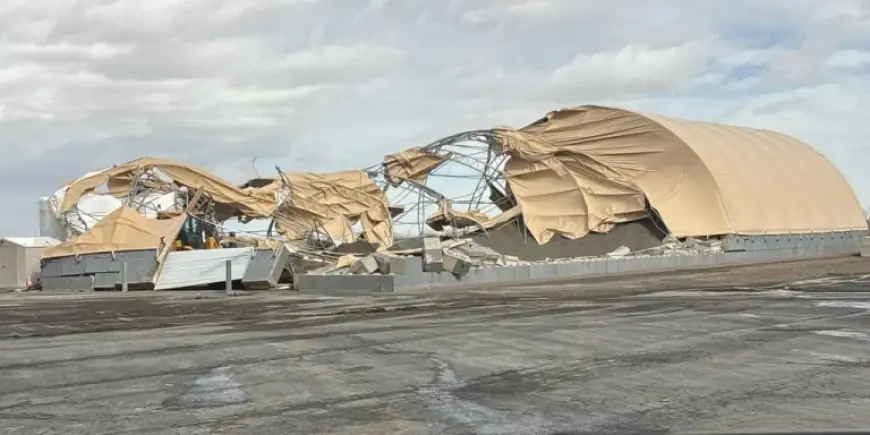
Wind also played a role in ground hazards earlier in the event. On Thursday, extreme gusts topped triple digits in parts of the Northern Plains. Winds reached 109 mph in Centennial, Wyoming and 104 mph in Hilger, Montana. A 92 mph gust in Cheyenne, Wyoming set a new daily record. The same period of intense wind shredded a salt shed in Arlington, Wyoming, and the conditions were powerful enough to topple trucks on Interstate 70 and another highway in Jefferson County, Colorado.
That history matters because the storm was still evolving as it moved east. The vicious winds were attributed to rapidly intensifying low pressure at the center of the clipper, creating a steep pressure drop that caused air to rush in behind the system as it raced eastward. In other words, the mechanics driving the damage and delays in the Plains were also powering the expanding wind field headed toward the Great Lakes and Ohio Valley.
Columbus and Pittsburgh in the path as winds ease, then ramp up Saturday night
The storm’s next stage pointed directly at cities in the Ohio Valley and farther east. Later Friday, the wind field was expected to broaden, bringing 50 to 60 mph gusts to cities like Louisville, Columbus, and Pittsburgh. That projection captured a key human reality of windstorms: even as some places see conditions shift hour by hour, other communities are only beginning to feel the strongest effects.
For now, the weather pattern is not a one-day story. Winds were expected to briefly die down before ramping up again Saturday night when a second winter storm moves into the Midwest. That second system, arriving behind the first, raised the prospect of renewed stress for communities already dealing with outages and disruptions.
Snow, meanwhile, was expected to stay mostly north of Interstate 94. In that zone, the combination of wind and snow could lead to brief but intense periods of whiteout driving conditions. Snow totals could reach 5 to 8 inches primarily north of Interstate 94, with the heaviest snow confined to the Great Lakes, where over a foot of snow was possible.
As the day unfolded, the aep power outage remained tied to a larger picture: a fast-moving windstorm whose impacts were already visible in tens of thousands of customers without power, hundreds of delayed flights, and a forecast that carried the strongest gusts toward more cities before the next system arrives Saturday night.