Jacksonville Weather: Record heat clashes with drought as rain chances rise

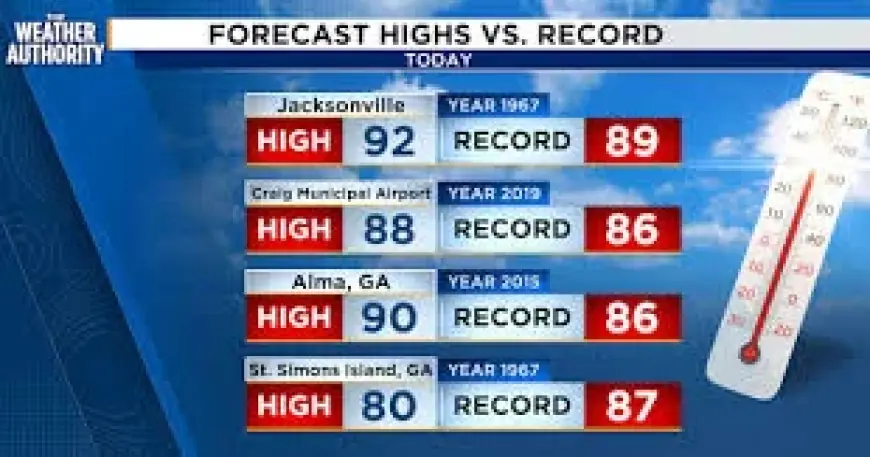
Jacksonville weather has turned summerlike, with back-to-back record highs even though spring is still nine days away. Yet the same forecast calling for “beneficial rain” underscores a competing reality: the area remains under an Extreme Drought and a Phase II Severe Water Shortage, meaning a wetter outlook does not automatically translate into immediate relief.
Richard Nunn’s Jacksonville Weather forecast shows 92 degrees, then a Friday shift
Confirmed conditions in Jacksonville have been unusually hot. Richard Nunn, identified as chief meteorologist, said another record high was set at JAX when temperatures reached 92 degrees, topping the previous record of 89 degrees set in 1967. The forecast then pivots sharply: temperatures are expected to drop to near seasonal averages following rain on Friday, with breezier and cooler conditions settling in.
The near-term timeline is specific. “Tonight” is described as mild with clearing skies and patchy fog. Thursday brings the most aggressive rain signal: cloudy conditions with rain chances becoming widespread through the afternoon and evening, and scattered showers possible through late evening. Morning lows are forecast in the 60s, with afternoon highs in the 70s to 80s. Rain chances are listed at 90 to 100 percent, with southwest winds at 10 to 15 mph and stronger gusts.
Friday is forecast as breezy and cooler, with a slight chance of showers at 10 to 20 percent. Lows are expected in the 40s and 50s for southeast Georgia and in the 50s for northeast Florida, with afternoon highs in the 70s to low 80s inland and 60s along the beaches. Winds turn northeast at 10 to 20 mph, a change Nunn links to increasing onshore wind on Friday and Saturday that could keep coastal counties under a slight chance of a passing shower.
Extreme Drought and Phase II Severe Water Shortage undercut “beneficial rain” messaging
The central tension inside the forecast is documented in two parallel statements: rain is described as “beneficial, ” but the area is simultaneously described as remaining under an Extreme Drought and a Phase II Severe Water Shortage. That combination creates a gap between the promise of upcoming rainfall and the persistence of restrictions.
Confirmed restrictions include landscape irrigation limited to one day a week, plus a directive not to water between 10: 00 a. m. and 4: 00 p. m. ET. The context does not confirm any planned change to those limits, even as rain chances increase. That matters because the forecast language could be read as signaling near-term relief, while the continuing drought designation suggests officials and residents are still operating under severe conditions.
Rainfall expectations add another layer. Rainfall models are said to average around 0. 50 to 1. 5 inches over the next seven days, while also leaving room for localized higher totals because slow-moving thunderstorms are possible. The forecast, in other words, contains both an averaged range and an acknowledgment that some places could see more. What remains unclear is how uneven rainfall might affect drought conditions across different neighborhoods or counties, because the context provides no location-by-location projections.
JAX rain timeline through Tuesday highlights uncertainty after the Thursday surge
A documented pattern in the forecast is a strong Thursday rain signal, followed by lower odds Friday and a rebuilding chance into Sunday. Rain chances are expected to increase through Sunday afternoon as scattered showers and thunderstorms develop to the south and push north across the area through early evening. For the weekend, Saturday carries a slight chance of showers at 20 percent, while Sunday’s chance increases to 60 to 70 percent. Morning lows are projected in the 50s and 60s, with afternoon highs in the 70s to low 80s.
Still, the timing and intensity beyond Thursday are not framed as a single continuous soaking event. Scattered showers and areas of light rain are expected to continue through early Monday, before cooler temperatures return on Tuesday. That sequence suggests multiple waves rather than one uninterrupted period of heavy rain, even though Thursday’s rain chances are described as widespread and near-certain.
The context also flags a risk that complicates water planning: slow-moving thunderstorms “will be possible. ” That phrasing supports the possibility of downpours that boost totals in some areas while leaving other areas closer to the lower end of the model average. The context does not confirm where those slow-moving storms might occur, or whether the heaviest rainfall would align with the areas most affected by drought.
One evidence threshold would clarify whether Jacksonville weather is actually pivoting from record heat toward meaningful drought relief: observed rainfall totals over the next seven days compared with the forecast model range of 0. 50 to 1. 5 inches. If totals land near the upper end in a broad, consistent way, it would establish that the “beneficial rain” described in the forecast was not just a short-lived Thursday surge, but part of a sustained pattern capable of supporting recovery even as restrictions remain in effect.