Jerry Garcia Tiger Guitar sale resets the high end of music-auction pricing

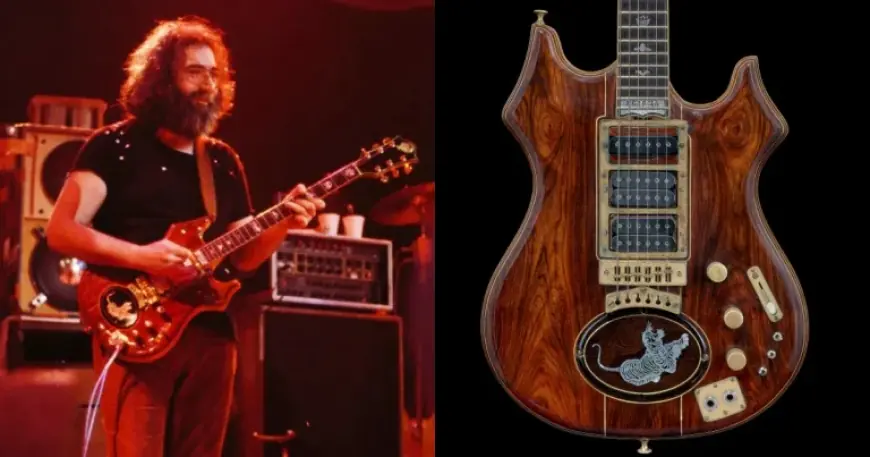
At Christie’s in New York on Thursday, the jerry garcia tiger guitar sold for $9, 500, 000, or $11, 560, 000 including fees, crushing its $1 million to $2 million pre-sale estimate as part of the Hall of Fame live auction of late Jim Irsay’s collection. The same auction night also produced a new top guitar price, signaling that bidders are willing to blow past estimates when a trophy instrument has unusually strong cultural gravity.
Christie’s New York, Jim Irsay
The sale placed Tiger among the most valuable guitars ever sold at auction, and it did so in a way that mattered as much as the total: it surpassed the estimate by a wide margin and also sold for more than twelve times what Jim Irsay paid for it in 2002, when he bought the instrument for $957, 500. The figures point to a market dynamic where the headline price is driven less by typical comparables and more by scarcity and narrative—especially when a single lot is understood as a once-in-a-generation artifact rather than just a high-end instrument.
Christie’s declined to confirm the buyer’s identity, leaving the purchase’s long-term outcome—public display, private storage, or active use—formally unconfirmed. Still, a circulating social media video appears to show Bobby Tseitlin of Timeless Gem and Family Guitars as the winning bidder, with guitarist Derek Trucks seated beside him and congratulating him as the hammer fell; neither Tseitlin nor Family Guitars immediately responded to a request for comment. The pattern suggests that in this tier of auctions, even when a final invoice is clear, the downstream story can remain partly opaque because key details depend on voluntary disclosure.
Doug Irwin, Tiger, and 1979
Beyond the price, the instrument’s documented timeline helped sharpen its appeal. Built by master luthier Doug Irwin over six years and completed in 1979, Tiger served as Jerry Garcia’s primary instrument throughout the 1980s and was described as holding a singular place in Grateful Dead history. The detail matters because it frames Tiger not as a peripheral collectible but as a working centerpiece tied to a defined period—an attribute that can magnify bidding when multiple motivated buyers chase the same kind of “anchor” object.
One commonly repeated performance claim around Tiger has also been refined. It had long been believed that Garcia played Tiger during the final encore of his last show with the Grateful Dead at Chicago’s Soldier Field on July 9, 1995. Longtime road manager Steve Parish recently clarified that Tiger’s final appearance came earlier, at the Warfield Theater in San Francisco on April 23, 1995, during a Jerry Garcia Band show, when Garcia reached for Tiger after his primary guitar, Rosebud, developed technical problems late in the set. That specificity can change how a buyer—and the market—values the story attached to the instrument: the most compelling provenance is not always the most famous version, but the best-supported one.
David Gilmour’s Black Strat benchmark
Tiger was not the night’s top instrument by price, and that context is part of what makes the result consequential. David Gilmour’s “Black Strat, ” a 1969 Fender Stratocaster closely associated with Pink Floyd’s defining recordings, sold for $12, 100, 000, or $14, 550, 000 including fees, far above its $2 million to $4 million estimate and becoming the world’s most valuable guitar ever sold at auction. The sale also bested the previous record of $6, 010, 000 set in 2020, when Kurt Cobain’s Martin D-18E used during Nirvana’s MTV Unplugged performance sold at auction.
Read together, the results map a clearer hierarchy in top-end guitar pricing: an all-time record for Gilmour’s Black Strat, with the jerry garcia tiger guitar directly behind it as the second most expensive instrument of the evening. The figures point to a market where estimates can function more like opening suggestions than guardrails when the lots are tied to catalog-defining artists, and where multiple records can fall in a single event if bidders treat the auction as a rare chance to secure legacy objects.
The night’s other realized prices reinforced that this was not a one-lot anomaly. Cobain’s 1969 Fender Competition Mustang, played in the “Smells Like Teen Spirit” music video and estimated at $2. 5 million to $5 million, realized $6, 907, 000. Eric Clapton’s Martin 000-42 used for his MTV Unplugged appearance fetched $4, 101, 000. With several marquee instruments clearing estimates, the pattern suggests that demand was broad across multiple artist legacies, not confined to one headline guitar.
The next confirmed milestone is that Christie’s “The Jim Irsay Collection” is scheduled to run from March 3 to March 17, and Thursday’s live auction was part of “The Jim Irsay Collection: Icons of Popular Culture. ” If the same bidding intensity holds across the remaining dates, the data suggests additional lots could challenge their pre-sale estimates as well, but which items do so—and by how much—remains the open, named question until the series concludes on March 17.