Kc-135 refueling sighting offers a rare glimpse of the B-21 test push

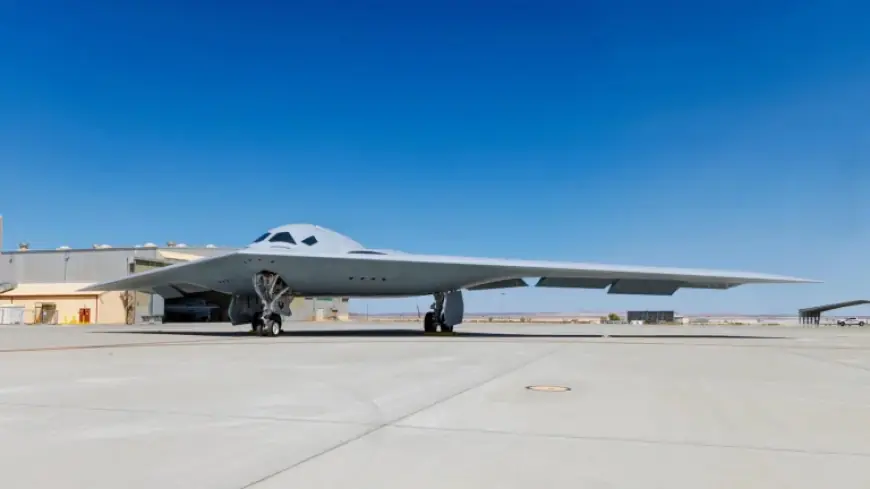
In images shared online, a B-21 Raider prototype sits tucked behind a kc-135 Stratotanker over California’s Mojave Desert, taking fuel in mid-air. The moment is brief, but it lands heavily for anyone tracking a program that rarely shows itself in public. It also arrives as the Department of the Air Force moves to speed up B-21 production with Northrop Grumman.
Ian Recchio and Jarod Hamilton capture a B-21 over the Mojave Desert
The photographs, credited to aviation photographers Ian Recchio and Jarod Hamilton, show the U. S. Air Force’s next-generation B-21 Raider flying behind a tanker during an aerial refueling operation. Another aircraft, an F-16, appears in the images as a chase plane, a role commonly used during flight testing to visually monitor the test platform and provide safety oversight.
The tanker in the photos is identified as a KC-135 Stratotanker, with the B-21 taking fuel while airborne over the Mojave Desert. The aircraft and the setting together offer what the context describes as a “rare and fleeting glimpse” into one of the Pentagon’s most secretive aircraft programs, made visible only because enthusiasts and photographers spotted the event and shared the images on social media.
The sighting is described as the first time the bomber has been visually documented taking fuel mid-air, a capability tied in the context to long-range strike missions. For observers, the significance is not a speech or a ceremony, but a simple sequence of frames: the bomber aligned behind the tanker, the test continuing in open sky.
March 10, 2026: KC-135 refueling tied to Edwards Air Force Base testing
The refueling mission took place on March 10, 2026, and lasted roughly five hours and 33 minutes. The aircraft was seen taking fuel from a specially equipped NKC-135 tanker operating out of Edwards Air Force Base in California. The context describes the episode as the first publicly observed aerial refueling for the B-21 Raider, turning a normally hidden test milestone into something the public could see.
That public visibility is limited to what the images can show, but the pieces outlined in the context form a clear picture of a flight test environment: a prototype bomber, a tanker configured for the mission, and a chase aircraft positioned to monitor the sortie. The flight’s duration underscores that this was not a quick pass for a photograph, but a lengthy test event captured only in fragments as it happened.
Even with the photos circulating, much of the program remains outside view. Still, the combination of location, aircraft types, and the tie to Edwards Air Force Base places the moment inside a familiar test-flight pattern: specialized support, careful oversight, and incremental demonstrations of capability.
Northrop Grumman and the U. S. Air Force accelerate B-21 production plans
The flight test glimpse comes as the Department of the Air Force pushes the B-21 program onto a faster production track. A new agreement with Northrop Grumman directs the manufacturer to speed up production of the aircraft, and its signing was publicly announced in February 2026. Under revised terms described in the context, Northrop Grumman will increase the annual production rate of the B-21 by around 25%.
The context also outlines near-term deliveries and a longer timeline: at least two test aircraft have been delivered so far, and the U. S. Air Force is slated to receive at least two more B-21 test aircraft in FY2026. With the updated agreement in place, the U. S. Air Force now expects to start fielding B-21s in 2027.
Those plans are tied to money already set in motion. The U. S. Air Force will spend an additional $4. 5 billion as part of the move, funding that had been authorized and appropriated under the FY2025 Reconciliation Act, also referred to in the context as the One Big Beautiful Bill. The intended effect, as described, is a faster acquisition pace than originally anticipated, more B-21s ready for future conflicts, and a compressed delivery schedule that should help keep the program from massively exceeding the projected budget.
In the longer arc described, the B-21 is positioned as the successor to the Northrop Grumman B-2 “Spirit, ” which carried the mantle for close to three decades as the only stealth bomber in the U. S. Air Force arsenal. The context states the B-2 remains operational and is part of the U. S. nuclear triad even in 2026, while also noting that the B-2s are slowly approaching retirement age and will need replacement in the years to come. Visually similar to the B-2, the B-21 features changes that include fewer engines and smaller dimensions.
In the end, the March 10, 2026 sighting boils down to a single, practical act: the B-21 taking fuel in the air from a tanker. It is also a reminder that the program’s biggest shifts may arrive not as public events, but as a combination of milestones—an aerial refueling captured over the Mojave Desert, and a February 2026 agreement that aims to move more aircraft from tests into the U. S. Air Force inventory on a faster schedule.