Tennis waste meets teen activism in a Southern California record attempt

A group of Los Angeles County high school students is asking the public to donate used tennis balls and pickleballs as they pursue a world record for recycling collections. The youth-led campaign, called “Another Bounce, ” is pairing a high-volume collection effort with pressure on manufacturers and local governments—an approach that treats sports waste as a systems problem, not just a cleanup project.
Another Bounce sets April 19 deadline
The students’ record attempt is designed around a specific sprint: a community collection event on April 19, with a goal of gathering donations by Earth Day on April 22. The collection footprint is defined, too. Donations are being gathered within a 30-mile radius of Pacific Palisades, while mailed contributions are accepted at a Santa Monica warehouse. Organizers have also arranged for local pickups that can be scheduled by Los Angeles-area players and clubs, with student volunteers handling the retrievals.
Those details matter because they reveal the basic constraint of the project: volume is only useful if it can be verified and stored. Sheila Morovati, founder and president of Habits of Waste, has said one of the challenges is simply keeping the balls somewhere until they can be counted. The pattern suggests the “world record” framing is doing double duty—motivating donors to give quickly while forcing the initiative to build credible logistics, including storage and tracking, at the same time.
A dozen students are leading the campaign through the newly launched Junior Board of Habits of Waste, a Brentwood-based nonprofit focused on changing habits and systems to combat climate change. In one account, the group first came together while helping rebuild their community after the devastating Palisades Fire, then redirected their momentum into this sustainability mission. Max Ehrman, a 15-year-old Brentwood School freshman and junior board member, has described the waste problem as one people often overlook.
Pacific Palisades teens target manufacturers
Another Bounce is not limiting itself to collection bins and drop-offs. The teens are also pushing for recycling improvements with ball manufacturers and elected officials in Southern California, and in one description they are managing “every aspect” of the initiative, from sponsorship outreach and logistics to data tracking and public policy engagement. Their advocacy includes speaking at city council meetings in Beverly Hills, Burbank, Santa Monica, Malibu, and Los Angeles to support ordinances that would require parks, schools, and private clubs to recycle tennis balls and pickleballs.
They are also directly targeting manufacturers, launching a public email campaign urging companies including Wilson, Penn, Franklin, Dunlop, and Selkirk to establish nationwide take-back and recycling programs. The figures point to why that demand is central to their strategy: the balls are described as not biodegradable and able to take more than 400 years to decompose. With that timeline, even a successful one-time collection drive would not, by itself, address what happens after everyday matches and practice sessions end across Southern California.
Morovati has framed the end goal as “true circularity, ” arguing manufacturers should ultimately take responsibility for recycling their own products into the next generation of gear. For now, organizations such as Ridwell and RecycleBalls are described as shredding and pelletizing collected balls into new products. That division of labor—third parties handling recycling while the campaign urges brand-level take-back—highlights an underlying question: who owns the waste stream once the sale is made and the ball is worn out?
Long Beach tennis shows the volume
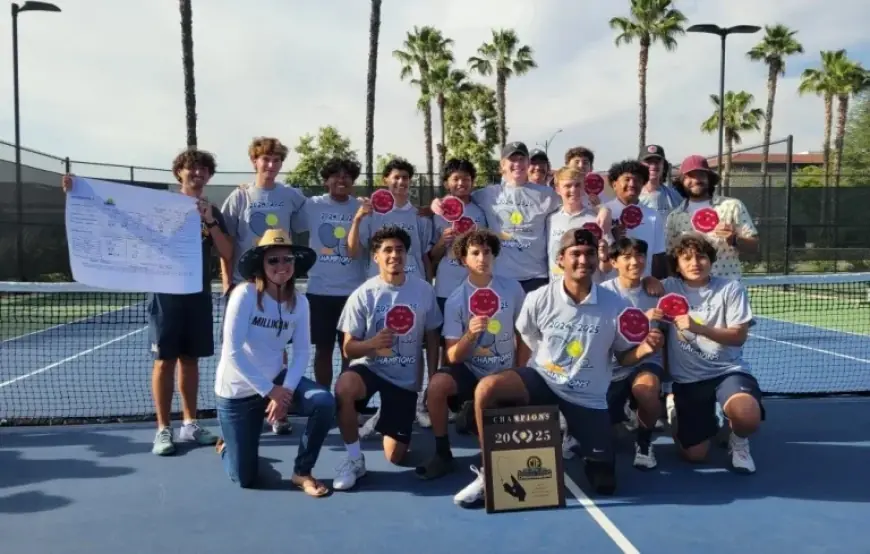
The push to keep balls out of landfills is colliding with a sports culture that is expanding in both participation and competitive intensity. In Long Beach, a preview of the 2025-26 Moore League boys’ season describes a “star-studded” class of players preparing to hit the courts, with programs chasing league titles and deep postseason runs. Millikan enters with confidence after a second CIF-SS Division 4 title in the past five years, while aiming to reclaim the Moore League title; head coach Spencer Pozgay also noted major roster turnover after 11 players graduated last spring. Long Beach Poly head coach Ricardo Montecinos has said his team is in contention for the league title, while the Bruins are trying to defend a three-time Moore League title with a largely new starting lineup under head coach Nick Medina.
That competitive churn—returning starters, varsity newcomers, and programs rebuilding lineups—helps explain why the teens’ sustainability message can travel through schools and clubs quickly. The pattern suggests that when sports participation is organized around constant training and match play, small items become big waste streams at scale, even if each individual player is only discarding a few balls at a time.
The scale described by the Another Bounce organizers is stark: an estimated 500 million tennis and pickleballs are thrown away each year worldwide, while 125 million tennis balls end up in U. S. landfills annually. Another set of industry estimates puts annual production at 500 million pickleballs and 330 million to 400 million tennis balls entering the market each year; one data point says only about 1% of tennis balls are ever recycled, and global estimates suggest 95% of all balls produced are either incinerated or sent to landfills. The numbers are being used as the campaign’s argument for why voluntary recycling alone may not be enough.
The next confirmed milestone is the April 19 Earth Month collection event, with the campaign aiming to hit its donation goal by April 22. If the storage-and-counting challenge holds, the data suggests logistics—not public awareness—could become the decisive factor in whether the world record attempt can be validated at the scale the students are targeting.