Brent Crude Oil Price Today: Hormuz Crisis Sends Oil From $119 to $87 in 48 Hours as Energy Secretary's Deleted Post Triggers 17% Flash Crash

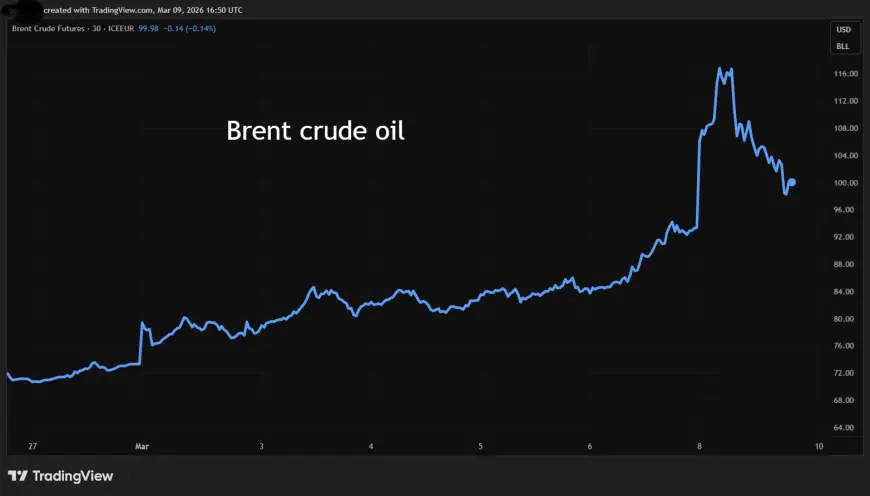
The Brent crude oil price has endured its most violent two-day swing since Russia invaded Ukraine in 2022 — spiking to $119.50 per barrel Monday before crashing back to settle at $87.80 Tuesday, a collapse driven by Iran war fears, diplomatic signals from President Trump, and a since-deleted social media post from Energy Secretary Chris Wright that briefly wiped 17% off the global oil benchmark in minutes.
Brent Crude Price Today: $87.80 After Settling From $119 High
Brent crude, the global benchmark, lost 11.28% to settle at $87.80 per barrel Tuesday. Global benchmark Brent had advanced 6.76% to settle at $98.96 per barrel on Monday, after hitting a high of $119.50 earlier in the session — the first time oil prices shot above $100 since Russia invaded Ukraine in 2022.
The two-day range alone — $80.26 to $119.50 — represents the kind of volatility that benchmark traders typically see across months, not 48 hours.
The Strait of Hormuz Shutdown: Why Brent Crude Crossed $100
The driver is the U.S.-Israeli war on Iran, which erupted in late February. Tankers have stopped transiting the strait since the war started, as oil shippers fear attacks by Iran. About 20% of global petroleum consumption was exported through the narrow waterway prior to the war.
Iraq's production from its three main southern oilfields collapsed 70% to 1.3 million barrels per day, down from 4.3 million bpd before the conflict. Kuwait announced precautionary cuts due to Iranian threats, while the UAE said it was carefully managing offshore production levels.
Saudi Aramco CEO Amin Nasser did not mince words. "There would be catastrophic consequences for the world's oil markets the longer the disruption goes on," Nasser said after posting full-year earnings, noting that global oil inventories were at a five-year low.
Energy Secretary Chris Wright's Deleted Post Triggered a Flash Crash
The Tuesday crash had a specific ignition point. Wright posted on X that "The U.S. Navy successfully escorted an oil tanker through the Strait of Hormuz to ensure oil remains flowing to global markets." The post was subsequently deleted.
Brent crude fell more than 17% immediately after Wright's post, and prices stayed far below their earlier levels even after the White House confirmed he had been wrong.
White House Press Secretary Karoline Leavitt was direct. "The U.S. Navy has not escorted a tanker or vessel at this time," she told reporters at a briefing Tuesday. An Energy Department spokesperson later attributed the error to department staff who had "incorrectly captioned" a video on Wright's account.
Trump's Comments and the IEA Emergency Meeting
Markets were already moving before the Wright post detonated. Oil dropped as traders believed a coalition of countries would tap emergency crude reserves to mitigate disruption from the conflict.
IEA Executive Director Fatih Birol said the agency's member countries would meet to assess current supply security and decide whether to release emergency stockpiles to the market. G7 finance ministers had already held a virtual meeting to discuss the Iran war, with a joint statement that they stand ready to take necessary measures including stockpile release.
Trump's own comments added to the volatility. Oil fell more than 10% after Trump told CBS News he was "thinking about taking over" the Strait of Hormuz and suggested the war was "very complete, pretty much."
JPMorgan Warning: Safe Passage Is the Only Real Fix
JPMorgan Chase commodities analysts wrote in a note Tuesday that "policy measures may have limited impact on oil prices unless safe passage through the Strait of Hormuz is assured."
Rapidan Energy Group President Bob McNally was blunt about what the market is processing. "Traders assumed for decades that no country would be allowed to shut the Strait. The fact that it has happened at all is completely calamitous and unexpected," McNally said.
The Strait of Hormuz handles 14 million barrels of crude oil daily. Even lifting all sanctions on Russian oil — which the EU is unlikely to approve — or doubling Venezuelan production would not offset that loss.
Defense Secretary Pete Hegseth said Tuesday the war with Iran would not end until "the enemy is totally and decisively defeated" — and would happen on Washington's timeline. Oil edged back up on those remarks. The next settlement date for Brent crude oil futures is March 31, 2026.