Magnitude 2.3 Earthquake Strikes Sleepy Hollow, Rattles Westchester County and NYC Bronx Tuesday Morning

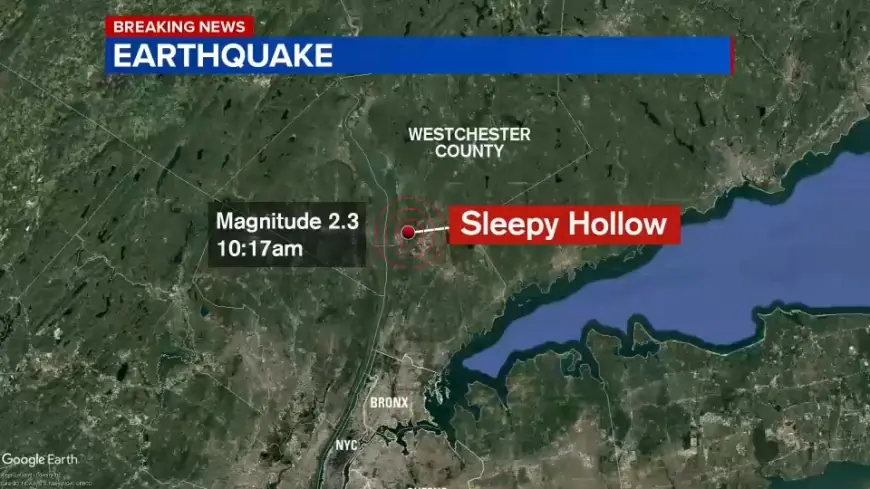
A sharp, shallow jolt hit Westchester County just after 10 a.m. Tuesday — felt from the Hudson Valley to the northern Bronx — as a magnitude 2.3 earthquake centered in Sleepy Hollow sent nearly 900 residents scrambling to report the shaking. No injuries. No structural damage. But the timing and location are anything but routine.
What Hit and Where
The USGS confirmed a 2.3-magnitude earthquake struck approximately half a mile west of Sleepy Hollow, New York, at 10:18 a.m. ET Tuesday morning. The quake originated 4.6 miles beneath the surface — a shallow depth that amplifies how forcefully energy travels through surrounding rock.
The epicenter was about 0.7 miles southeast of Tarrytown, 3.8 miles south-southeast of Greenburgh, and 4.8 miles south of Dobbs Ferry. Shaking spread well beyond that tight radius. Residents reported feeling it in Hawthorne, Rye Brook, Mamaroneck, Harrison, and other communities throughout Westchester.
Close to 900 people filed reports with the USGS by 11 a.m., with most coming from Westchester but a notable number arriving from the Bronx — specifically areas generally north of the Cross Bronx Expressway.
"Like a Train Going By"
The descriptions from residents were consistent and telling. On Reddit, people characterized it as feeling "like a train going by" or "like a big rumble." That signature — an abrupt, directional jolt rather than a rolling wave — is typical of shallow East Coast tremors traveling through dense, ancient bedrock that transmits seismic energy with far less absorption than the fractured geology of the West Coast.
WABC Chief Meteorologist Lee Goldberg said he had just walked into an auto shop in Mount Kisco — about 13 miles north of Sleepy Hollow — where employees confirmed they felt it clearly. Goldberg noted the shaking was detected as far south as the Bronx and as far north as Putnam County, a spread that reflects the efficiency of the region's bedrock as a seismic conductor.
Indian Point in the Picture
The proximity of Tuesday's epicenter to the former Indian Point Energy Center, decommissioned in 2021, is not lost on local officials. Officials at the former Indian Point site launched precautionary surveys following the quake, and Westchester County Executive Ken Jenkins issued a pointed statement: "Today's earthquake underscores yet another reason why a nuclear power plant does not belong in Westchester County."
Indian Point sits astride what researchers have identified as the previously unrecognized intersection of two active seismic zones, with the Ramapo Seismic Zone passing within a mile or two northwest of the plant. The facility produced power for decades under that geological reality before its closure.
The Fault Behind It
The Ramapo Fault — an active system running from Pennsylvania through New Jersey and into New York — generates a number of typically small earthquakes in the region each year and is the most likely source of Tuesday's event.
There have been only 20 earthquakes of at least magnitude 2.3 in the Sleepy Hollow vicinity since 1950, making Tuesday's tremor a relatively rare occurrence even against the region's active seismic backdrop.
The recent pattern is worth noting. A magnitude 3.0 event rattled Hasbrouck Heights, New Jersey, in August 2025. Before that, a 4.8-magnitude quake struck Tewksbury, New Jersey, on the morning of April 5, 2024, sending shockwaves felt from Philadelphia to Boston and triggering numerous aftershocks. Tuesday's tremor is far smaller — but it arrives in the same active corridor.
What Comes Next
Westchester County's Department of Emergency Services has received no damage reports, and USGS officials told ABC News they do not expect any to emerge.
Goldberg said aftershocks or additional tremors throughout the afternoon or coming days remain possible. The USGS has not issued a formal aftershock advisory. Historical records note that moderately damaging earthquakes strike somewhere in the New York–Philadelphia–Wilmington urban corridor roughly twice a century, with smaller quakes felt every two to three years — a pattern Tuesday's event fits squarely.