Oil Prices Today Whipsaw Between $87 and $119 as Iran War Shuts Hormuz, Dow Futures Stabilize Tuesday

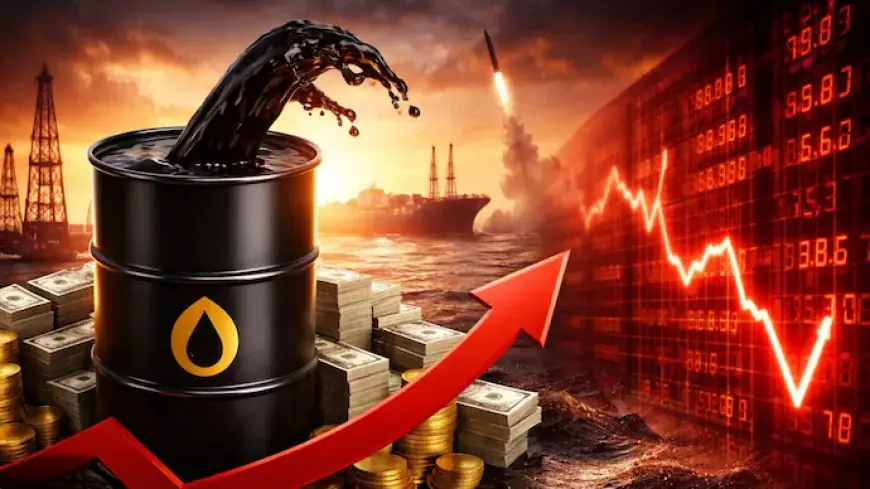
Wall Street is catching its breath Tuesday after the most violent single-day swing in oil markets in decades. Crude hit $119 overnight Sunday before retreating sharply — and the Dow, down nearly 900 points at its session low Monday, closed up 239 points after President Trump signaled the Iran war may be approaching its end.
The Wild Ride in Crude
WTI futures are trading at $87.82 on Tuesday, with Monday's session range stretching between $84.45 and $91.44 — a stark comedown from a 52-week high of $119.43 hit just days ago. Monday alone saw Brent climb as high as $119.50 per barrel before settling at $103.47, a gain of 11.6%, while WTI closed 12.2% higher at $101.97 — on track for the largest single-day percentage jump in the oil market's history, before paring gains late in the session.
The driver is straightforward and severe. The Strait of Hormuz — the narrow waterway through which roughly 20% of the world's oil travels — remains effectively closed, with Iran threatening to attack any tanker attempting to transit. The estimated 20% supply disruption is roughly twice the record set during the Suez Crisis of 1956–1957.
Iraq and Kuwait have already begun cutting production, with analysts warning that Saudi Arabia and the UAE may also be vulnerable if the Strait stays closed for a sustained period.
Dow Futures and the Trump Factor
Dow futures are modestly higher Tuesday as oil pulls back, easing some of Monday's risk-off tone. That follows a dramatic reversal on the cash market. The S&P 500 rose 0.83% to close at 6,795.99 Monday, while the Dow added 239.25 points to finish at 47,740.80 — an impressive turnaround from a session low that had the index down nearly 900 points.
The catalyst was Trump. The president told a CBS News reporter that "the war is very complete, pretty much," adding that Iran has "no navy, no communications, no Air Force." US crude dropped to around $87 in late hours, and 10-year Treasury yields halted a five-day climb.
Still, the administration's messaging has been erratic. Oil climbed to nearly $120 per barrel before pulling back after Trump sent mixed signals and the G7 mulled releasing emergency oil supplies. On Sunday night, he dismissed concerns about energy costs on Truth Social, calling a spike in oil prices "a very small price to pay for U.S.A., and World, Safety and Peace."
What Analysts Are Watching
The forecasts from energy analysts span a wide and uncomfortable range. Rystad Energy Vice President Janiv Shah said Brent could hit $135 per barrel if current conditions last four months, and would surpass $110 with just two months of disruption.
ExxonMobil chief economist Tyler Goodspeed told CNBC that he sees "many more scenarios — and more probable ones — in which the Strait remains effectively closed harder for longer" than scenarios in which normal traffic resumes.
Not everyone is bracing for catastrophe. BlackRock investment strategists wrote in a client note Monday that the shock is "likely to be short-lived," with the firm expecting energy flow disruptions to last weeks rather than months. BlackRock said it continues to favor equities in the U.S. and Japan.
At the Pump and on the Trading Floor
OPIS chief oil analyst Denton Cinquegrana said retail gasoline prices are likely to hit $4 per gallon by the end of this week, with the national average sitting at $3.478 a gallon as of Monday. Cinquegrana noted that crude oil trading volume has been "some of the most active" he has seen in just over 25 years.
Cruise line stocks bore the brunt of the selloff Monday — Carnival dropped more than 6%, its biggest single-day decline since November, while Norwegian fell nearly 5%, extending a seven-session losing streak. Both Carnival and Norwegian have now shed more than 20% in March alone.
The IEA has called a meeting of its more than 30 member countries Tuesday to assess supply conditions and decide whether to release emergency stockpiles to the market. French Finance Minister Bruno Le Maire said countries worldwide are prepared to act to stabilize oil prices. The G7 energy ministers are also scheduled to hold a virtual session Tuesday morning on a coordinated reserve release.