

























Interstellar Comet 3i Atlas Nasa: JUICE’s JANUS Camera Reveals Coma, Tail and Jets

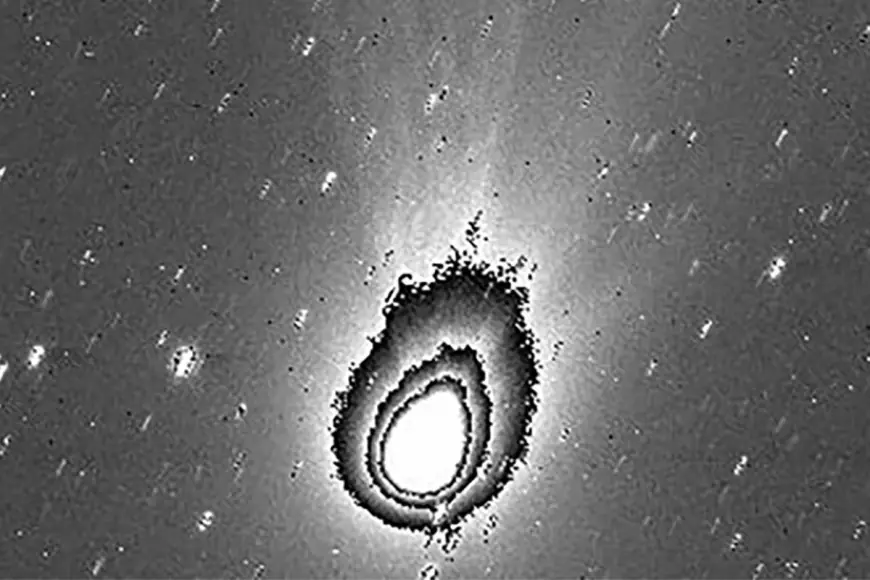
The European Space Agency’s Jupiter-bound spacecraft JUICE has returned a detailed science-camera portrait of Interstellar Comet 3i Atlas Nasa, capturing a bright coma, a long tail and filamentary jets. The imagery and associated instrument data, taken during a concentrated observing campaign in November 2025, give scientists a rich dataset to probe the comet’s behaviour just after its closest approach to the Sun.
JANUS image of Interstellar Comet 3i Atlas Nasa
On 6 November 2025, the JANUS science camera on JUICE photographed the interstellar visitor from roughly 66 million kilometres away, seven days after the comet’s perihelion. JANUS produced more than 120 images across a wide wavelength range that together reveal a small, optically bright coma surrounding an unseen nucleus, a long anti-sunward tail and multiple rays, jets and filamentary structures. An inset processed to highlight coma structure accentuates concentric, ragged-edged shells and directional features; arrows added to the dataset mark the comet’s velocity vector and the Sun’s direction to clarify morphology.
Juice instruments and the November 2025 observing campaign
During November 2025, JUICE mobilised five of its science instruments to study the object: JANUS for multicolour imaging, MAJIS and UVS for spectrometry, SWI for compositional data and PEP for particle measurements. Teams also examined images from JUICE’s navigation camera that had earlier photographed the comet. Because JUICE spent months on the far side of the Sun relative to Earth and used its main high-gain antenna as a thermal shield, communications were constrained; a smaller medium-gain antenna relayed data at a lower rate and instrument groups had to wait to receive the full dataset. The staggered delivery delayed analysis, but instrument teams are now working through imaging, spectrometry and particle files with plans to convene in late March to synthesise findings.
The immediate cause-and-effect is clear: the spacecraft’s operational posture while behind the Sun limited downlink capacity, which in turn postponed hands-on analysis of the raw files and extended the timeline for coordinated interpretation. As a result, the JANUS team has spent weeks assembling and calibrating more than 120 frames before passing them to the broader science teams for comparative study with MAJIS, SWI, UVS and PEP outputs.
Beyond the imaging counts, the campaign provided concrete measurement points: the single, high-resolution JANUS acquisition on 6 November, the distance of roughly 66 million km at the time of capture, and the fact that all observations took place within the month following the comet’s solar closest approach. Those anchors allow specialists to place morphological changes and spectrometric signatures on a tight timeline tied directly to solar heating.
What makes this notable is that the combined instrument suite sampled the comet across optical, infrared and particle channels in a narrow post-perihelion window, offering the chance to link visible jets and coma morphology with simultaneous compositional and particle-flow measurements. The MAJIS and UVS teams are focusing on spectrometric fingerprints, SWI investigators are examining chemical composition, and PEP researchers are analysing particle environments to build a composite picture of the comet’s activity.
The JUICE campaign highlights how a spacecraft en route to the Jovian system can be repurposed for opportunistic science: while on course to study Jupiter’s icy moons, the probe treated a passing interstellar object as a transient target, delivering over 120 JANUS frames and complementary data sets that scientists will mine in the coming months. The coordinated review scheduled for late March will be the first opportunity for all instrument teams to cross-compare results and to outline what the observations reveal about the comet’s makeup and outgassing behaviour.
For now, the images stand as the most detailed look so far from JUICE’s science camera, documenting a visitor from beyond the Solar System in active outburst and laying the groundwork for multi-instrument interpretation once teams complete their analyses.