
























3i Atlas Update: Why fresh JANUS images arriving now change the comet story

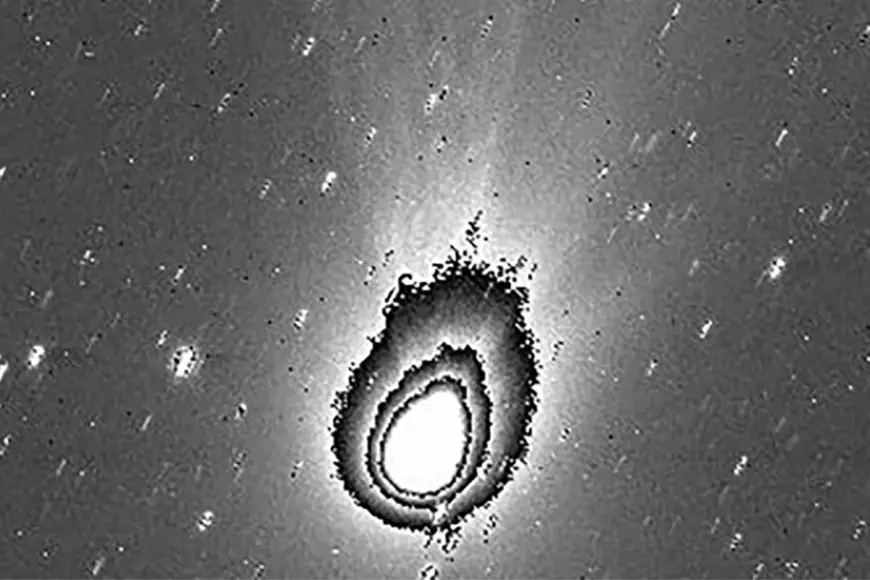
Why this matters now: the first real science photos from a dedicated onboard camera have only just reached instrument teams after a months-long wait, and that data—tagged here as the 3i atlas update—shifts the focus from simple detection to structural analysis. The newly available frames reveal a complex coma, a long tail and multiple jets, giving researchers material to test ideas about how an interstellar comet behaves when it nears the Sun.
3i Atlas Update — timing, tools and what the new package means
Here’s the part that matters: JANUS, the science camera on the Juice spacecraft, took more than 120 images of comet 3I/ATLAS across a wide wavelength range, and those frames have only recently been delivered to teams for analysis. The delay came while the spacecraft was positioned opposite the Sun and using its main antenna as a thermal shield, which limited data return and slowed access to large files. With the science images now in hand, instrument teams working on JANUS, MAJIS, SWI, PEP and UVS can combine imagery, spectrometry and particle data to move from first impressions to tests of composition and activity.
What’s easy to miss is that navigation-camera shots circulated earlier offered useful context but lacked the spectral breadth and resolution JANUS provides; the new set permits a far more technical look at coma morphology and dust–gas interactions.
Image highlights and operational specifics
- Camera and date: JANUS captured the principal science image on 6 November 2025, seven days after the comet's closest approach to the Sun.
- Distance at imaging: the spacecraft was about 66 million km from the comet when the JANUS science-frame was taken.
- What the pictures show: a bright halo of gas (coma) around the comet’s head, a long tail, and visible rays, jet streams and filaments emanating from the nucleus region.
- Scope of observations: over 120 JANUS frames plus complementary data from MAJIS, SWI, PEP and UVS were collected during November 2025; the navigation camera also recorded images earlier.
Teams are coordinating later meetings to integrate findings from the different instruments; a collective discussion is planned for late March to compare imagery, spectra and particle measurements and to outline next analysis steps.
Micro timeline:
- 1 July 2025 — comet 3I/ATLAS discovered passing through the Solar System.
- 6 November 2025 — JANUS captured key science images, seven days after the comet's closest solar approach.
- Late March — instrument teams will formally convene to compare and synthesize results.
Short Q& A
- Q: How many JANUS images were taken? A: More than 120 frames across multiple wavelengths.
- Q: Which instruments observed the comet? A: JANUS, MAJIS, SWI, PEP, UVS and the navigation camera all collected data during the November observing campaign.
- Q: What structural features are visible? A: The images show the coma, a long tail, and rays, jets, streams and filaments extending from the comet.
The real question now is how those structural details will map to compositional signatures in the spectrometry and particle datasets. If spectrometers and particle instruments confirm distinct chemical or dust properties, this set of coordinated observations could be the most informative snapshot yet of an interstellar comet in active outgassing mode.
One forward-looking signal to watch for is the outcome of the late-March integration meeting: a clear plan for joint papers or targeted follow-up analyses will indicate teams have converged on testable hypotheses drawn from the JANUS frames.
It’s easy to overlook, but the combination of high-resolution imaging plus simultaneous spectrometry and particle measurements is uncommon for objects on hyperbolic trajectories; this campaign provides an unusually broad dataset for an interstellar visitor.
Note on uncertainty: teams only recently received the full science dataset, so detailed interpretations and conclusions may evolve as analysis proceeds. Recent updates indicate instrument groups are actively examining the imagery and complementary data; further technical results are expected after the planned late-March discussions.