
























Trump Spain Rift Deepens After Trade Threat, Madrid Refuses US Base Access For Iran Strikes

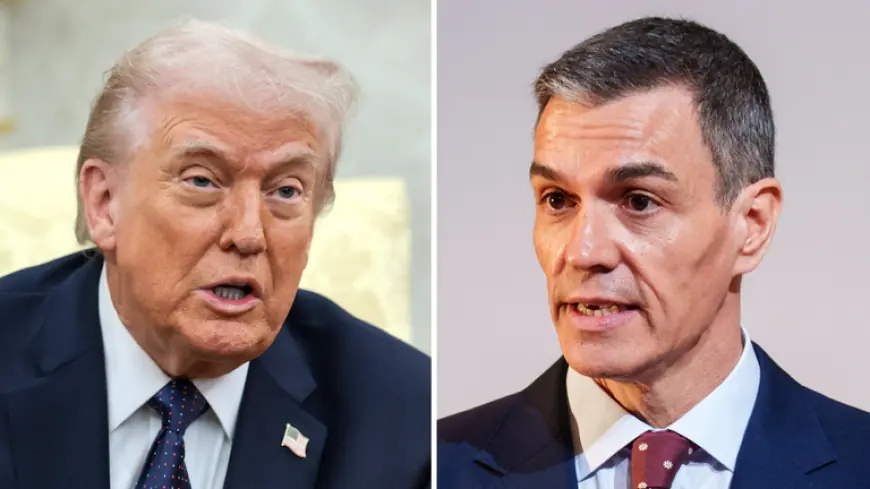
Spain and the Trump administration traded sharply different accounts on Tuesday night and Wednesday morning, setting off the most serious U.S.–Spain clash in years and widening a transatlantic fracture already strained by the expanding war with Iran. By Wednesday, March 4, 2026, 10:00 a.m. ET, Madrid was publicly rejecting Washington’s claim that Spain had agreed to cooperate militarily, after President Donald Trump threatened to cut off U.S. trade with Spain over its refusal to support operations tied to Iran.
The dispute is less about one tactical request than about leverage. The White House is signaling it wants allied alignment—operational, political, and symbolic—behind U.S. and Israeli actions. Spain is signaling that it will not be pressured into participation, even indirectly, and that access to Spanish facilities is not automatic when Madrid believes a campaign violates its red lines. The result is a confrontation that blends foreign policy, defense posture, and economics into one volatile package.
Spain Rejects “Cooperation” Claim
Spain’s government has been unusually direct in public language, portraying the dispute as a question of sovereignty rather than a negotiable misunderstanding. Senior Spanish officials have denied that any new agreement was reached to expand U.S. military use of shared facilities on Spanish territory, and they have reiterated Spain’s opposition to deepening the war in Iran.
What makes this moment combustible is the gap between statements. Washington has implied a concession; Madrid has said flatly that no concession exists. In diplomacy, that kind of mismatch is rarely accidental. It can be a tactic—one side trying to create momentum, the other trying to kill it quickly before it becomes “the story.” But it can also reflect a deeper breakdown: when internal channels fail, public messaging becomes the battlefield.
Spain’s stance is also shaped by domestic politics. Any perception that Madrid is enabling strikes—especially those linked to Iran bombing or broader escalation—would trigger backlash in a country where memories of past Middle East interventions remain politically radioactive. That history matters because it narrows the space for quiet compromise. Even a technical adjustment to U.S. access can look like a strategic shift once it is framed as “helping the war.”
Trump Spain Trade Threat Raises The Stakes
Trump’s trade threat is designed to do two things at once: punish dissent and warn other allies that opting out has a cost. In practical terms, a sudden halt to trade would face layers of legal, diplomatic, and economic friction—because Spain is embedded in European trade policy and because supply chains are rarely cleanly separable by political decree. But the threat’s immediate utility is political: it turns a military dispute into a pocketbook dispute and forces businesses, voters, and allied leaders to ask whether they want to be collateral damage in a confrontation they didn’t choose.
That’s why the language matters even if the policy path is murky. Markets and governments price intent. The message from Washington is that alliance relationships are conditional and transactional in a crisis. The message from Madrid is that alliance membership does not equal automatic compliance—particularly when the conflict touches questions of legality, proportionality, and escalation risk.
There is a second-order effect, too: once trade becomes a tool in a military dispute, the pressure spreads beyond the original issue. Spanish officials may harden their stance simply to avoid setting a precedent. And other European capitals—watching the U.S. single out one country—may quietly recalibrate their own risk exposure, from base access rules to diplomatic posture, to avoid becoming the next target.
War With Iran Pushes Allies Into Hard Choices
The U.S.–Spain standoff is inseparable from the larger question hanging over Washington’s approach: how to sustain a military campaign against Iran while keeping a coalition intact. The more the conflict expands—through Iran strikes, retaliation, or regional spillover—the more the U.S. will seek operational flexibility across allied territory, airspace, and logistics networks. That’s where Spain’s geography becomes strategic. Facilities on the Iberian Peninsula are valuable not only for direct operations, but also for transit, resupply, surveillance, and contingency planning.
Spain is effectively drawing a line between alliance cooperation in principle and participation in a specific war. That line is politically coherent at home, but it creates real constraints for a U.S. posture that relies on distributed access. For Washington, the concern isn’t only Spain. It’s the domino risk: if one ally says no, others may follow—or they may demand explicit limits and conditions that slow decision-making in a fast-moving conflict.
For Madrid, the concern is equally structural: once access is granted for one escalation step, it can be difficult to control the next. Governments fear “mission creep” as much as generals do. Spain’s argument is that saying no now prevents being pulled into a widening war later—especially if Iran retaliation begins targeting U.S.-linked infrastructure across the region.
What Happens Next For US And Spain
Four forward scenarios are now plausible, and each has a clear trigger.
One path is quiet de-escalation: Washington softens the public posture, Spain reiterates limited existing commitments, and both sides avoid a formal rupture. The trigger would be a stabilizing turn in the war with Iran—fewer strikes, fewer retaliations, less pressure for immediate access.
A second path is negotiated limits: Spain offers narrowly defined logistical cooperation—framed as defensive or humanitarian—while maintaining restrictions tied to offensive operations. The trigger would be U.S. officials deciding that some access is better than none, and that public victory laps are less useful than workable constraints.
A third path is trade escalation: Washington moves beyond threats into tangible steps—tariff actions, procurement restrictions, or targeted pressure. The trigger would be a continued refusal from Madrid coupled with a political need in Washington to show consequences.
The fourth path is the most dangerous: regional spillover forces a new calculation. If attacks expand to include wider targets, or if a major incident hits U.S. personnel or diplomatic facilities, the U.S. may demand broader allied support—and Spain may face an even harsher choice between solidarity and separation.