

























Apple Store Pre-Orders Open March 4 for MacBook Air with M5 as M5 Pro and M5 Max Expand Lineup

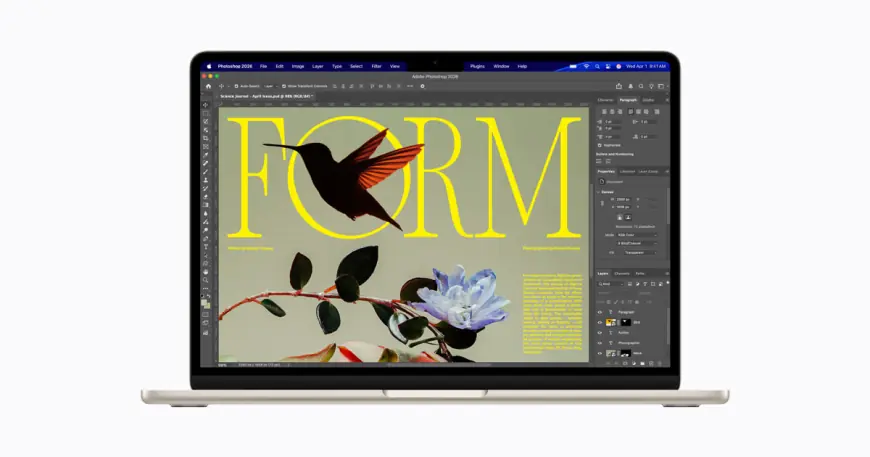
Apple announced a refreshed MacBook Air powered by the M5 chip, and confirmed expanded M5 Pro and M5 Max configurations for MacBook Pro models. The company says pre-orders begin March 4, with availability starting March 11, and the apple store will list the updated models and pricing when sales start.
John Ternus and the MacBook Air with M5
Apple’s senior vice president of Hardware Engineering, John Ternus, framed the new MacBook Air as a portability-first laptop that gains considerable compute headroom from M5. The Air ships with a 10-core CPU and up-to-10-core GPU, each GPU core paired with a Neural Accelerator, and 153 GB/s of unified memory bandwidth — a 28 percent increase over the prior M4 generation. Apple says those changes enable up to 4x faster performance for AI tasks versus M4 and up to 9. 5x faster than M1, positioning the Air to handle heavier creative and AI workflows.
Other concrete upgrades include double the starting storage — now 512 GB with faster SSD technology and configurable up to 4 TB — Apple’s N1 wireless chip with Wi‑Fi 7 and Bluetooth 6, a 12 MP Center Stage camera, an advertised battery life of up to 18 hours, and two Thunderbolt 4 ports that support up to two external displays. The Air will be offered in 13‑ and 15‑inch sizes and four finishes: sky blue, midnight, starlight, and silver.
Apple Store Availability and Pricing
Apple set new entry prices and bumped base storage across its notebooks. For the MacBook Air, the company increased the starting price by $100: the 13‑inch model now starts at $1, 099 and the 15‑inch at $1, 299. The apple store will accept pre-orders beginning March 4, with unit shipments and in‑store availability starting March 11.
The higher‑end MacBook Pro models also carry larger base storage and steeper entry prices. The 14‑inch MacBook Pro with M5 Pro now begins with 1 TB of storage and a starting price of $2, 199; the 16‑inch M5 Pro starts at $2, 699. M5 Max configurations start at $3, 599. Apple positioned the price increases as tied to the doubled baseline storage and the expanded silicon options now available in the lineup.
M5 Pro and M5 Max Cores, Performance, and the New Core Mix
The M5 family now introduces a three‑type core structure. Apple retooled its core taxonomy so that chips feature efficiency cores, a new balanced middle tier labeled performance cores, and the most powerful cores now called super cores. That reclassification creates a mid‑tier core intended to deliver better power efficiency in higher‑performance chips that otherwise omit traditional efficiency cores.
In the new MacBook Pro configurations, Apple offers M5 Pro and M5 Max variants that scale CPU and GPU resources significantly: up to 18 CPU cores in some M5 Pro/Max configurations (presented as 12 performance cores and 6 super cores in advertised breakdowns), up to 20 GPU cores in M5 Pro, and up to 40 GPU cores in M5 Max. Apple cites a roughly 30 percent multithreaded CPU improvement for M5 Pro over M4 Pro, and about 15 percent for M5 Max versus M4 Max. The company also claims both Pro and Max deliver over 4x the peak CPU compute for AI compared with the previous generation and about 20 percent better GPU performance.
The effect is straightforward: added CPU and GPU cores plus a more efficient memory subsystem yield measurable gains for multithreaded pro workloads and on‑device AI compute, while the new balanced core tier helps preserve acceptable battery life in machines that use fewer or no traditional efficiency cores.
What makes this notable is the broadening of M5 beyond Apple’s highest‑end Pro notebooks into its mainstream Air line — a shift that coincides with higher baseline storage and starting prices across the Mac portfolio. The timing matters because Apple is moving M5 from a more limited set of devices into laptops aimed at students and mobile professionals, changing the entry economics and capabilities of its most popular laptop family.