

























3D Printed Prosthetic Revolutionizes with Pressure-Mapping Sensors

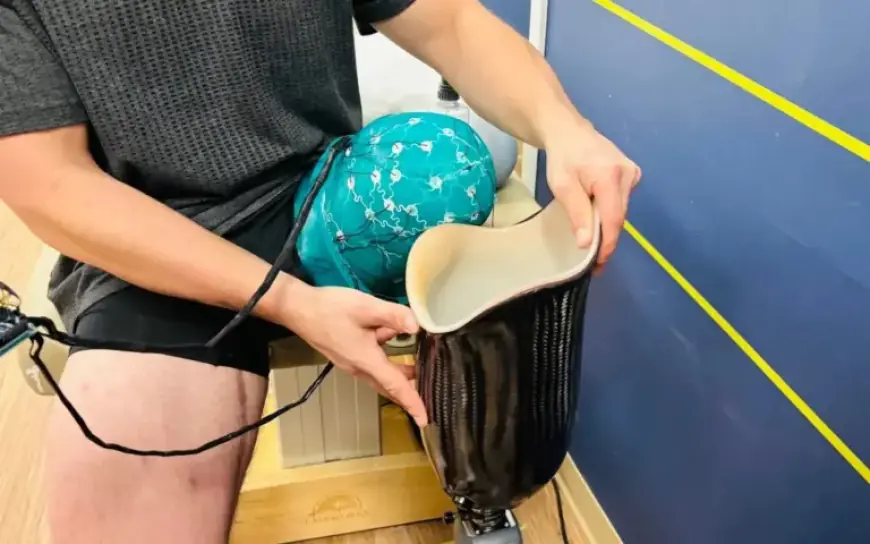
Researchers at Simon Fraser University (SFU) have made groundbreaking advancements in prosthetic technology. They have developed a 3D printed prosthetic limb socket that integrates pressure-mapping sensors and artificial intelligence. This innovative system tailors socket designs based on individual patient biomechanics, enhancing user comfort and functionality.
Innovative Design Features
The core of this new prosthetic technology is a silicone liner embedded with miniature pressure sensors. Patients wear this liner under the socket. It continuously maps the force distribution across the residual limb during movements, such as standing and walking. The data collected creates a biomechanical profile that artificial intelligence processes to generate customized socket designs.
Significant Enhancements
Lead Professor Woo Soo Kim from the SFU Additive Manufacturing Lab shared insights on this pioneering technology. He highlighted how it effectively captures unique pressure and force distribution data to create lighter, breathable, and pressure-responsive prosthetic sockets.
- Pressure and force distribution data used to design bespoke prosthetics
- 3D printing reduces socket weight and enhances breathability
Lattice Structures for Improved Performance
The SFU team employed a lattice structure based on the Gyroid pattern for socket construction. This approach deviates from conventional solid-infill techniques. Models inspired by honeycomb and trabecular bone structures enable superior energy absorption.
- Energy absorption increased by 1,600% while standing
- 1,290% increase in energy dissipation during walking
These enhancements potentially reduce pressure ulcers, alleviate pain, and minimize musculoskeletal complications commonly associated with traditional prosthetics.
Clinical Collaboration and Accessibility Goals
The project was developed in partnership with Hodgson Group Orthotics and Prosthetics, whose clinical team provided validation on fit and load distribution. Prosthetist Loren Schubert emphasized the importance of data-driven design in improving fit, comfort, and skin health for prosthetic users.
Cost reduction and scalability were key research objectives. The team aims to make this technology widely available through local prosthetic providers. As Professor Kim stated, “We want to help local prosthetic companies better serve their clients, ensuring that personalized and comfortable prostheses are affordable and accessible.”
This innovation marks a significant step forward in the quest for advanced prosthetic solutions, enhancing the quality of life for countless individuals.