
























Dubai Airport Shuts Down as Regional Airspace Closures Trigger Global Flight Chaos

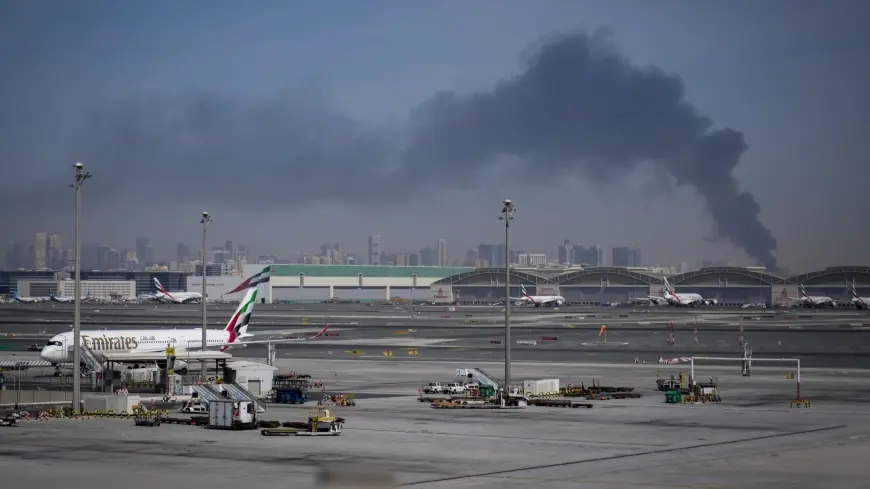
Dubai’s airport system — led by Dubai International Airport — suspended passenger flight operations on Monday, March 2, 2026, extending a rolling shutdown that has rippled far beyond the Gulf and into airline networks worldwide. The immediate cause isn’t a local operational hiccup like fog or a runway incident; it’s the sudden narrowing of safe air corridors across the region, with carriers unable to route aircraft reliably in and out of one of the world’s busiest connecting hubs.
By late morning Monday in U.S. Eastern Time, the practical effect was already visible in every time zone: long-haul flights canceled before departure, aircraft diverting to alternate airports, crews and aircraft stranded out of position, and travelers stuck in “connection cities” that normally function like high-speed interchanges. When Dubai’s hub slows, the impact isn’t linear. It cascades — because so many itineraries use Dubai as the midpoint between Europe, Asia, Africa, and Australia.
The operational message from Dubai’s airport authority has been consistent: with airspace measures in place, flights at both Dubai International and the city’s second airport, Al Maktoum International, face cancellations and significant disruption. Airlines have mirrored that caution with broad suspensions rather than piecemeal delays, a sign the constraint is structural, not a short-lived bottleneck.
What’s actually happening at Dubai International Airport
The shutdown is best understood as an airspace problem masquerading as an airport problem. Even if terminals, runways, and ground crews are ready, a hub cannot function when planes can’t safely arrive and depart along predictable routes. Modern airline networks depend on tight timing: aircraft land, unload, reload, depart; crews swap; connections roll forward. Remove the certainty of flight paths and the hub model breaks.
That uncertainty has been compounded by incidents across the region that have raised the perceived risk level for commercial aviation. Dubai officials have described minor damage in one area of the airport and injuries to staff during the broader escalation. While the physical damage appears limited, the operational consequence is outsized: insurance terms tighten, airline risk teams step in, and dispatchers become far more conservative about routing. In aviation, “minor” can still be decisive if it changes the risk calculus.
For travelers, the most important detail is that the disruption is not confined to people flying to Dubai. It hits anyone using Dubai as a connection point — which is a huge share of passengers. When a connecting hub pauses, the options downstream shrink quickly: rebooking becomes a global puzzle, not a local fix.
Why this is bigger than a Dubai-only story
Dubai’s airport ecosystem is a switchboard for international travel. When it goes offline, airlines don’t just lose one city; they lose a highly efficient bridge between regions that otherwise require less convenient routings. The knock-on effects include:
-
Aircraft shortages in distant airports as inbound planes never arrive.
-
Crew duty-time limits forcing additional cancellations.
-
Air cargo delays, because belly freight rides in passenger jets that are now grounded or rerouted.
-
Hotel and ground-transport stress in cities absorbing unexpected diversions.
This is why the current disruption is being compared, in scale and complexity, to the largest aviation shocks of the past decade: not because the cause is identical, but because the system-wide consequence is similar — the network can’t “self-heal” until hubs and air corridors become reliable again.
What travelers should expect next
In the near term, the most likely scenario is not a clean “reopen at noon” moment, but a staggered restart: a trickle of repatriation flights, limited corridors for certain routes, then a gradual return of scheduled service. When hubs restart after an airspace disruption, airlines prioritize getting aircraft and crews back into position, which means some routes resume quickly while others remain canceled even after the airport technically reopens.
If you’re holding a ticket that touches Dubai, the best predictor of what happens next is not the departure board at your local airport; it’s whether airlines are willing to publish stable schedules again. When carriers keep extending suspensions in blocks of hours, they’re signaling they don’t trust the route picture yet.
What comes next: four scenarios with clear triggers
Dubai airport operations now hinge on a handful of triggers that will determine whether this is a short freeze or a multi-day network reset:
-
Air corridors reopen with enforceable stability. If safe routes are restored and remain consistent for a full operating cycle, airlines can rebuild banks of arrivals and departures. This is the fastest path to normal.
-
A partial reopening with heavy constraints. If only limited corridors are available, Dubai can function, but as a reduced-capacity hub. That typically means fewer connections, longer layovers, and persistent cancellations on certain long-haul pairings.
-
Extended closures as risk pricing bites. Even if routes exist on paper, elevated insurance and security risk can keep airlines from returning at scale. In this scenario, the airport might reopen operationally while the network remains thin.
-
A broader escalation forces a longer reroute era. If the region’s airspace remains unpredictable, airlines may shift to entirely different hubs and routings for weeks, effectively rerouting global travel flows away from the Gulf until conditions stabilize.
Dubai’s airport brand has long been built on reliability, speed, and connectivity. The next few days will test how quickly that system can restart — and whether the global network can absorb the shock without turning a regional airspace crisis into a sustained worldwide travel crunch.