
























Spacex Launch Today: Falcon 9 Deploys 29 Starlink Satellites from Cape Canaveral

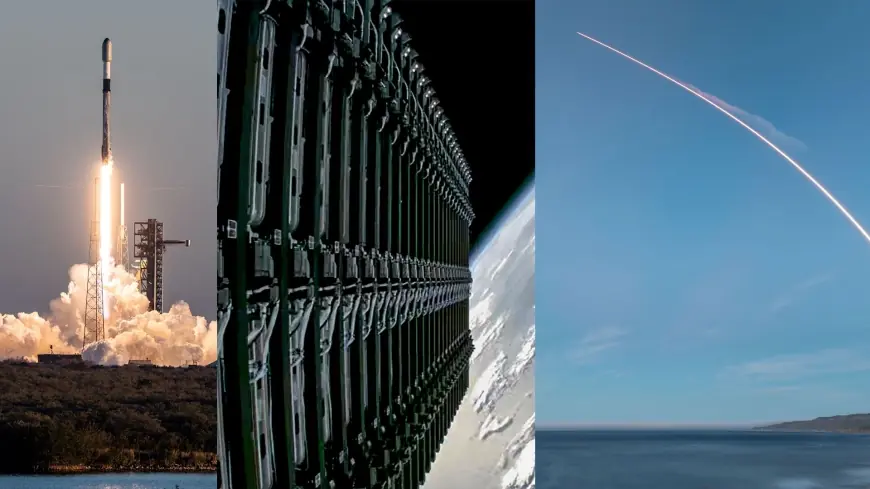
SpaceX completed a night launch that deployed 29 Starlink internet satellites, a flight that underscored the company’s rapid cadence of constellation builds. The mission matters now because it continued a string of high-frequency launches this week and altered the launch azimuth after months of flights on a different trajectory.
Spacex Launch Today — Starlink 10-41 mission
The flight, designated Starlink 10-41, confirmed deployment of 29 satellites at 11: 03 p. m. EST on Mar. 1 (0403 UTC). This mission was counted as SpaceX’s 22nd launch of the year supporting its broadband internet satellite constellation in low Earth orbit. The successful deployment followed earlier activity: a Sunday morning mission that lofted 25 Starlink satellites, bringing the company’s tally for the year to 566 satellites launched so far.
Cape Canaveral Space Force Station liftoff and timing
The Falcon 9 lifted off from Space Launch Complex 40 at Cape Canaveral Space Force Station at 9: 56: 40 p. m. EST (0256: 40 UTC). The 45th Weather Squadron had forecast a 90 percent chance of favorable weather for the Sunday night launch window, noting only a small chance of interference from cumulus clouds; because the forecast was favorable, the launch proceeded. Earlier in the week, three Falcon 9 flights on Feb. 24, 25 and 27 put more than 80 satellites into low Earth orbit, illustrating the concentrated tempo leading into this flight.
Booster B1078 and droneship Just Read the Instructions
The mission used the Falcon 9 first stage booster B1078, making its 26th flight after previous missions that included Crew-6, Nusantara Lima and USSF-124. Less than 8. 5 minutes after liftoff, B1078 returned and landed on the droneship Just Read the Instructions, positioned in the Atlantic Ocean off the coast of South Carolina. That touchdown marked the 152nd landing on that vessel and the 580th booster landing for the company overall.
February launches and boosters B1092, B1093 and B1069
This weekend’s activity capped a week that began with two Cape Canaveral departures and a California launch. On Tuesday, Feb. 24 at 6: 04 p. m. EST (2304 GMT), a Falcon 9 from SLC-40 at Cape Canaveral lifted 29 satellites. On Wednesday, Feb. 25 at 9: 17 a. m. EST (1417 GMT; 6: 17 a. m. PST local time), a Falcon 9 launched 25 units from Space Launch Complex 4E at Vandenberg Space Force Base in California. A third Falcon 9 on Friday, Feb. 27 at 7: 16 a. m. EST (1216 GMT) from SLC-40 carried 29 more.
All three of those flights successfully deployed their Starlink payloads—listed as Groups 6-110, 17-26 and 6-108—and each first stage returned to an ocean-based droneship. Tuesday’s booster B1092 touched down on Just Read the Instructions in the Atlantic, completing its 10th mission. Wednesday’s booster B1093 landed on Of Course I Still Love You in the Pacific, marking its 11th flight. Friday’s booster B1069 completed its 30th trip to space and back on the A Shortfall of Gravitas droneship in the Atlantic. The three launches added 83 satellites and pushed the constellation to more than 9, 850 units in Earth orbit, a tally maintained by satellite tracker Jonathan McDowell.
45th Weather Squadron forecast, Starlink service and operational notes
Operational conditions and recent adjustments shaped the week’s flight decisions. A last-minute abort on a prior California mission Wednesday was caused by concern about the first stage’s ability to land on a Pacific droneship; after that scrub the Falcon 9 lifted off Thursday morning from Vandenberg at 6: 40 a. m. PDT (9: 40 a. m. EDT; 1340 UTC) with 46 Starlink satellites on the Starlink 3-5 mission. That abort-to-launch sequence demonstrates the direct link between recovery considerations and launch timing: concern over drone-ship recovery prompted a delay, which in turn shifted the launch to the following morning.
The Starlink service continues to be positioned as a global broadband network, providing internet where connectivity is sparse and supporting cell-to-satellite links on select carriers as well as in-flight wifi on some airlines. What makes this notable is the return to a north-easterly trajectory for the Starlink 10-41 mission after roughly four months of mostly south-easterly trajectories, a change that reflects mission planning tailored to constellation distribution and orbital-slot needs.
Public access, media delivery and Crew Dragon status
For public viewers, a video clip remains available showing a Falcon 9 first stage separating and firing its engines to return to Cape Canaveral shortly after a Jan. 7 liftoff. On the human spaceflight side, astronauts assigned to fly the Crew Dragon spacecraft later this year said they are excited for the capsule’s first orbital mission set for launch on a Saturday, though significant work remains before the vehicle is cleared to carry people.
Separately, one news website displayed a message that a reader’s browser was not supported and urged visitors to download a modern browser for the best experience, noting the site was built to take advantage of the latest web technologies.