

























Flight radar spikes as Gulf airspace shuts down, grounding Qatar Airways and disrupting Emirates

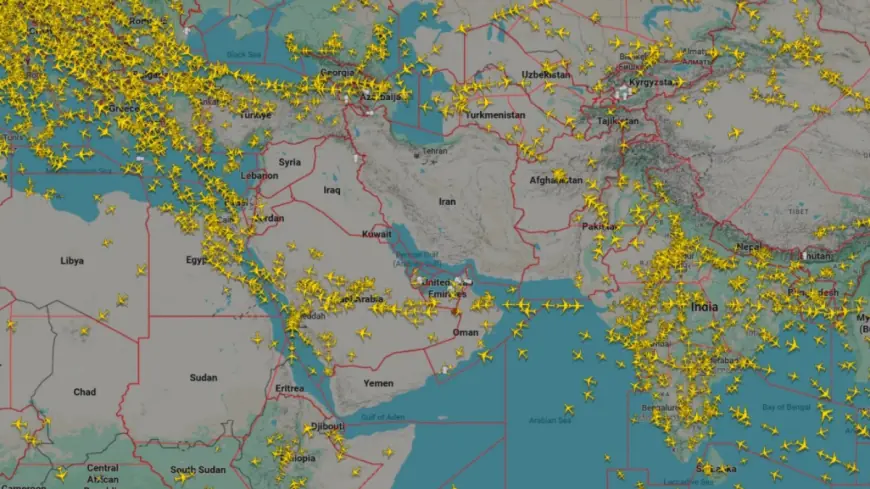
Commercial aviation around the Gulf is in emergency mode, with rolling airspace closures around the United Arab Emirates, Qatar, and Bahrain rippling into mass cancellations and diversions worldwide. If you’re searching “flight radar,” “flight tracker,” or “flight radar 24” right now, you’re likely seeing the same pattern on live maps: aircraft turning back mid-route, long detours around closed corridors, and busy holding loops outside the region as crews wait for clearance that may not come.
The short answer to the biggest questions: Dubai airport has been operating under severe disruption and intermittent closure conditions, and Qatar’s national airspace has been closed, forcing Qatar Airways to suspend flights. Emirates and Etihad have both issued broad advisories and suspensions affecting departures and arrivals at their home hubs. The situation has been changing hour by hour, and the practical reality for travelers is that a “scheduled” flight is not the same as a “departing” flight until the aircraft is physically at the gate, crewed, fueled, and cleared.
Is Dubai airport closed, and is Dubai airspace closed?
When people ask “is Dubai airport closed,” they usually mean one of three things:
-
Is the airport accepting arrivals and departures at all?
-
Is my airline operating to Dubai?
-
Is Dubai airspace closed, making routes impossible even if the terminal is open?
Right now, Dubai’s status has effectively been functional shutdown for many commercial operations, even if the airport is not “permanently closed” in the literal sense. What you’ll see in practice is a mix of: full cancellations, suspended ticketing, diverted inbound flights, aircraft parked at alternate airports, and limited movements when airspace windows briefly open.
The key point: airspace availability is the real switch. An airport can be physically intact, staffed, and lit up—yet still unusable for commercial schedules if civil aviation authorities restrict airspace for security reasons.
Qatar Airways news: why flights are suspended and what “Doha airport” means today
For “Qatar Airways news,” the operational headline is simple: Qatar Airways has suspended flight operations because Qatari airspace remains closed. Doha’s main airport can technically remain open for tightly controlled movements, but commercial passenger operations can’t run normally without an open, safe flight information region.
That means two things for travelers:
-
If your itinerary routes through Doha, treat it as high risk until you see an official reopening announcement and your flight status changes to “operational” with a confirmed aircraft assignment.
-
Even when flights resume, expect backlogs: crews out of position, aircraft stranded away from base, and a multi-day domino effect as networks are rebuilt.
Cargo is also a hidden casualty. When a hub carrier pauses, pharmaceuticals and time-sensitive shipments often get rerouted through neighboring airports, adding delays and increasing the odds of missed connections for passenger bags as well.
Emirates flights cancelled, Etihad updates, and what “flight status” really means
Searches for “emirates flights cancelled” and “emirates flight status” are surging for a reason: a hub carrier’s schedule is a web, not a list. When Dubai’s operations freeze, aircraft and crews land elsewhere, and the airline has to reassemble a global network across dozens of time zones.
A few realities to keep in mind as you check your status:
-
Cancelled can appear late, especially if the airline is waiting on a decision from civil aviation authorities.
-
Delayed can quietly become a cancellation once crews time out or an aircraft can’t arrive from its previous leg.
-
On time can be misleading until boarding begins—because airspace restrictions can trigger last-minute reroutes or ground stops.
Etihad and other Gulf carriers have been issuing rolling suspensions and restart targets, but those targets are conditional. The most reliable indicator isn’t a rumor on social media—it’s the airline’s own flight-status tool showing a confirmed operational departure, plus airport departure boards reflecting the same.
Where to watch flights: using a flight tracker without being fooled by the map
A flight tracker is useful, but it can also create false confidence. Here’s how to read it during a crisis:
-
Look for the aircraft registration and inbound leg. If your flight’s plane is still sitting in another country, your departure is at risk even if the listed time hasn’t changed yet.
-
Watch for pattern clues. Multiple flights on the same route turning back, diverting, or holding usually signals an airspace constraint rather than a single-aircraft issue.
-
Check alternate airports. Diversions often go to nearby major fields; if you see a wave of arrivals there, it’s a sign the hub is not accepting traffic.
If you’re using FlightRadar24 or a similar service, remember: the map shows what’s airborne and trackable, not what’s permitted next. Restrictions can be imposed faster than the network can unwind.
Flights to Dubai from Sydney, Philippine Airlines routes, and what to expect this week
For travelers watching “Sydney airport” boards or searching “flights to Dubai,” long-haul routes are especially vulnerable. Gulf hubs are a major bridge between Australia/Asia and Europe. When that bridge breaks, airlines either:
-
Cancel outright, if they can’t safely route or don’t have contingency slots, or
-
Reroute, adding flight time, fuel costs, and sometimes unplanned technical stops.
Carriers like Philippine Airlines that connect through the region (directly or indirectly) can be affected even if they are not based in the Gulf, because aircraft rotations, overflight permissions, and connecting passengers all get disrupted.
Practical advice: if you must travel soon, ask the airline about rebooking via alternate hubs rather than waiting for the original Gulf connection to stabilize.
Travel insurance: what’s covered when airspace closures are war-related
This is the part many travelers only discover after the fact: standard travel insurance often excludes losses tied to war, invasions, or similar hostilities, and some policies treat airspace closures as consequences of excluded events.
What to do immediately if your trip is impacted:
-
Save proof: cancellation notices, airport alerts, screenshots of flight status, and any rebooking offers.
-
Call your insurer and ask one blunt question: Is my disruption covered if the cause is conflict-related airspace closure?
-
If you used a credit card with travel protections, check whether it offers trip interruption benefits—and whether they contain similar exclusions.
Even when insurance doesn’t pay, airlines may offer waivers, reroutes, or refunds under their own policies during extraordinary events, so pursue the airline solution first.
The bottom line for anyone staring at a flight tracker today: treat the Gulf as a fast-moving operational zone. Dubai and Doha are not just destinations—they are global switching yards. When their airspace closes, the entire network shudders, and the safest travel plan is the one that assumes disruption until your wheels are actually off the ground.