























Iran’s Risky Move: Attempting to Sink a U.S. Navy Supercarrier

In a recent declaration, Iran’s Supreme Leader Ayatollah Ali Khamenei made a provocative statement regarding the U.S. Navy’s presence in the Middle East. He suggested that Iran may attempt to attack and potentially sink a U.S. Navy vessel, possibly an aircraft carrier, stating that the American warships operating near Iran are formidable. However, he warned that more dangerous than these warships are the weapons capable of sending them “to the bottom of the sea.”
Iran’s Military Objectives
Tehran is reportedly pursuing a deal to acquire Chinese-made CM-302 supersonic missiles, which have a range of approximately 290 kilometers (180 miles). These missiles are designed to evade naval defenses by traveling at low altitudes. Despite Iran’s aspirations, defense analysts express skepticism about its ability to effectively challenge U.S. carriers, which are state-of-the-art vessels engineered for high endurance in combat situations.
Resilience of U.S. Aircraft Carriers
Modern aircraft carriers are exceptionally robust, engineered to absorb extensive damage while maintaining operational capabilities. The last U.S. Navy aircraft carrier to be sunk in combat was the USS Bismarck Sea (CVE-95) during World War II, over 80 years ago. Compared to that era, today’s carriers, such as the USS Abraham Lincoln and the USS Gerald R. Ford, incorporate advanced technologies and comprehensive defensive systems.
- USS Abraham Lincoln (CVN-72): Currently deployed in the region, equipped with advanced armaments.
- USS Gerald R. Ford (CVN-78): The newest carrier, set to bolster U.S. naval capabilities in the Middle East.
Defensive Strategies and Survivability
Experts highlight that U.S. supercarriers are built to endure and continue fighting even after significant damage. They emphasize that the sophisticated defensive frameworks surrounding these carriers include:
- Aegis destroyers and cruisers
- Combat air patrol aircraft
- Electronic warfare systems
- Decoys and point defenses
Analysts argue that even if Iran could launch a successful missile strike, modern missiles are generally designed for softer targets. U.S. carriers feature extensive internal subdivisions, which enhance their survivability.
Historical Lessons and Implications
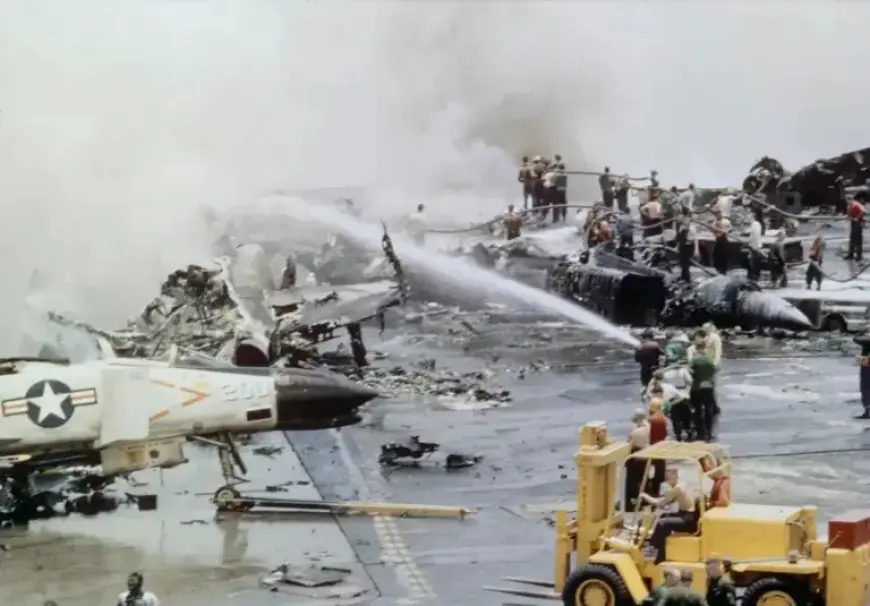
Historical incidents have shown that aircraft carriers can withstand severe incidents without sinking. For instance, during a controlled exercise to determine the carrier’s resiliency, the USS America (CV-66) proved to be remarkably durable, enduring intense live-fire testing before being scuttled.
The implications of an attack on a U.S. carrier extend beyond physical damage. Khamenei’s threats could serve to shift the narrative surrounding U.S. military vulnerability and play into Iran’s broader strategy of deterrence. A successful strike, even if not lethal, could enhance Iran’s diplomatic leverage, showcasing its capability to inflict harm.
Potential Political Fallout
A strike on a U.S. carrier could generate significant political repercussions. Carriers symbolize U.S. military power, and any damage may provoke an immediate political response in the United States. Geopolitical analysts note that this dynamic could inadvertently escalate tensions, as the U.S. must navigate a complex landscape of public perception and response options.
Moreover, any attempt to strike a carrier would provide Iran with valuable intelligence about U.S. operational strategies and defenses. This cat-and-mouse game could subsequently inform Iran’s tactics and its management of escalation with the U.S.
As tensions mount, the world watches closely as Iran continues to test its military capabilities while challenging U.S. naval supremacy in the region.