

























Planets Aligning Tonight: how and when to catch the six-planet parade as it peaks

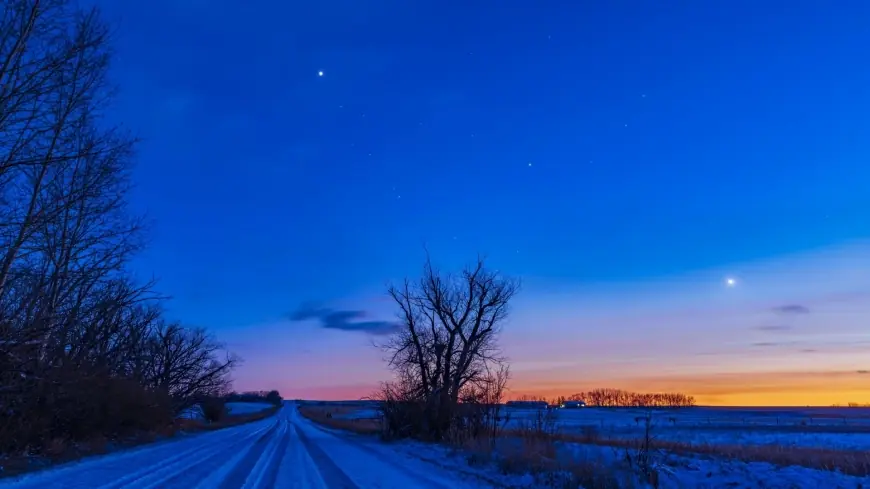
The sight of six worlds stepping across the sky has been described as a planetary parade, and with planets aligning tonight observers get a rare viewing opportunity that peaks around Feb. 28. If you plan to head out, know where to look, what equipment will help and how weather and technical safety can affect your chances.
Planets Aligning Tonight and the Feb. 28 peak
Jupiter, Saturn, Venus, Neptune, Uranus and Mercury compose the planetary parade taking place this week, with visibility concentrated on the nights surrounding Feb. 28. Most of the naked-eye action will be low in the western sky for several of those planets, while Jupiter will be visible high in the eastern sky. The arrangement of the six planets produces a brief, challenging show for skywatchers.
Where to look: western horizon, raised locations and timing after sunset
Most of the visible planets will sit low toward the western horizon; observers are advised to stake out a raised location with a clear view of the horizon well ahead of time. Mercury will be shining about 10 degrees above the late winter skyline — roughly the width of a clenched fist held at arm's length — with Venus close to its left. Mercury and Venus will follow the sun out of sight roughly an hour after sunset, briefly becoming more visible as the sky darkens and they draw nearer to the horizon. Using a smartphone stargazing app can help you pinpoint their local positions so you’re not guessing at the horizon line.
Neptune and Saturn: a close pairing, telescope needs and safety warnings
Saturn will glow less than 10 degrees to the upper left of Venus, and the ice giant Neptune will be positioned about two degrees to the right of Saturn. Neptune will be too dim to spot with the unaided eye; under dark skies, a telescope with an aperture of 8 inches (200 millimeters) or more can reveal its tiny bluish disk. Because Neptune sits low on the horizon and close to the glare of the sun, it will be a particular challenge to find on the nights surrounding Feb. 28. Observers are reminded to ensure the sun is firmly below the horizon before pointing any telescopic equipment in that general direction.
Uranus, Jupiter and the waxing gibbous moon: sweep, locations and obscured stars
Uranus will be easier to locate for scope users by sweeping across a patch of sky about 5 degrees below the Pleiades open star cluster, to the right of the "V" formation of stars in the constellation Taurus, in the hours following sunset. Jupiter will be high in the eastern sky while the waxing gibbous moon sits below it; that moonlight will obscure the stars of the constellation Cancer with its reflected light. The two more distant planets in the parade will generally need added magnification — and patience — to spot.
Preparation, apps and the photographer’s challenge
Your ability to actually spot the parade will depend on preparation, equipment and a spot of luck with the weather — "we truly hope it doesn't rain on your parade. " Those new to the night sky may want a smartphone astronomy app that uses augmented reality to help pinpoint constellations, planets, galaxies and meteor shower radiants. Night sky photographer Josh Dury, described as an award-winning night sky photographer, grappled with the sheer scope of the scene along with the glow of the setting sun and other challenges to capture a — unclear in the provided context.
Technical note about site access and browser support
A news website included a technical message saying it built its site to take advantage of the latest technology to make it faster and easier to use and that it wants to ensure the best experience for all readers. That message warned that some browsers are not supported and asked users to download a supported browser for the best experience.