
























Planets Aligning Tonight: Six-Planet Parade Peaks on Feb. 28 — How to See Mercury, Venus, Jupiter and More

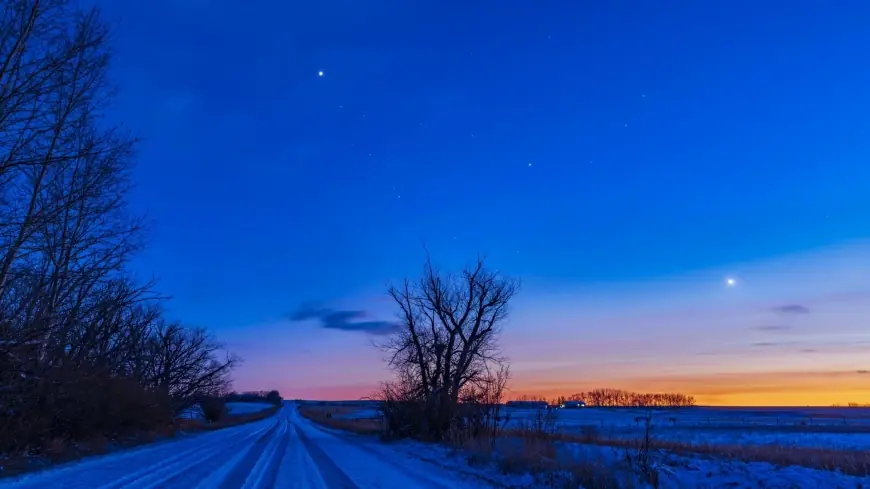
Planets Aligning Tonight creates a rare six-planet parade visible this week, and the timing matters because the lineup will present the best opportunities immediately after sunset on Feb. 28. Observers are being urged to prepare with the right site, equipment and safety precautions to make the most of the event.
Mercury and Venus: low in the western sky and close to the sun
Mercury will sit roughly 10 degrees above the late-winter skyline, with Venus just to its left and both sinking toward the horizon as the sun sets. Because those two planets are low and close to the setting sun, they will follow the sun out of sight roughly an hour after sunset; they briefly become more visible as the sky darkens and they draw nearer to the horizon. The proximity to twilight and solar glare is the principal reason observers must stake out a clear, raised viewing location well ahead of time.
Planets Aligning Tonight: Saturn, Neptune and the difficulty of low-horizon viewing
Saturn will appear less than 10 degrees to the upper left of Venus, with Neptune positioned about 2 degrees to the right of Saturn. Neptune’s placement low on the horizon and close to the sun’s glare means it will be too faint for unaided eyes. Under dark skies, a telescope with an aperture of 8 inches (200 millimeters) or more can reveal Neptune’s tiny bluish disk, but that same low altitude will make spotting it on nights surrounding Feb. 28 especially challenging. Observers are specifically warned to ensure the sun is firmly below the horizon before pointing telescopic equipment toward these low targets.
Jupiter and the waxing gibbous moon in the eastern sky
Jupiter will shine high in the eastern sky while the waxing gibbous moon sits below it; the moon’s reflected light will obscure the stars of the constellation Cancer. That brightness contrast is a direct cause of reduced stellar visibility around Jupiter, so those hoping to use nearby stars for orientation should allow for the moon’s interference when planning their viewing session.
Uranus and the Pleiades reference for telescopic hunters
Uranus will require a telescope and careful aiming: it can be found approximately 5 degrees below the Pleiades open star cluster and to the right of the "V" formation in the constellation Taurus in the hours after sunset. Newcomers are advised to use a smartphone astronomy app that employs augmented reality to pinpoint small, dim targets like Uranus and Neptune rather than relying on unaided guesses.
Practical preparations, safety and a photographer’s challenges
Observers are reminded that successful viewing will hinge on three elements: preparation, appropriate equipment and a stroke of luck with the weather. Practical steps include staking out a raised location with an unobstructed horizon well before sunset and using a smartphone stargazing app to map the planets’ positions for a given local environment. Publications promoting the event note that purchases through embedded links may generate an affiliate commission, and they encourage sign-ups for monthly entertainment and skywatching newsletters that highlight night-sky events, moon phases and astrophotography.
Award-winning night-sky photographer Josh Dury wrestled with the scene’s scale, the glow of the setting sun and other challenges to capture images of the alignment. Observers should also observe telescope safety: do not point optical equipment anywhere near the sky while the sun remains above the horizon.
We truly hope it doesn't rain on your parade, but if skies hold, the six-planet arrangement tonight offers a compact set of targets: Mercury, Venus, Saturn, Neptune, Uranus and Jupiter. Proper site selection, timing on Feb. 28 and careful use of optics will determine which of those planets each viewer will be able to see.