























Uae air travel disruption as uae hubs suspend flights after strikes

Airlines cancelled and diverted services across the region after the US and Israel launched deadly strikes on Iran, triggering widespread airspace closures and the suspension of operations at major Gulf hubs. The shutdown has left hundreds of thousands of travellers stranded or diverted and forced carriers to reroute long‑haul services, with implications for flight times, fuel use and airport operations.
Uae hubs hit: Dubai International and Al Maktoum suspended
All flights in and out of Dubai International and Al Maktoum International airport in Dubai were suspended as the disruption spread through regional airspace. Emirates suspended all its operations in and out of Dubai until 15: 00 local time (13: 00 GMT) on Sunday because of airspace closures. Dubai international airport, the world’s busiest airport for international flights, and the landmark Burj Al Arab hotel sustained damage, and four people were injured; at Dubai International four members of staff were injured in an incident on Saturday, a spokesman said.
Airlines cancel and reroute: British Airways, Virgin Atlantic and Wizz Air responses
British Airways and Virgin Atlantic were among carriers to have grounded flights to the region. British Airways cancelled services to Tel Aviv and Bahrain until Wednesday and warned that services between Heathrow and Abu Dhabi, Amman, Bahrain, Doha, Dubai or Tel Aviv could be affected for several days. Wizz Air suspended all flights to and from Israel, Dubai, Abu Dhabi and Amman up until and including next Saturday. Virgin Atlantic suspended services between Heathrow and Riyadh on Sunday after earlier cancelling flights from Heathrow to Dubai on Saturday and Sunday, and warned its flights to India, Saudi Arabia and the Maldives may take longer because they are being rerouted around the affected region.
Passenger disruption and personal accounts from Dubai connections
Hundreds of thousands of travellers were stranded or diverted when key transit hubs in Dubai, Abu Dhabi and Doha closed. Passengers described long waits and cancelled connections: Sarah Short, who was due to return from a holiday in Dubai to Heathrow, said the plane sat on the tarmac for over three hours after the pilot announced they were not going anywhere. Emma Belcher and her husband Vic were returning to Heathrow from the Maldives Dubai when their connecting flight was cancelled.
Airspace closures, rerouting and operational strain
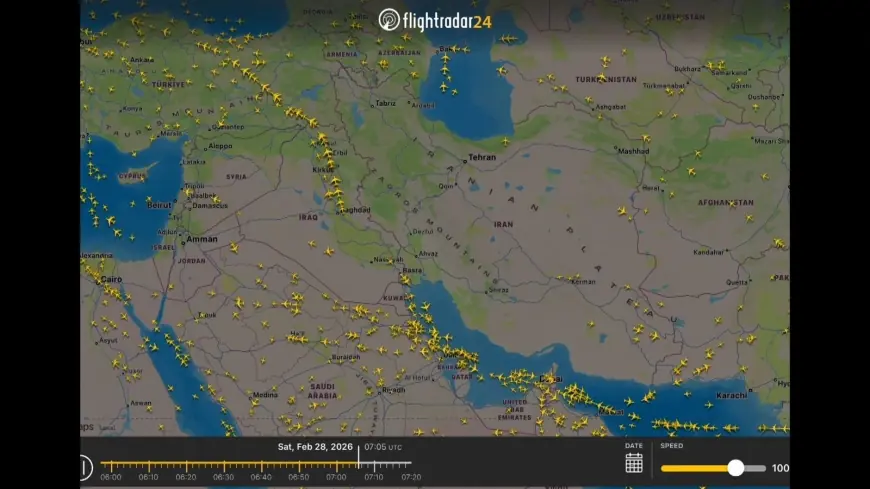
Airspaces over Iran, Israel, Iraq, Qatar, Bahrain, Kuwait, Syria and the UAE remained closed on Sunday morning, while Saudi Arabia had a partial closure; Jordanian and Lebanese airspace remained open but with limited flight activity. There was no flight activity over the UAE after the government announced a temporary and partial closure of its airspace. Tracking showed flights between Europe and Asia travelling Saudi Arabia or the Caucasus, and many airlines crossing the Middle East will have to reroute flights south over Saudi Arabia, adding hours and consuming additional fuel. Those added flights will put pressure on air traffic controllers in Saudi Arabia who might have to slow traffic to make sure they can handle it safely, and countries that closed their airspace will miss out on overflight fees.
Scale of cancellations, delays and passenger flows
More than 1, 000 flights by major Middle Eastern airlines were cancelled after the hub closures. The three major carriers that operate at Dubai, Abu Dhabi and Doha—Emirates, Qatar Airways and Etihad—typically have about 90, 000 passengers per day passing through those hubs, with even more travellers headed to Middle East destinations. Of about 4, 218 flights scheduled to land in Middle Eastern countries on Saturday, 966 (22. 9%) were cancelled, a figure that rises above 1, 800 if outbound flights are included; for Sunday, 716 flights out of 4, 329 scheduled to the Middle East were cancelled. Globally, more than 18, 000 flights had been delayed and more than 2, 350 cancelled as of 10. 30pm GMT on Saturday.
Damage, casualties, official advice and expert warnings
Iran launched retaliatory attacks including on Bahrain, Kuwait, Qatar and the UAE, and major international airports in the region became targets of those retaliatory strikes. Abu Dhabi Airports said a post that an incident at Zayed International airport resulted in one fatality and seven injuries; that post was later deleted. The UK Foreign Office urged British nationals to shelter in place, and Heathrow urged travellers to check with their airline before setting out. Airline industry analyst Henry Harteveldt, president of Atmosphere Research Group, warned: "For travellers, there's no way to sugarcoat this. You should prepare for delays or cancellations for the next few days as these attacks evolve and hopefully end. " Mike McCormick, who used to oversee air traffic control for the FAA before he retired and is now a professor at Embry‑Riddle Aeronautical University, said over the next few days these countries might be able to reopen parts of their air unclear in the provided context.